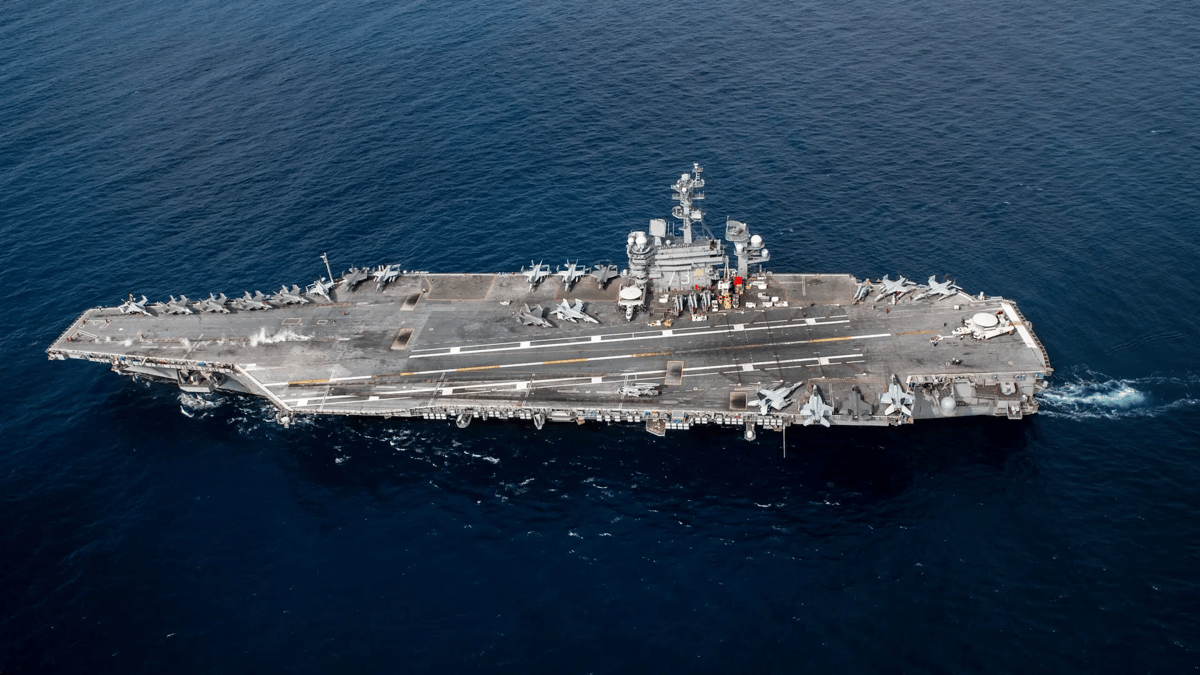
The United States appears to be approaching a point of decision on military action against Iran, with Israeli security officials noting an accelerated buildup of American forces in the Middle East expected to reach full operational capacity within days. The aircraft carrier USS Abraham Lincoln has shifted to a classified operational mode by deactivating its radar systems, a move interpreted as a clear message of heightened readiness and retained surprise capability directed at Tehran amid escalating regional tensions.
In Israel the IDF and broader defense establishment continue to maintain an exceptionally high state of alert, operating on the assumption that all options remain on the table and that developments in the coming days could prove decisive. Prime Minister Benjamin Netanyahu is scheduled to convene a limited security discussion tomorrow with select ministers and top defense officials to review potential scenarios and coordinate national posture.
Israeli assessments indicate that once American air and naval reinforcements are complete, President Trump may authorize a broad offensive operation in Iran. While Israel is not expected to participate directly in any US-led strike, preparations encompass both defensive and offensive measures to counter a likely Iranian retaliation. The arrival of three additional F-35I Adir stealth fighters at Nevatim Airbase in recent days brings Israel's fleet to 48 aircraft, enhancing its ability to penetrate defended airspace and conduct precision strikes if required.
The IDF has intensified air defense deployments and offensive planning in the past 24 hours, viewing any significant American action as almost certain to provoke Iranian missile or drone attacks targeting Israeli territory or assets. Officials stress that Israel's multilayered defense relies not only on interception systems but also on preemptive or responsive strikes against launchers and missile stocks to minimize damage to the home front. Should escalation occur the political echelon will need to decide whether to launch a preemptive blow on Iranian launchers before the first salvos are fired.
Security sources describe the current moment as a potential historic opportunity to weaken or topple the ayatollahs' regime if Trump opts for decisive action rather than limited strikes. They hope renewed domestic unrest in Iran could amplify the impact of any US operation. At the same time assessments do not rule out the possibility that Trump may leverage the credible military threat to negotiate a new nuclear deal with Iran, marketing it as superior to the Obama-era agreement. In such a scenario military action might be avoided and the chance to dismantle the regime could slip away.
The Abraham Lincoln's radar blackout aligns with reports of ongoing US force accumulation, including fighter jets, refueling aircraft, and Patriot batteries deployed to protect regional bases. Chief of the General Staff Lt. Gen. Eyal Zamir visited Nevatim Airbase to inspect the F-35 squadron, reinforcing the message that Israel stands prepared to defend itself and act offensively if necessary. Daily coordination with CENTCOM continues to ensure alignment should events accelerate. While the precise timing and scope of any US decision remain uncertain, Israeli preparations reflect the gravity of the situation and the understanding that an Iranian response would likely prioritize Israeli targets.