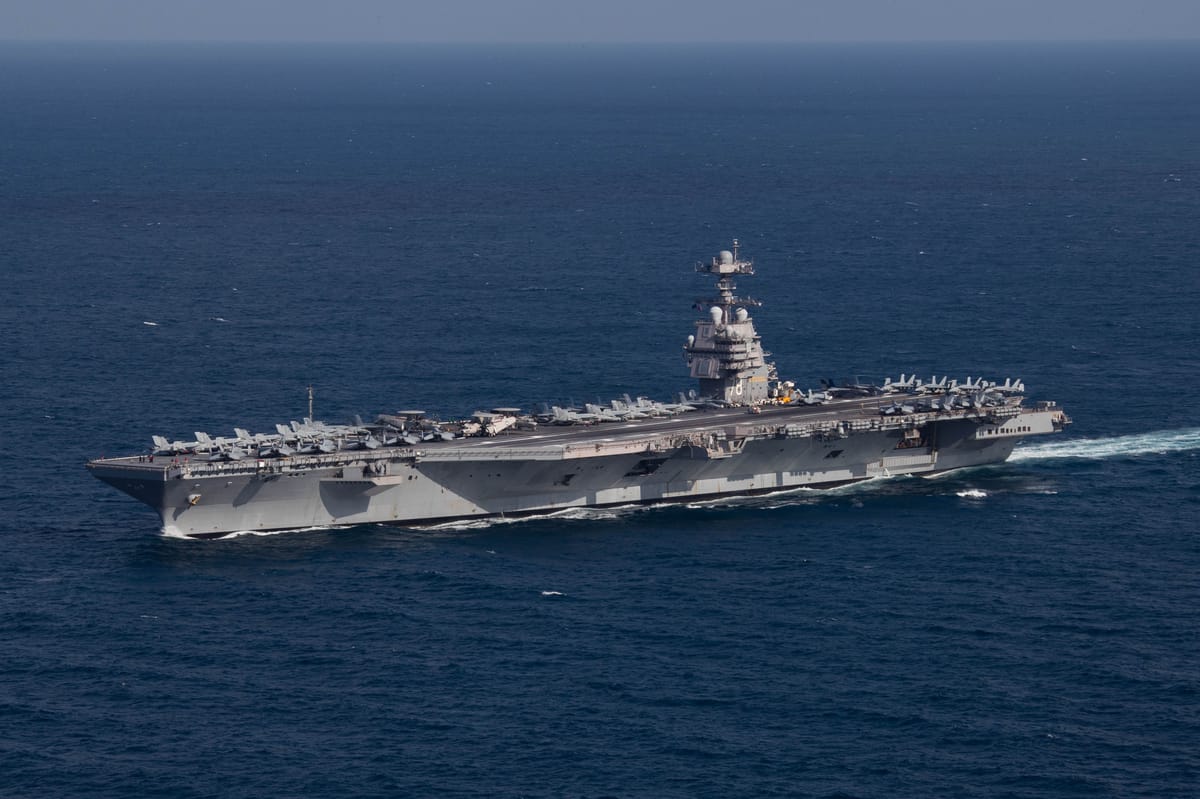
The U.S. Navy has achieved a massive strategic realignment in the Middle East as the USS Gerald R. Ford (CVN 78), the world’s largest and most advanced supercarrier, officially entered the Red Sea on Friday after transiting the Suez Canal.
The move creates a formidable "carrier pincer" against the Iranian regime, placing Tehran’s military assets between two nuclear-powered strike groups as Operation Epic Fury enters its second week.
With the arrival of theFor, the United States now commands the Iranian theater from two distinct maritime axes:
* The West (Red Sea): The USS Gerald R. Ford and its strike group (including the destroyer *USS Bainbridge*) provide a new launch point for strikes against Western Iran and Iranian-backed Houthi positions in Yemen.
* The East (Arabian Sea): The USS Abraham Lincoln (CVN 72) remains stationed in the Arabian Sea/Gulf of Oman, continuing its bombardment of Iranian infrastructure from the south and east.
Operation Epic Fury: A Week of Decapitation
Since the joint U.S.-Israeli campaign began on February 28, the "pincer" has been closing in on a regime already reeling from the assassination of Supreme Leader Ali Khamenei and the destruction of over 80% of its air defense systems.
Pentagon officials report that the two-carrier presence is designed to "completely saturate" Iranian defenses. While the Lincoln has focused on degrading Iran's space and ballistic missile capabilities, the Ford’s arrival in the Red Sea secures a critical corridor, ensuring the Strait of Bab el-Mandeb remains open despite threats from the "Axis of Resistance."
The naval buildup shows no signs of slowing. Reports from U.S. Fleet Forces Command indicate that athird carrier, the USS George H.W. Bush (CVN 77), has completed pre-deployment training and is expected to head toward the Eastern Mediterranean or the Middle East shortly. If deployed, this would place three U.S. supercarriers in the region simultaneously, the largest such concentration of power since the 2003 invasion of Iraq.