USS Gerald R. Ford Races to Israel as Nuclear Talks Resume | WATCH
While mediators in Geneva attempt to avert war, the U.S. is completing an unprecedented deployment; 11 F-22s have landed at Ovda Base, and the USS Gerald R. Ford is steaming toward the Eastern Mediterranean.
The third and fateful round of negotiations between the United States and Iran opened this morning (Thursday) under a heavy cloud of imminent conflict. Global observers view this summit as Tehran’s final lifeline before military options transition from contingency plans to active operations.
As diplomats convene, satellite imagery and military reports reveal the sheer scale of the U.S. buildup:
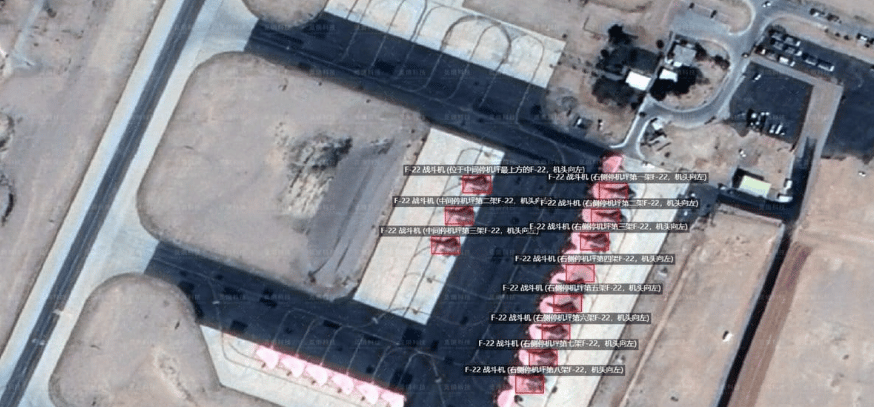
Stealth Squadron in the South: 11 U.S. F-22 Raptor stealth fighters landed in recent days at Israel’s Ovda Airbase. They were accompanied by refueling tankers, transport planes, and passenger aircraft transferring ground personnel. A CENTCOM official has confirmed these details.
The USS Ford in Transit: The USS Gerald R. Ford aircraft carrier has officially departed its temporary moorings in Crete and is reportedly making full speed toward the Israeli coast.
Satellite footage reveals F22s at Ovda base, Israel (Photo: Mizarvision)
USS Carrier Gerald R Ford (Photo: Kann News)
The White House Strategy: Let Israel Strike First
New reports from Politico suggest that senior advisors to President Trump believe it is politically advantageous for Israel to take the lead. "If the Israelis start it and the Iranians retaliate against us, it provides the perfect legitimacy for a broad American response," an administration source explained. Internal White House sentiment is increasingly leaning toward the inevitability of a strike, with the only remaining question being the scope of the attack.
Geneva: Demands with No Sunset Clauses
The talks are being mediated by Omani Foreign Minister Badr Al-Busaidi, who met with Trump envoys Steve Witkoff and Jared Kushner.
The American demands, as presented by Witkoff, are stricter than ever:
Permanent Agreement: A total elimination of sunset clauses. "They need to behave themselves for the rest of their lives," Witkoff reportedly stated.
Stockpile Removal: An immediate demand for the disposal of the 10,000 kg of enriched uranium currently held by Tehran.
The Missile Issue: Secretary of State Marco Rubio emphasized that Iran’s refusal to discuss ballistic missiles is a major problem.
Here's what Rubio said:
They are not enriching uranium at the moment, but they are trying to reach a point where they eventually could.
Iran possesses a very large number of ballistic missiles, especially short-range ballistic missiles threatening the United States and our bases in the region, our regional partners, and all our bases in the UAE, Qatar, and Bahrain.
They also have naval assets threatening shipping and attempting to threaten the U.S. Navy.
Beyond the nuclear program, they have conventional weapons designed solely to attack America and Americans.
Iran refuses to discuss ballistic missiles. That is a major problem.
They are trying to obtain intercontinental ballistic missiles. For example, you’ve seen them attempting to launch satellites into space.
Iran is on its way to being capable of developing weapons that can reach the U.S. mainland.
They already have weapons that can reach most of Europe, as we speak.
They are under sanctions, their economy is devastated, their people are suffering, yet they continue to invest in increasingly capable missiles every year. This is a threat that cannot continue.
Ultimately, discussions will have to go beyond the nuclear program alone. But if progress cannot be made on the nuclear program, it will be difficult to progress on ballistic missiles as well.
If what they want is a peaceful nuclear program, they can do it like most countries: above-ground reactors and imported fuel. We currently have agreements to do this with countries.
If they truly want energy, they can use small modular reactors, which are affordable and accessible to many countries. But when you say “we want to enrich, and we want to enrich deep underground,” and you have a history of enriching to 20% and even 60%, while also building missiles capable of carrying warheads — that does not sound like a country uninterested in obtaining nuclear weapons.
Iran, for its part, claims to have submitted a proposal that refutes American allegations, warning that if it is rejected, it will prove Washington is not serious about diplomacy. However, given the massive movement of planes and ships, it appears Washington is already prepared for the day after diplomacy fails.
“We will not discuss the ballistic missile program. Expecting Iran to negotiate over its missiles is illogical, unrealistic, and highly irresponsible. National defense capabilities are not bargaining chips. Repeating calls to discuss missiles signals ‘lack of seriousness’ and is a recipe for deliberate failure. This is precisely Israel’s method.”
Iranian sources told the Al-Arabi Al-Jadeed:
The Iranian delegation went into negotiations with "a package of proposals that includes the maximum possible Iranian flexibility, within the framework of Iranian red lines to address American concerns, or more precisely, excuses, regarding Iran's nuclear program."
USS Carrier Gerald R Ford| צילום: Photo: Kann News
0:00/0:19
Ready for more?
Join our newsletter to receive updates on new articles and exclusive content.
We respect your privacy and will never share your information.