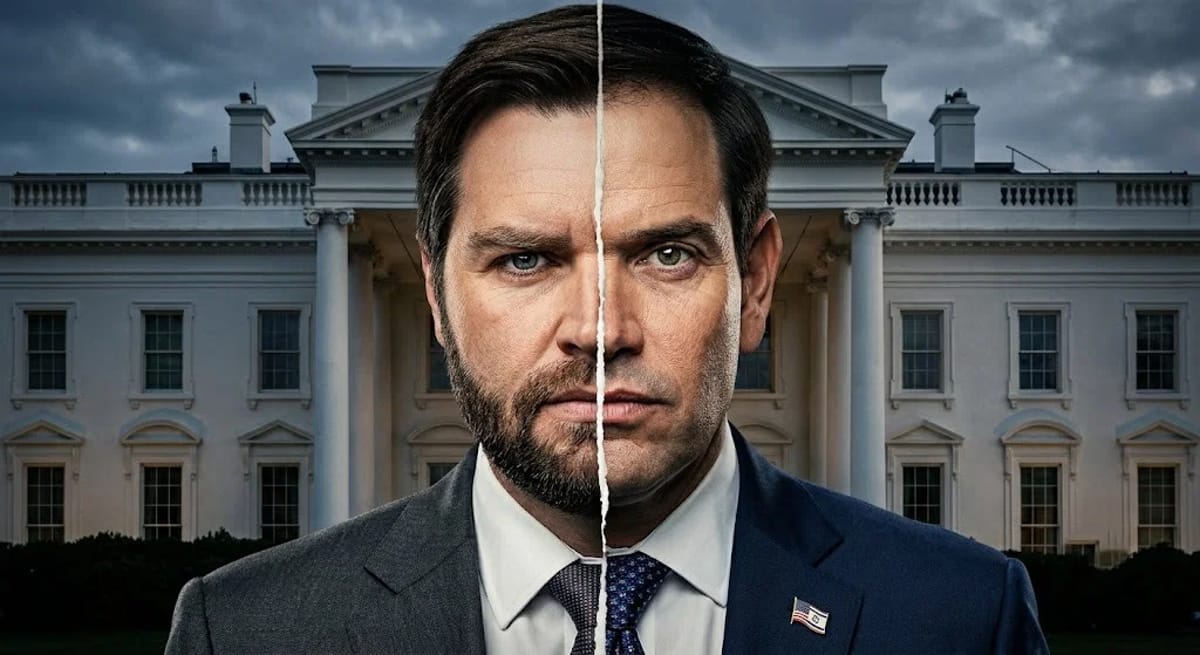
The White House insists there is no daylight between them. The reality tells a different story.
Behind the carefully worded statements about "full unity" in Washington, two of the most powerful figures in the Trump administration are pulling in sharply different directions on the most consequential foreign policy question of our time: what America owes Israel, and what it is willing to give Iran.
Vice President JD Vance and Secretary of State Marco Rubio have both been seen as potential successors to President Trump and are the product of powerful, competing constituencies within the Republican Party. That competition is now playing out in real time, with Israel's security as the stakes.
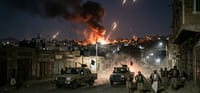
Vance lashed out at Israeli critics of the preliminary US-Iran deal, and suggested that Israeli bombings of civilian infrastructure in Beirut, intended to weaken Hezbollah, were undermining US-led peace efforts. He has also revealed that the US invited an Iranian intelligence official to serve as a deconfliction liaison with the Pentagon in Qatar, and framed Iran as a potential partner in a transactional deal that would allow America to refocus its strategic attention on China.
In an interview with the New York Times, Vance criticized Israeli ministers Ben Gvir and Smotrich over their opposition to the Iran MOU and calls to escalate in Lebanon, saying: "You are a country of nine million people, and you cannot simply rely on killing as a means to solve every national security problem you face."
Rubio has staked out the opposite ground. While Vance was meeting with Iranians in Switzerland, Rubio traveled through the Gulf to reassure allies rattled by what they see as excessive concessions to Tehran, repeatedly defending Israel's military campaign in Lebanon as a justified response to Hezbollah attacks. When asked to address Vance's criticism of Israel, Rubio deflected before recounting a Hezbollah assault on an Israeli checkpoint earlier in the week, letting the contrast speak for itself.
The sharpest point of friction is Lebanon. A US-brokered "deconfliction cell" on the Lebanese front includes Iran alongside the United States, Qatar, Pakistan, and Lebanon itself, but not Israel, a move Rubio's camp views as a dangerous concession of influence to Tehran in a theater where he has been trying to build an Iran-free framework.
The MOU itself is also notably silent on Iran's missile program, one of the Trump administration's stated goals at the outset of the conflict, a gap that hawks in Rubio's orbit see as a structural failure Vance accepted in his rush to close a deal.
The White House is not acknowledging the split. White House spokeswoman Anna Kelly said "there is only one camp, and that is President Trump's camp," while a State Department spokesman dismissed talk of a Vance-Rubio split as a "trite and false narrative."
Analysts are unconvinced. Michael Rubin of the American Enterprise Institute said Rubio and Vance represent "different strains" at their core. One is the America First isolationist willing to do business with Tehran; the other is the Senate hawk who built his career on confronting Iran, Russia, and Cuba.
For Israel, the question is which strain wins. If Vance's diplomatic architecture holds, Jerusalem may find itself squeezed between a White House demanding restraint and an Iran that has been handed legitimacy it did not earn on the battlefield. If it collapses, Rubio will be positioned to say he saw it coming, and to rebuild a Republican foreign policy that puts the alliance with Israel back at its center.
The 2028 race has already begun. And the Middle East is its first primary.