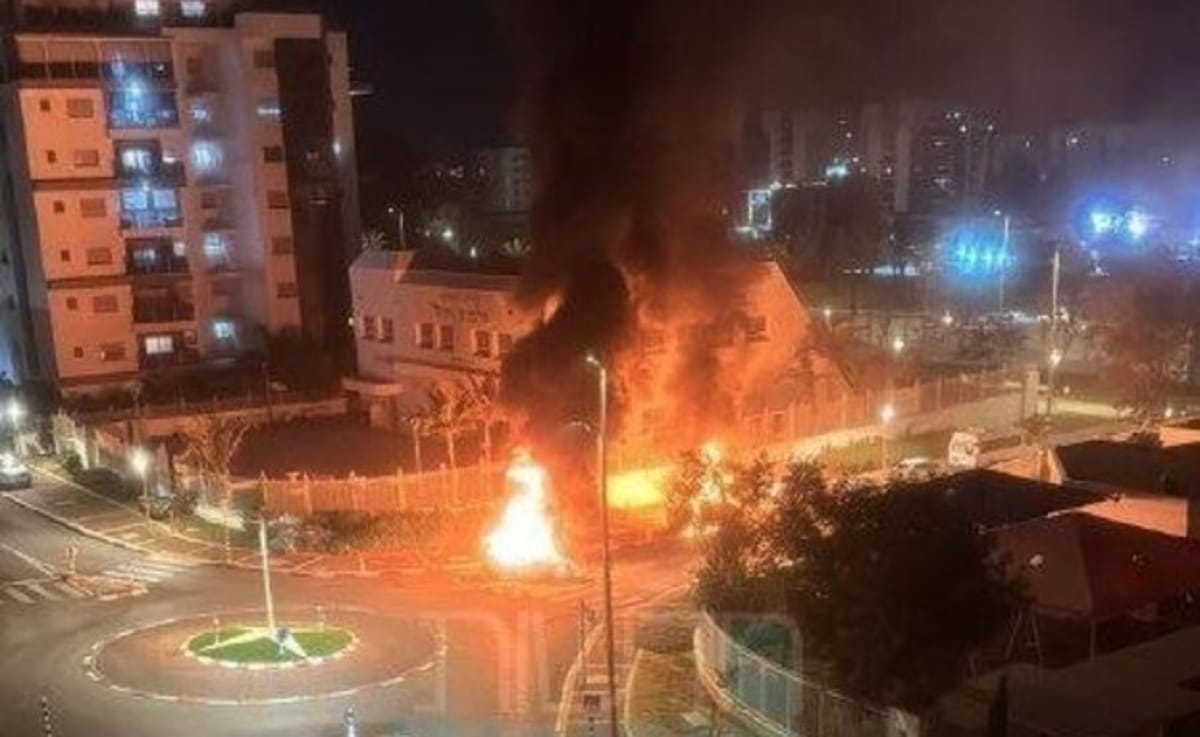
Hezbollah launched more than 50 rockets toward Israel tonight, with around 25 crossing into Israeli territory.
The terror group also launched large numbers of explosive drones toward IDF forces operating in southern Lebanon, with several entering Israeli airspace.
Sirens were heard across several communities, including Tiberias and its surroundings, where alerts reportedly sounded for the first time since the ceasefire.
Hezbollah has also fired toward Safed, Nahariya, Karmiel, Acre, the Krayot area, and Kiryat Shmonah, where one rocket reportedly caused heavy damage after striking a commercial center.
Israeli forces, meanwhile, have continued striking Hezbollah targets across southern Lebanon, including weapons depots, command centers, and terror infrastructure. The IDF said it has eliminated hundreds of Hezbollah terrorists since the ceasefire began and is deepening operations around the Beaufort Ridge, a symbolic and tactically significant area overlooking parts of southern Lebanon. But the renewed fighting has exposed a larger strategic question: what exactly is Israel trying to achieve in Lebanon?
Maariv's military correspondent Avi Ashkenazi argued that the capture of Beaufort, while symbolically powerful, does not fundamentally change the war. The position gives Israel tactical advantages in observation and fire control, but it does not by itself stop rocket fire on Kiryat Shmona, Metula, or the Galilee.
Hezbollah right now is escalating for two main reasons: to show that it remains an active force inside Lebanon, and to pressure the United States to include Lebanon in any wider ceasefire arrangement involving Iran. In other words, Hezbollah is trying to force Washington to restrain Israel by connecting the Lebanese front to the broader regional deal-making.
That possibility has intensified criticism inside Israel. Some argue that Israel has the military power to strike Hezbollah far more aggressively but is being restrained by diplomatic pressure from Washington and by the lack of a clear political decision from Jerusalem.
The central problem, according to Ashkenazi, is not the IDF’s operational ability, but the absence of a defined strategic endgame. Israel has plans, forces, and battlefield achievements. What it appears to lack is a clear political decision about the day after.
For residents of northern Israel, that uncertainty is not theoretical. It is heard in the sirens, seen in the smoke rising from impact sites, and felt in communities that are still waiting for a decisive answer to a basic question: who is setting the rules of this war — Israel, Hezbollah, or Washington?