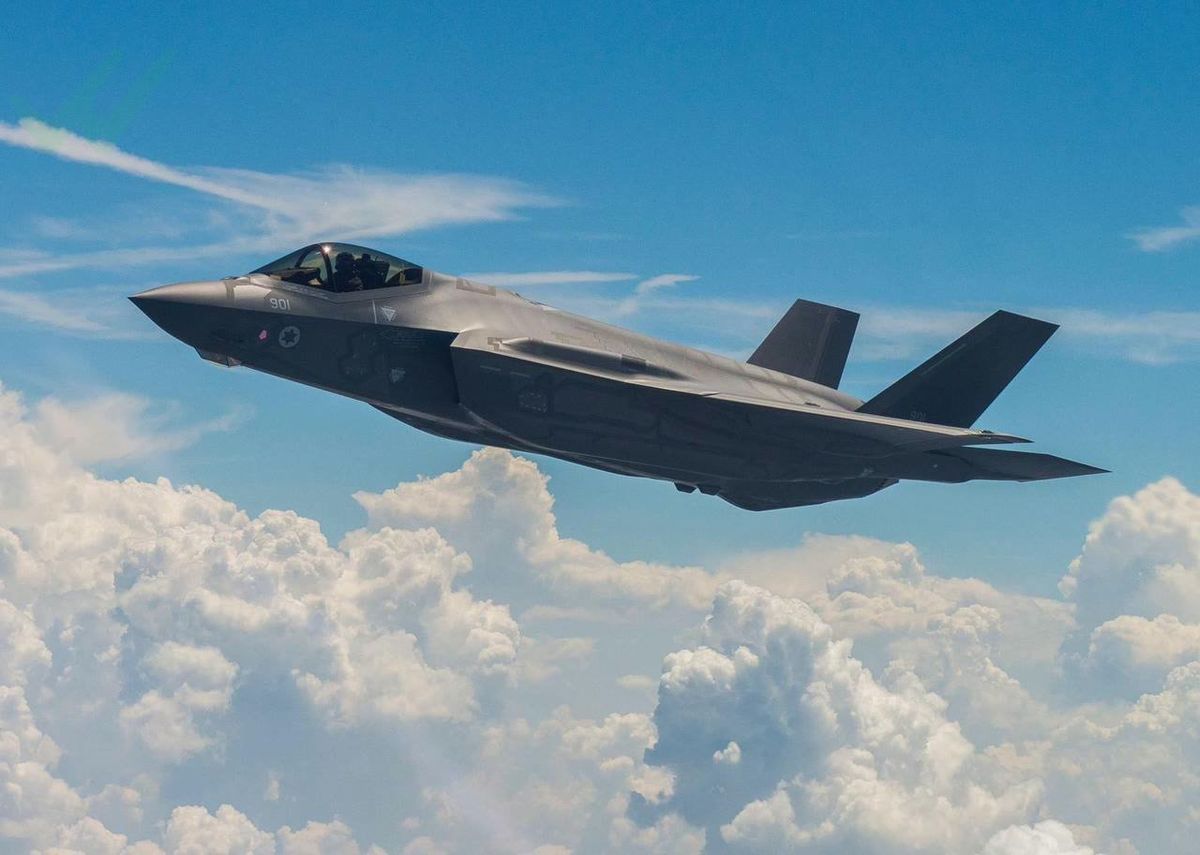
Israel's government has authorized the Ministry of Defense to simultaneously procure two full fighter squadrons, a fourth F-35 Adir stealth unit and a second squadron of advanced F-15IA jets, marking the first concrete step in an ambitious 350-billion-shekel defense expansion that officials say will define the country's military posture for the next two decades.
The Ministerial Committee for Procurement approved the acquisition over the weekend, with a package that goes well beyond airframes. The deal encompasses absorption infrastructure, operational support systems, spare-parts inventories, and long-term logistics frameworksm reflecting the scale of what Israeli officials are calling an "intensive security decade" ahead.
"We will continue to invest, strengthen, and stay ahead of our enemies to safeguard Israel's security today and in the future."
Operational catalyst
Defense Minister Israel Katz cited lessons from Operation Lion's Roar, Israel's most recent major air campaign, as a driving force behind the accelerated timeline. He described the Air Force's performance as decisive and argued that sustaining that edge requires investment now, not later.
Ministry of Defense Director-General Maj. Gen. (Res.) Emir Baram, who presented the plan alongside Katz, characterized the fighter acquisition as "the first and most central step" in executing the broader buildup. He said the ministry is simultaneously addressing current wartime requirements and building the capability Israel will need a decade from now.
Following committee approval, Baram directed Israel's procurement delegation in the United States to move toward finalizing the transactions with American government and military counterparts. The deals will be structured through the U.S. Foreign Military Sales framework, requiring coordination with the Pentagon and the aircraft manufacturers, Lockheed Martin for the F-35 and Boeing for the F-15IA.
A dual-platform strategy
The decision to pursue both platforms simultaneously, rather than sequentially, signals a deliberate strategic choice. The F-35 Adir—Israel's heavily customized variant of Lockheed's fifth-generation stealth fighter—provides low-observable strike capability deep in contested airspace. The F-15IA is a fourth-generation platform built for range, payload capacity, and multi-role flexibility.
Baram said the combination gives the Air Force "complete flexibility to address diverse combat scenarios across multiple theaters of operation"—language that reflects Israel's broadening threat calculus from Gaza and Lebanon to the wider region.
Katz framed the program under the banner of "Shield of Israel," stating it is designed to guarantee the Israeli Defense Forces a "sustained qualitative advantage." He said the expansion will also push the Air Force toward autonomous flight capabilities, next-generation air-defense systems, and military capabilities in space, domains that Israeli planners believe will be decisive in future conflict.
Budget and timeline
The 350-billion-shekel allocation, equivalent to roughly $95 billion at current exchange rates, is spread over ten years and has been formally authorized by Prime Minister Benjamin Netanyahu and the defense minister. The fighter squadrons represent only the opening phase; officials indicated that additional procurement programs will follow as part of the same framework.
The scale of the commitment demonstrates how significantly Israel's security calculus has shifted since the October 2023 Hamas attack. Defense spending has climbed sharply, and the government has repeatedly signaled its intention to rebuild and expand military capacity rather than simply restore pre-war readiness levels.
How quickly the procurement process advances will depend in part on U.S. production schedules, congressional notification timelines under the Arms Export Control Act, and the capacity of the Pentagon's Foreign Military Sales bureaucracy to process a large and complex deal. F-35 deliveries to international partners have historically involved multi-year lead times.
Still, officials indicated they intend to move with urgency. "The Ministry of Defense will continue leading procurement processes with responsibility and long-term vision," Baram said, "to ensure the defense establishment's readiness for all future challenges."