
A major sexual assault allegation is throwing one of America’s most closely watched Senate races into turmoil, threatening Democratic hopes of defeating longtime Republican Sen. Susan Collins in Maine.
Jenny Racicot, 41, a Maine Democrat who previously dated Graham Platner, has accused the Democratic Senate nominee of sexually assaulting her in 2021. Platner has categorically denied any nonconsensual conduct and said his campaign is now taking time to consider “the best path forward.”
The allegation was first reported by Politico, which said Racicot described her account in multiple interviews and that the outlet reviewed supporting material, including communications involving her therapist and others. CNN subsequently published additional reporting on the allegation. Reuters said it had not independently reached Racicot for comment.
According to the published accounts, Racicot alleged that Platner came to her home while heavily intoxicated and forced sexual contact despite her objections. She said the two had been involved in an on-and-off relationship and that she later confronted him over what she described as nonconsensual behavior. Platner firmly rejects that characterization.
“Any accusation of non-consensual behavior is categorically false,” Platner said in a video response. He nevertheless acknowledged the political damage facing his campaign, saying it was “taking the time to reflect on the best path forward.”
Democrats Turn Against Their Own Nominee
The political fallout was immediate.
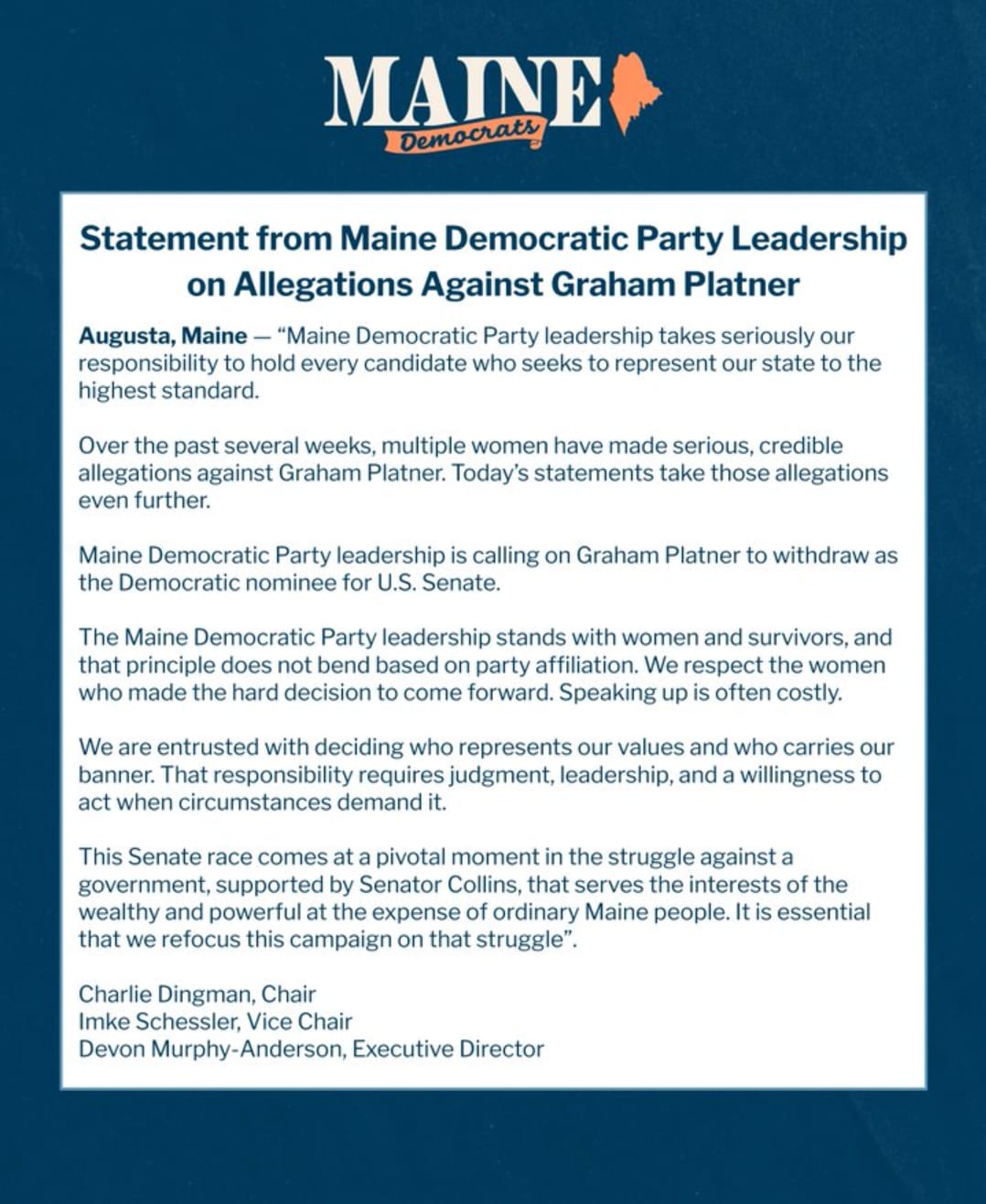
The leadership of the Maine Democratic Party called on Platner to withdraw as the party’s nominee for the U.S. Senate, citing what it described as multiple serious allegations against him. National Democratic leaders also escalated the pressure.
Senate Democratic leader Chuck Schumer and Sen. Kirsten Gillibrand, who leads the Democratic Senatorial Campaign Committee, announced that the DSCC would not invest in the Maine Senate race if Platner remained on the ballot. Progressive Rep. Ro Khanna withdrew his endorsement, as did Democratic Sen. Ruben Gallego of Arizona.
The crisis could have major national consequences. Collins’ seat is one of the Democrats’ most important targets as they seek to regain control of the Senate. Republicans currently hold a 53–47 advantage, meaning Democrats face a difficult path to a majority.
Under Maine law, Platner can withdraw by July 13, after which the state Democratic Party would have until July 27 to select a replacement nominee.
A Progressive Firebrand With a Fiercely Anti-Israel Record
Platner, a former Marine and oyster farmer, emerged as a favorite of the Democratic Party’s progressive wing and won the party’s Senate nomination on June 9. He has been strongly backed by Sen. Bernie Sanders and has taken positions sharply hostile to Israel and the U.S.-Israel relationship. Jewish and progressive media have openly described him as an anti-Israel candidate, while his campaign has attacked U.S. military support for Israel and accused Israel of grave wrongdoing in Gaza.
His rise made him one of the most prominent new figures in the party’s populist left, and potentially one of the most consequential anti-Israel voices seeking a seat in the U.S. Senate.
But his campaign had already been engulfed by controversy before Racicot’s allegation surfaced.
A previous New York Times report included accusations from a former girlfriend who alleged physically intimidating behavior during an earlier relationship. Platner strongly disputed those claims and described accusations of physical misconduct as false and politically motivated. The Times also reported sharply differing accounts from women who had dated him, including more positive descriptions from several former partners.
Platner has also faced scrutiny over sexually explicit messages reportedly sent to women during his marriage, old online posts, and a tattoo linked to Nazi imagery that he later covered. He has said he did not understand the tattoo’s Nazi significance when he obtained it and has spoken publicly about struggling with undiagnosed PTSD and alcohol after military service.
Platner Camp Points to Political Warfare
Platner and his allies have repeatedly portrayed the succession of scandals as an organized effort to destroy an insurgent progressive campaign.
In earlier controversies, his campaign accused political opponents and hostile operatives of pushing damaging stories for partisan purposes. Following the latest allegation, however, the response from within his own party has become far more severe, with senior Democrats openly demanding his departure and the national Senate campaign arm threatening to withhold support.
Racicot, for her part, has said that politics made her decision to speak publicly more difficult, not easier. According to Reuters’ account of the Politico report, she described a moral conflict between supporting Platner’s political views and opposing him personally.
The allegation remains an allegation, and Platner denies it.
But politically, the damage is already profound. A candidate once seen by progressives as a rising populist star, and by pro-Israel voters as a potentially dangerous new Senate voice, is now facing abandonment by his own party leadership just months before a race that could help determine control of the U.S. Senate.