
There is a form of evil that the West struggles to understand, because it does not appear as barbarism, or mindless madness.
It has a theological core. A narcissist core. A self-idealizing core. And it acts in a covert way to penetrate the halls of philosophy, just as it does the ranks of the military.
The evil we produce, just like the evil we fight, can appear as a moral language, wrapped in compassion, maybe even weaponized empathy, or equipped with intelligence - while speaking in the name of the wounded, the weak, the offended, the oppressed - the just.
This is the most inverted type of evil.
The Bible says that the beginning of wisdom is the fear of God. In other words; genuine wisdom requires limits, reverence, humility, and the recognition that man is not a God.
This is where the question of feminine evil begins. Within the realm of the lack of boundaries, where the woman who was created from the rib of man, believes her cause is more just than God himself.
This is the realm of pure boundless idealism which mimics the traits of a woman in a state of absolute love or in thirst of vengeance.
I mean not women as individuals, and certainly not the claim that women embody evil. That would be insane. The claim is deeper. There is a form of evil in history that I call feminine, that is above and beyond Nietzsche's or Foucault's dynamics of power, not because it belongs to every woman, but because it operates through archetypes of dependence, grievance, moral emotionalism, victimhood, false compassion, and an endless demand that reality be repaired at someone else’s expense, using someone elses force and resources - as power and justice.
The talmud teaches us that women wear their weapons on their bodies... but one can argue, that classical idealism, even in its Hegelian fashion, seeks, within the struggle of contradiction, within its class differentiation, turned into idealism, to create a performative struggle, in which all human power can merge into, and within it, reach a pure form of female consolidation, that surpasses any prior contradiction.
Almost mimicking the existential female contradiction between being the sexual object of the man and the nurturing object of the child.
That struggle almost emulates the difference between forms of idealism and forms of reality, which it must mimic.
Masculine evil, in its crude form, is easier to recognize. It is here to survive and to rule. Conquest, violence, domination, blood, force, war. It is visible. It can be named, marked, and condemned. Even when it becomes monstrous, something can still be learned from it, because it stands openly as force. It collides with reality, and therefore can be exposed by it.
It is not framed within the language of Idealism or Justice. It might fight by its name, but it fights out in the open.
Feminine evil bypasses reality, through idealism, that through masculinity is interpreted into Force.
It uses moral and ideal language in order to surpass reality. It does not say, I want to rule. It says, I am wounded. And now I seek repair. The state owes me. Men owe me. History owes me.
This is where the modern state enters the picture.
Modern nationalism, despite its masculine appearance, carries within it a feminine element, turning the collective into a great mother, that some children must die for. It seeks to define family, tribe, God, community, and personal responsibility with a political organism that embraces, feeds, educates, punishes, and defines the person anew.
It is therefore no accident that the great movements of the twentieth century, even when they appeared as extreme masculinity, relied on feminine myths of grievance, rebirth, the great mother, the wounded land, the humiliated people, the sick society, and the group that must be redeemed.
Even the perception of a total economic world, such as that of the socialist versus the capitalist, can be traced into a materialistic reading that has been idealized.
One cannot say that idealism in and of itself is necessarily feminist or feminine, but one can also not deny, that when inserted into political life, it carries a radical emotive nature.
Communism, in its psychopathic demand for total equality, is a clear example. Behind its scientific, economic, and historical language stood an emotional demand: to abolish the gaps of reality in the name of moral injury.
Not to correct a specific injustice, but to erase difference itself. Not to lift the weak, but to break the structure in which there are strong and weak. This is not wisdom. It is revenge dressed up as justice.
Nazism too, despite all its masculine aesthetics, relied on a maternal myth: Germany as the wounded mother ideal, the people as a humiliated biological body birthed of the land, the nation as an organism that had to be purified, reborn, and protected in its holy soil.
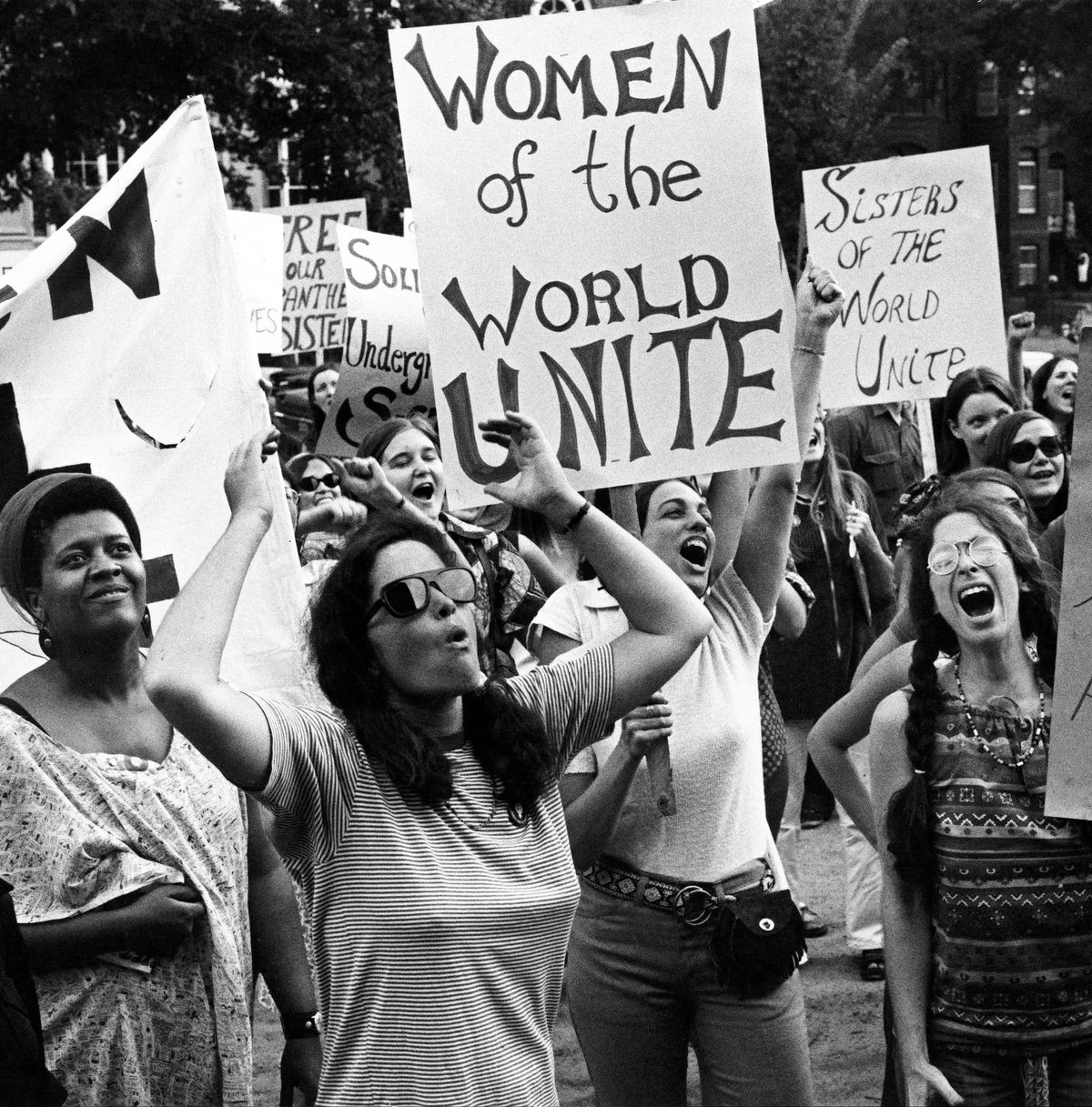
Later Feminism? Nothing much but the matureness of the two without any need for ideological justification other than the sanctification of the female ideal of body and grievance itself, which came to be once men refused to die in the name of abstract ideals.
On the surface, this was a century dictated by the politics of men. In practice, the men were recruited as children of a monstrous maternal myth.
This is the historical law that must be examined seriously. In the great political programs, especially those that seek to redeem man through the state, the intellectual resources of society are displaced into a feminine grievance: requiring total correction.
As Nietzsche said "outside of love and revenge woman is a mediocre actor", and in that sense, Europe's modern nationalism to a large extent was based on these core emotions of love and vengeance.
At that moment, wisdom no longer governs. But it is men who seek to fall in love with the state, with the ideal, because these men believe that these forms of abstract love, that can also be manifested via politics and identity, will give them as mature men the unconditional love that every man seeks from his mother or his female lover.
Thus it is not only woman performing a philosophical-biological act like a archetypical spectacle of seduction, but it is man, desperate in his limited capacity, seeking to prove himself, to be worthy of this ideal of War, that survives the danger of the end of reproduction, which he believes would turn him into worthy for a woman in the actual real world. He must survive her world of idealism, to prove himself Worthy in the world of phenomena.
Thus man is so busy for fulfilling that action, he almost forgets that which defines it, may very well be absolutely out of his reach.
And there is an even deeper contradiction: the temptation of feminine idealism is that it enables an extreme realization of masculine violence. That is the seduction of feminine idealism: it gives expression to the animalistic impulses of men, and it does so in the name of some higher justice.
But there is an even deeper contradiction. If you suddenly choose to become some kind of pacifist, then what does that say about you? How much of a man are you, really?
This is why I still believe in liberalism. Because I do think that liberalism contains within it a certain form of masculine restraint.
Emotion takes control of wisdom and turns it into a weapon. Which is why advanced societies can commit monstrous crimes. The problem is not a lack of scientists, engineers, or philosophers. Hitler did not rule over a barbaric tribe without technology. Stalin did not rule over savages from the forest. On the contrary, behind both monsters stood enormous bureaucratic, scientific, industrial, and intellectual systems. The real question is not how stupidity produces evil. The real question is how intelligence serves myths.
The answer is that where there is no fear of God, the tension of War becomes romantic.
Think of Islam, in Islam the war is a religious ideal, not a romantic ideal. That is a very big difference.
But in the West, there is no wisdom, intelligence is tempted to become the slave of a wound or feeling.
The West forgot to fight while the feminine idea of War became self-consumed into feminism itself, the Muslim world was always fighting, regardless of any gender ideal.
The West failed to protect itself from the possibility that its systems would be captured by secular theologies of grievance. Each time under a different name: class, race, gender, nation, victim, minority, identity, liberation. Each time the same mechanism appears: the wound becomes the center of the world, complaint becomes morality, pity becomes government, and wisdom the servant of hatred.
True within these schemes we see Nations that are more independent, freedom-loving, self-fulfilling, and others, that have a more passive, reactionary, and hypervigilant nature. But the national scheme as a whole, is very much prone, much due to the archetype of Western christianity, Libra, and chivalry, to seek affirmation, within an ideal, that is so abstract, and so emotionally dependent, that it is only a matter of time that it won't manifest itself in commerce alone.
This is also why the sexual revolution of the nineteen sixties matters. Herbert Marcuse, in his attempt to unite Freud and Marx, did not merely offer a political theory. He gave intellectual legitimacy to the release of restraint. He turned sexual repression, class struggle, and cultural rebellion into one system. But this release of restraint could only succeed because the previous structure had already become weak, unstable, and vulnerable.
When we go to war we use a totality of emotion, where reason has no place.
But if our ideal, is based I'm grievance, and rebellion, then we will never have peace and we shall always be in constant War.
When the father becomes weak, the great mother takes over. When law becomes weak, emotion becomes law. When wisdom becomes weak, the victim becomes a prophet or a saint.
This is also why Islam presents such a deep challenge to the West. Unlike modern Christianity, romantic nationalism, and Western liberalism, Islam manages to preserve a transition from the tribe to the collective without surrendering to the same extent to myths of the great mother, endless pity, and the worship of weakness. It contains a structural hardness that the West has lost. One may oppose it, fear it, or criticize it sharply, but one cannot deny that it understands something the West has forgotten: a society cannot exist on compassion, idealization, and grievance.
Socialism, and nationalism are merely feminine reactions, to the more manly version of classical liberalism, that which is based on the goddess Libra - which too was feminine to the core.
This is exactly where feminine evil becomes political.
It is not satisfied with asking for help. It demands that the entire world be rebuilt around a wound. It does not want justice. It wants reality to apologize. It does not want freedom. It wants immunity. It does not want truth. It wants recognition. At its peak, it recruits masculine evil, force, violence, police, army, law, bureaucracy, in order to protect its emotional fragility cloaked as an ideal.
This creates a paradox. Masculine violence becomes the servant of feminine emotion. The state, the court, the academy, the media, and the police no longer act in the name of truth, law, or justice, but in the name of an emotional story that must not be questioned. Whoever questions it is not mistaken. He is dangerous. Whoever asks for evidence is not rational. He is harmful. Whoever refuses to participate in the myth becomes an enemy.
This is why we need a new study of evil. Not only a history of wars, dictators, ideologies, and political movements, but a genealogy of the mechanisms of evil: how masculine evil and feminine evil appear in society and history, how they unite, and how they serve each other.
Masculine evil conquers.
Feminine evil justifies.
Masculine evil attacks.
Feminine evil tells itself that it was attacked.
Masculine evil uses power.
Feminine evil uses morality in order to make unlimited power legitimate.
Masculine evil can be exposed on the battlefield.
Feminine evil hides in the courtroom, the academy, the welfare system, the media, the therapeutic apparatus, and the language of compassion, safety, sensitivity, the good of the child, the good of society, and the good of the victim.
Remember what George Orwell wrote about the most obedient members of the party? Exactly, Young Women.
From here comes the great question: how does one build a society that recognizes the wound without worshiping it? How does one preserve compassion without turning it into a religion? How does one give women, mothers, the weak, and the vulnerable their proper place without turning vulnerability into a ruling principle that castrates truth, freedom, and responsibility?
The answer begins with separation. We must separate woman from the feminine myth. Compassion from extortion. Motherhood from the mother state. Justice from chronic grievance. Emotion from truth.
Women build civilizations when they connect life, continuity, home, limits, loyalty, and wisdom. The feminine myth destroys civilizations when it turns the wound into the center of the world, victimhood into identity, and masculinity into an enemy that must be domesticated, humiliated, weakened, or recruited.
But men also destroy civilizations when they abandon their role. When they agree to become children of the great mother. When they hand over their power to myths of pity. When they use money and violence not in the name of truth, but in the name of an emotional lie. When they are afraid to say that reality comes before feeling.
The struggle, therefore, is not between men and women. The struggle is between wisdom and emotion released from restraint. Between the fear of God and the worship of the wounded as God. Between a civilization that can say no and a civilization that apologizes for its own existence.
Feminine evil, in its deepest sense, is the moment when society stops seeking truth. It is the moment when wisdom becomes enslaved to pain, in the name of "rights". It is the moment when the state becomes a a vehicle for redistributing. It is the moment when men become children, law becomes therapy, justice becomes pity, and reality is ordered to kneel.
No future can be built from that place.
But only where man understands again that the cure for evil is not another ideology, another revolution, another state, another therapy, or another release of restraint, but wisdom.
And the beginning of wisdom is the fear of God.