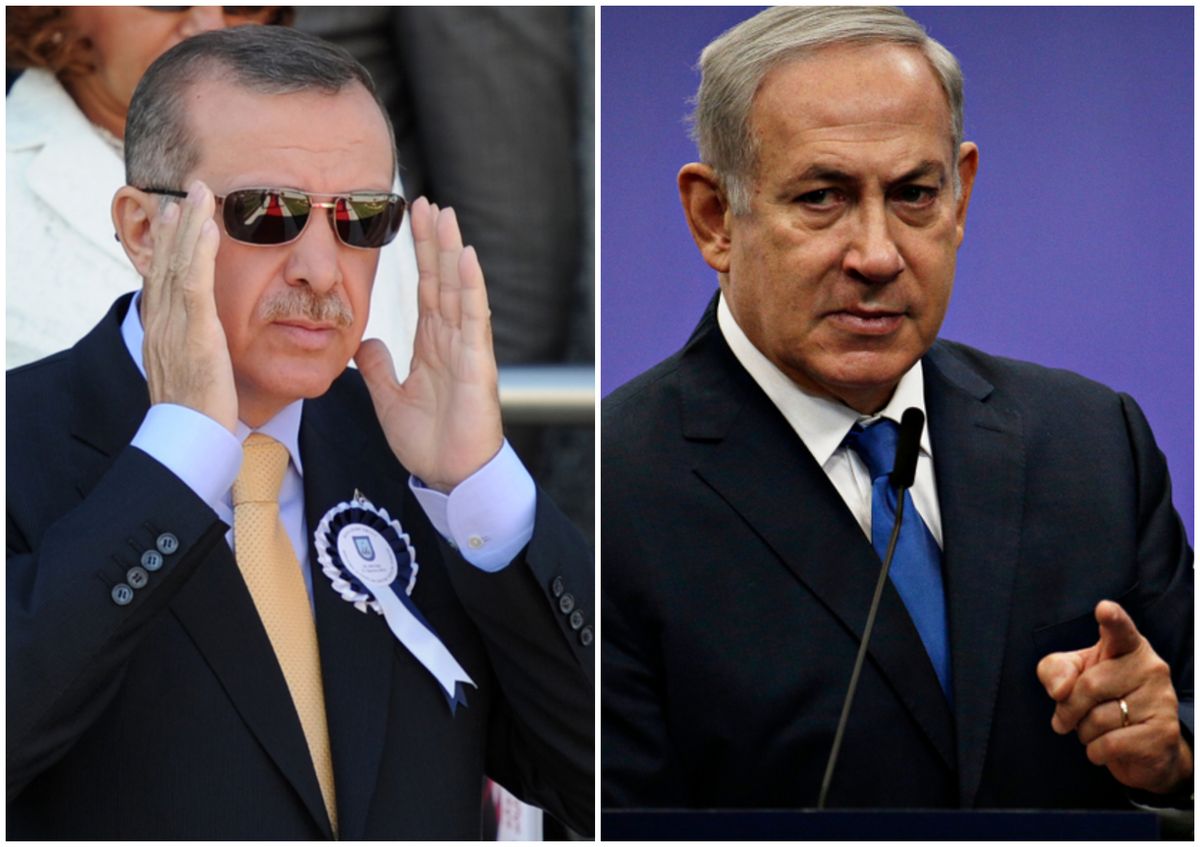
Can Israel afford to trust Erdogan's Turkey?
This question, raised by Turkish ambitions in Syria, extends far beyond the troubled relationship between Jerusalem and Ankara. It touches on one of the most painful lessons from October 7: at what point does a seemingly manageable threat become one that's too late to stop?
There are fundamental differences between Recep Tayyip Erdogan's Turkey and the ayatollahs' Iran. Ankara is a NATO member, maintains strategic ties with the United States, has an economy deeply integrated with the West, and operates primarily as a state power pursuing regional interests. Turkey is not Iran.
Yet this distinction sometimes leads to a far more dangerous conclusion: Because Erdogan is a rational leader with whom negotiation is possible, Israel can supposedly establish red lines and reach a kind of strategic coexistence in Syria. It's precisely this assumption that needs reexamination today.
The issue isn't whether Erdogan is rational. A country doesn't build its security on whether a foreign leader inspires sympathy or revulsion. It examines his actions, his worldview, his relationship with power, and above all, the capabilities he's accumulating.
Under Erdogan, Turkey has become a far more centralized regime. International organizations monitoring democracy in the country have pointed for years to the concentration of powers in the president's hands, erosion of institutional independence, and heavy pressure on political opponents, journalists, and media outlets.
So the question isn't just can Erdogan be trusted?
The real question is far more troubling: Can Israel afford to allow a leader who has displayed sharp and consistent hostility toward it for years to gradually acquire additional strategic depth in the Syrian arena? National security cannot be built on the assumption that one man's intentions won't change tomorrow.
What drives this hostility toward Israel?
Israel and Turkey have no territorial dispute. Israel makes no claim to Turkish land, Turkey doesn't border Israel, and in the past the two countries maintained close relations and significant security cooperation.
Yet during Erdogan's tenure, confrontation with Israel has become an almost permanent component of Turkish policy.
Since the Gaza war began, Ankara has intensified its approach further: it halted trade with Israel, joined South Africa's case at the International Court of Justice, and Erdogan himself has repeatedly used extreme language and accusations against Israel and its leaders.
One can support the Palestinians. One can oppose an Israeli government's policies. One can demand establishment of a Palestinian state.
But the intensity of the confrontation, its duration, and Erdogan's language compel Israel to ask whether it faces merely a political disagreement, or hostility that has become a deeper component of the Turkish president's worldview and regional ambitions.
One can debate whether it's accurate to call this "deep hatred"--- that's interpretation. The persistent hostility itself is far harder to deny.
October 7 changed the meaning of "acceptable risk"
This is the central point. For years, Israel grew accustomed to thinking of Hamas as a serious but containable threat. Deterrence, technological barriers, intelligence, and periodic strikes were supposed to keep it within certain bounds.
October 7 shattered that assumption.
This doesn't mean Turkey is Hamas, that Erdogan is planning war with Israel, or that Ankara intends to attack. There's currently no factual basis for such a claim. The lesson is entirely different.
When a certain process could potentially create a significant strategic threat in the future, the fact that there's no proof today of intent to attack cannot serve as a guarantee for tomorrow's security. Hence Syria's enormous importance.
The possibility that Turkey will establish military presence there—infrastructure, political influence, and strategic depth—is no longer a theoretical question. Israel has already made clear it views some of Ankara's possible moves as changes that could harm its freedom of action. Ankara and Damascus naturally present a different picture.
But precisely at this point, a responsible state doesn't only ask what Turkey intends to do today. It asks what Turkey will be capable of doing in five or ten years if regional realities change.
Don't wait until strategic growth becomes irreversible
Here one must use the metaphor of "strategic cancer" carefully but clearly.
The cancer isn't Turkey, and certainly not the Turkish people. It refers to a process whereby military presence by an actor who may become hostile develops gradually, until the military and political cost of removing it becomes nearly impossible. Israel knows this mechanism well.
Iran didn't build its ring of threat in a single day. It accumulated proxies, missiles, infrastructure, weapons, and power centers over years, until slow accumulation became a strategic threat.
Turkey operates entirely differently and shouldn't be artificially turned into another Iran.
But herein lies the problem: Turkey is a far stronger country, with a large military, advanced defense industry, significant economy, and international standing incomparable to an Iranian proxy.
Therefore the question must be asked before a fait accompli is created, not after.
Israel can and should talk with Erdogan. It can negotiate, establish red lines, and build coordination mechanisms to prevent unwanted deterioration into confrontation between two regional powers. But there's a vast difference between dialogue and trust.
After October 7, Israel cannot afford to confuse the two. Israeli security cannot depend on whether Erdogan will change his policy tomorrow. It must be built so that even if he does, he won't have the tools to turn that change into a strategic threat against Israel.
Perhaps this is one of October 7's most important lessons: facing a slowly developing threat, the right moment to address it is sometimes precisely when voices are still saying it's too early to worry.