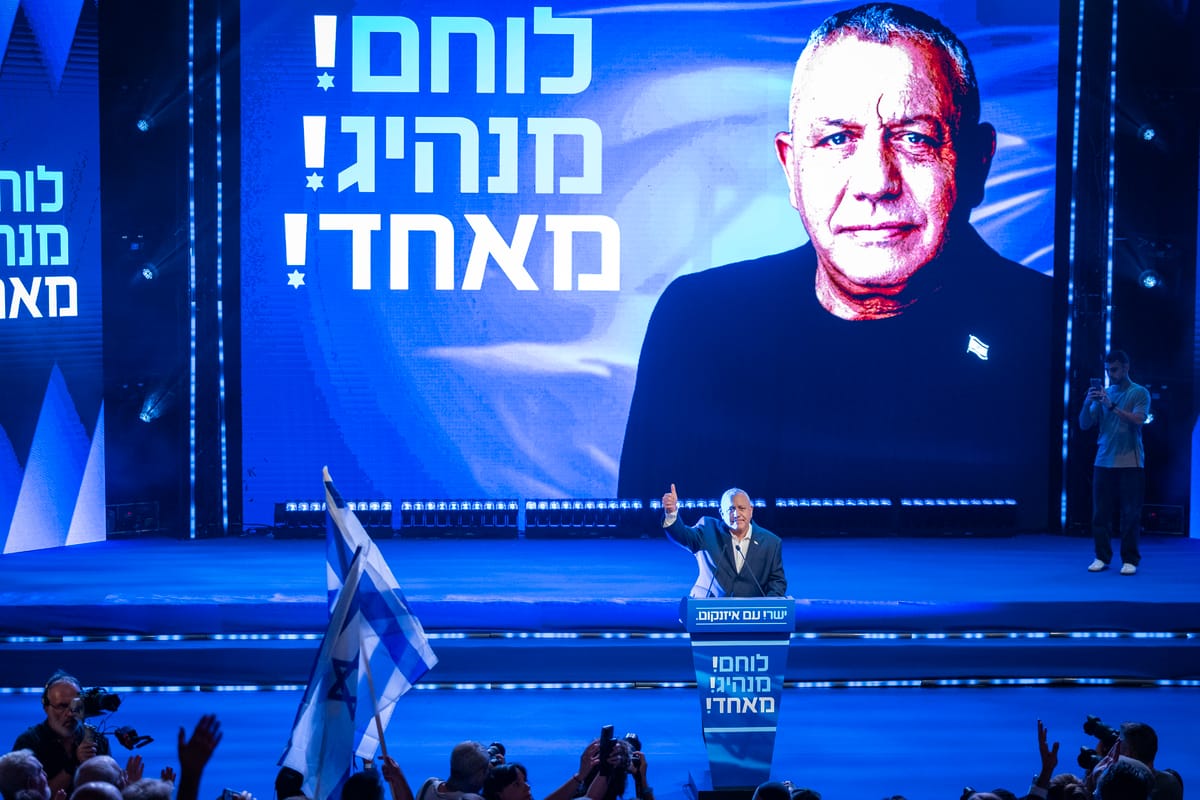
Six weeks before Israelis vote on October 27, Gadi Eisenkot's Yashar has established itself as the largest party in most polling. That is not the same as a path to power, and the distance between the two is the central fact of this campaign.
The seat picture has been stable since parties submitted their final slates on September 8. In the five surveys published this week, Yashar emerged as the largest party in four, generally in the low-to-mid twenties. On the day after the slates closed, Channel 12 had Yashar at 25 and Likud at 21, Channel 13 had Yashar at 22 to Likud's 19, and Kan had Yashar at 24 and Likud at 21.
The exception is consistent and worth naming. An i24NEWS poll conducted by Direct Polls has Likud leading by a significant margin at 27 seats to Yashar's 22, and gives Netanyahu's bloc together with Ofer Winter 60 seats against 48 for the opposition and 12 for the Arab parties. No other pollster produces anything close to that spread.
What no poll produces is a majority. Channel 12's post-slate survey found the anti-Netanyahu bloc at 57 and the pro-Netanyahu bloc at 52, with Arab-majority parties holding the remaining 11. Channel 13 and Kan both had the blocs level, at 53 apiece and 52 apiece respectively. A Maariv poll conducted by Lazar Research found the opposition could reach 61 only if the Hendel–Zelekha slate joined it, and only in a scenario where Winter's People of Israel fell below the threshold.
This is why the question of who wins the election and the question of who becomes prime minister have different answers.
Israelis do not elect a prime minister directly. The president hands the mandate to whoever appears most able to assemble 61 seats, which is an assessment of coalition arithmetic rather than a reward for finishing first. Eisenkot can lead the largest party and still watch someone else build a government. Netanyahu can finish second and still return to office if his bloc holds and the threshold parties fall his way.
What is working for Eisenkot
He has displaced the previous opposition leadership as the organizing center of the anti-Netanyahu camp. B'Yachad, the joint slate led by Naftali Bennett and Yair Lapid, has settled at 12 to 13 seats in recent polling, roughly half of Yashar's total.
On the question of who is more suited to serve as prime minister, he has generally led. A Maariv poll in August recorded his widest margin, 52 percent to Netanyahu's 38. A Channel 12 mandate poll later that month again showed him ahead. Not every survey agrees: a Channel 14 poll by Filber on September 9 had Netanyahu at 51 and Eisenkot at 34, though Channel 14's polling has consistently been the most favorable to the prime minister of any Israeli outlet.
His biography does work that Bennett's and Lapid's does not. A former IDF chief of staff who sat in the war cabinet, and whose son Gal was killed in Gaza in December 2023, he reaches voters in the center and parts of the center-right who have not been available to the opposition for years.
What could still stop him
The arithmetic, first. Without the Hendel–Zelekha slate crossing the threshold and joining him, or some arrangement with the Arab parties that a portion of his own electorate will reject, 61 is out of reach in most scenarios.
The threshold itself, second. Winter's People of Israel crossed in all five of this week's polls. The Hendel–Zelekha Economic Party crossed in only one, the Kan survey, and sat at 3.2 percent in Channel 13's and 2.9 percent in Channel 12's. Each of these is a four-seat swing, and each flips the bloc map on its own.
Third, the opposition is not one thing. Bennett and Lapid bring a substantial bloc with their own demands. Avigdor Liberman and Yair Golan will set their own conditions. A large party that cannot assemble the rest does not form a government.
And six weeks is a long time in an Israeli campaign. A security event, a significant development in Iran or Gaza or Lebanon, or a turnout gap in Likud strongholds is enough to move two or three seats, which in this configuration is enough to move everything.
The bottom line
On current polling, Eisenkot is the more plausible alternative prime minister and Yashar is the more likely largest party. Neither of those facts produces a government. Unless the picture shifts, the most probable outcome on October 28 is that the arithmetic is decided not by the two leading parties but by whichever four-seat faction ends up on the right side of the threshold.