The Strait of Hormuz has dominated headlines since the first day of the conflict, when Iran announced it was closing the waterway to all traffic. The consequences have been sweeping: roughly one-fifth of global oil output is now bottled up behind the strait, sending fuel prices sharply higher worldwide, including in Israel.
Tehran knows that Hormuz is the last meaningful card it holds. The narrowest point of the exit from the Persian Gulf, just 39 kilometers wide, passes through Iranian territory, giving the regime de facto military control over one of the world's most critical chokepoints. Iran's ballistic capabilities, meanwhile, have been exposed as insufficient to deter either Israel or the United States, with the conflict having laid bare significant weaknesses in its offensive arsenal.
Iran has also calculated, correctly, that the West remains unwilling to join the fighting. European powers have stayed on the sidelines, waiting for ships to pass freely and energy prices to fall. That reluctance gives Tehran room to squeeze, using economic pressure as its primary remaining weapon.
But Trump recognized early in the conflict that the U.S. cannot force the strait open alone. Doing so would require a significant international military coalition, one that would expose Paris, Berlin, and London to Iranian missile fire. That realization, the report said, landed heavily inside the White House, sending presidential rhetoric swinging between threats of forcing the strait open by military means and demands that Iran open it voluntarily.
A further complication: Iran has deployed a "light fleet" of small, fast vessels that have proven highly effective at terrorizing the passages, compared to Hamas's use of small, decentralized cells against IDF divisions in Gaza. The asymmetry between massive U.S. warships and nimble Iranian speedboats has made it difficult for CENTCOM to simply eliminate Iran's presence in the strait by force.
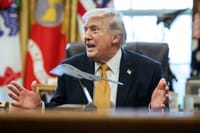
So Trump has chosen a sophisticated judo move, turning Iran's last card against itself. "It's either everyone, or no one," Trump said yesterday in a Fox interview and in a Truth Social post.
The logic is straightforward: if Iran seeks to damage the global economy by blocking Hormuz, the blockade will now damage Iran's own economy in equal measure, adding to the pressure on Tehran and potentially pushing it toward the negotiating table.
What happens next, how Iran responds to a confrontation that appears increasingly likely to turn military, remains to be seen.