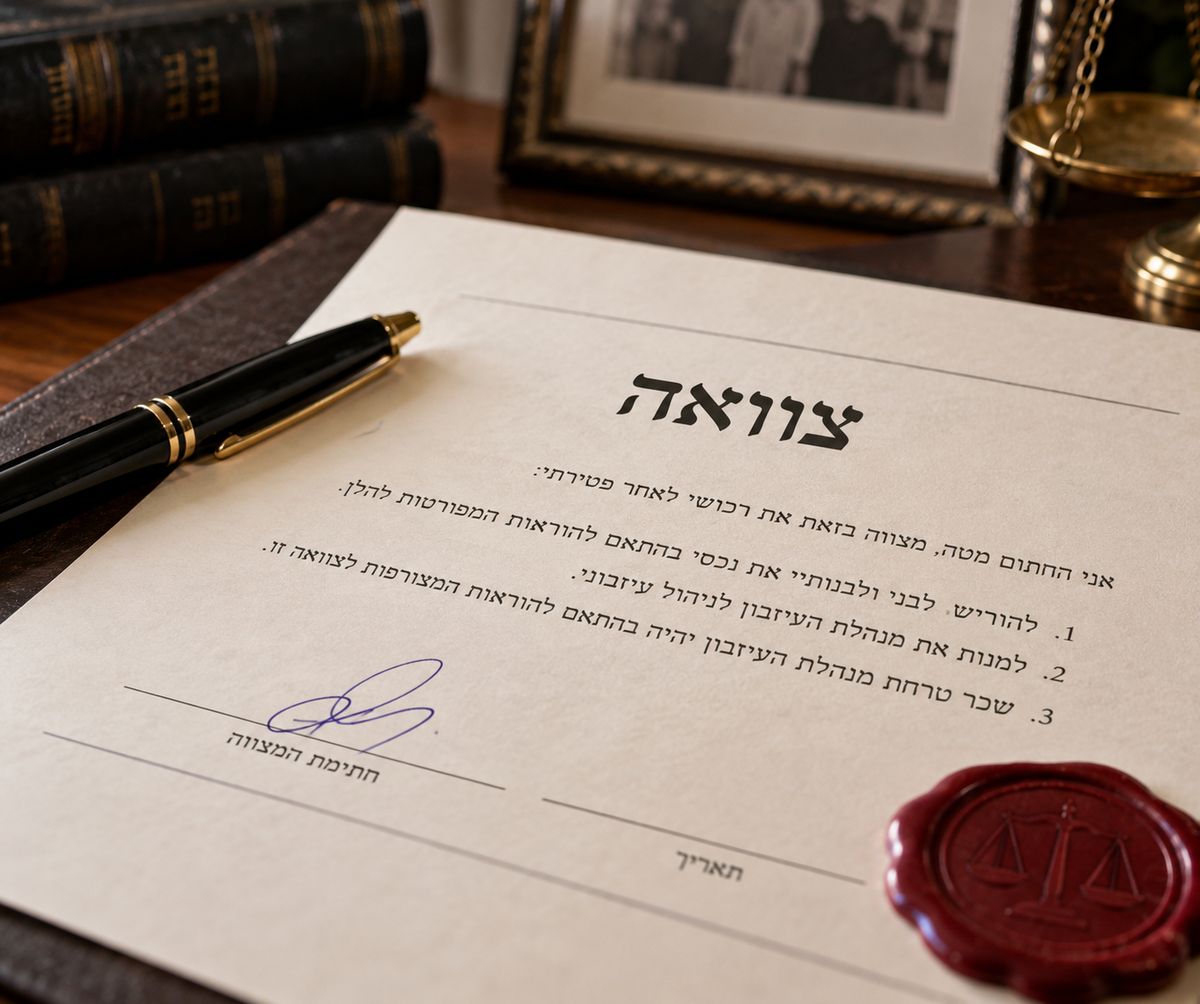
An inheritance dispute between four siblings and their father reached an Israeli court after the father transferred his rights in the family home to his three daughters, even though a mutual will he had made with his late wife specified that after both their deaths, the rights would pass to their son. The son petitioned the court to cancel the transfer to his sisters, and the father and daughters argued that as long as the father is alive, the son has no right to interfere in his decisions regarding the property.
The couple drew up a mutual will in December 2021, under which after one of them died, the rights in the home would pass to the surviving spouse, and after that spouse's death the son was to inherit the property.
The mother died in May 2023, and in September that year an order was issued to execute her will. In March 2024 her rights in the home were registered in the father's name.
But in February 2025 it emerged that the father's rights in the home had been transferred for no payment to his three daughters, while the son, who was supposed to inherit the home after his father's death, received no rights in it.
Son demanded cancellation of the transfer
Following the discovery of the transfer, the son filed a claim in the Tiberias Family Court, asking to cancel the transfer of rights to his sisters.
He argued that the move contradicts the terms of the mutual will and harms the rights that were established for him. He also raised claims regarding his father's competence to carry out the transaction.
The father and daughters opposed the claim. They argued that the father owns the rights in the home, and therefore he is entitled to transfer them as a gift to his children. They further argued that the son has no vested right in the property as long as his father is alive.
The Family Court decided to allow the claim to be heard, and also ordered the appointment of a guardian ad litem for the father, as part of measures intended to protect his affairs.
The sisters did not accept the decision and appealed to the appellate court.
Can you sue over an inheritance while the parent is still alive?
The central question was whether a person designated in a mutual will as a future heir is entitled to petition the court while the surviving parent is still alive.
The judge explained that as a rule, a person cannot demand to receive an inheritance from someone who is still alive. However, in the present case the situation is different: the mother has already died, her will has been executed, and the home was included in an inheritance arrangement made jointly by both parents.
The court ruled that in appropriate circumstances, when an action by the surviving spouse is liable to frustrate the provisions of the mutual will, it is possible to allow the designated heir to petition the court even before the parent's death.
However, the judge emphasized that this does not constitute a finding that the father acted contrary to the will or that the gift to the three daughters is unlawful. These questions will be clarified in the main claim.
Difficulties that emerged in examining the father
As part of the proceeding, the court also addressed the father's condition. In a hearing held with him, difficulties emerged in his memory regarding the transfer of the home and the will, as well as difficulty orienting himself in the place where he was staying.
Following this, it was decided to take steps to examine his condition and protect his affairs.