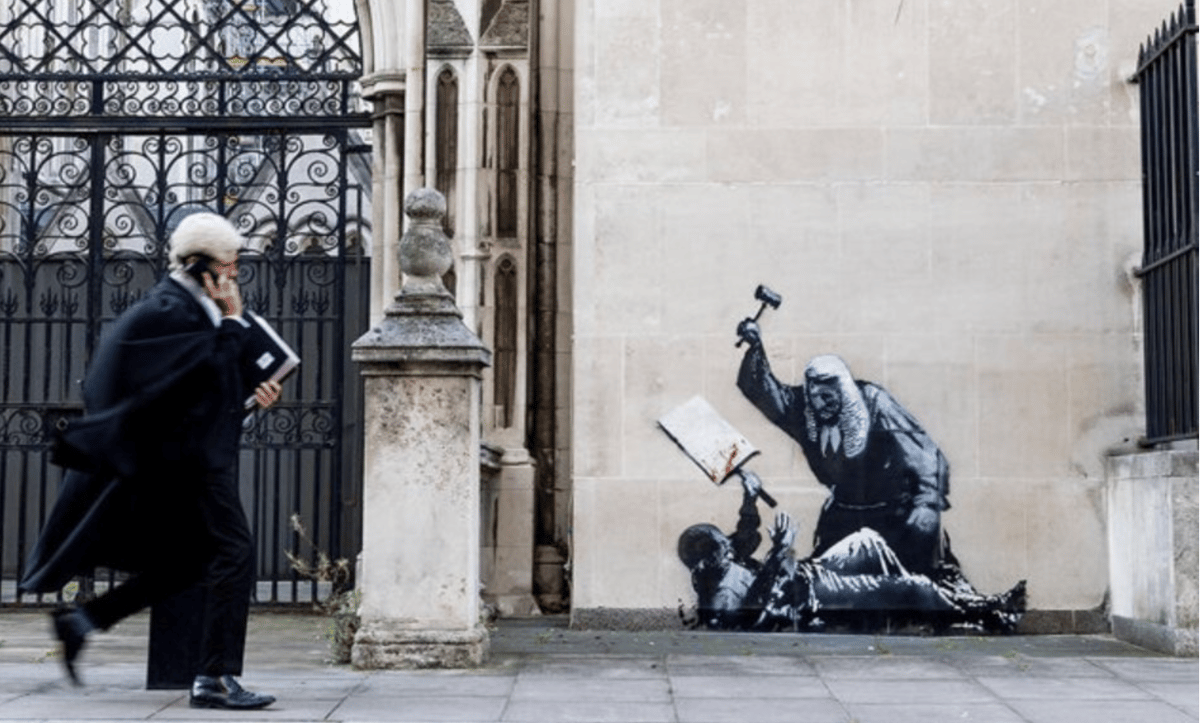
A fresh work by the elusive British street artist and activist Banksy briefly appeared this week on the exterior of London’s Royal Courts of Justice before being swiftly covered in black plastic and cordoned off by security guards. The mural, showing a wigged judge in black robes raising a gavel over a prone protester holding a blank sign stained with red paint, was interpreted online as a biting critique of police crackdowns on pro-Palestinian demonstrations.
The timing was not lost on observers: the piece emerged just two days after nearly 900 demonstrators were arrested in London protests against the government’s restrictions on social media platforms.
Officials moved quickly to block public access. A spokesperson for His Majesty’s Courts and Tribunals Service told the BBC that “the Royal Courts of Justice is a protected heritage site, and the service is obliged to preserve its original character.” The mural, they confirmed, will be removed.
On social media, the cover-up itself went viral. One account, Grifty, mocked the move: “One hour after Banksy mocked the courts for censoring people, the courts censored his mural. It proves his point.”