Just days after the wreckage of the Altalena was discovered 503 meters deep off Israel's coast, some 78 years after it was sunk, it's worth revisiting the date that marked the end of that turbulent chapter in Israeli history.
On 17 Elul in the Hebrew year 5708 (1948), the Irgun (the pre-state underground militia known in Hebrew as Etzel) was formally disbanded and absorbed into the newly formed Israel Defense Forces. The dissolution was completed with the dismantling of the Jerusalem Battalion, the last Irgun unit that had maintained its independence.
But what ended that day wasn't merely a military organization. Along with the Irgun came the dissolution of the political movement it spawned. Menachem Begin and his Herut party were consigned to the opposition benches for nearly three decades, until the political upheaval of 1977 brought them to power.
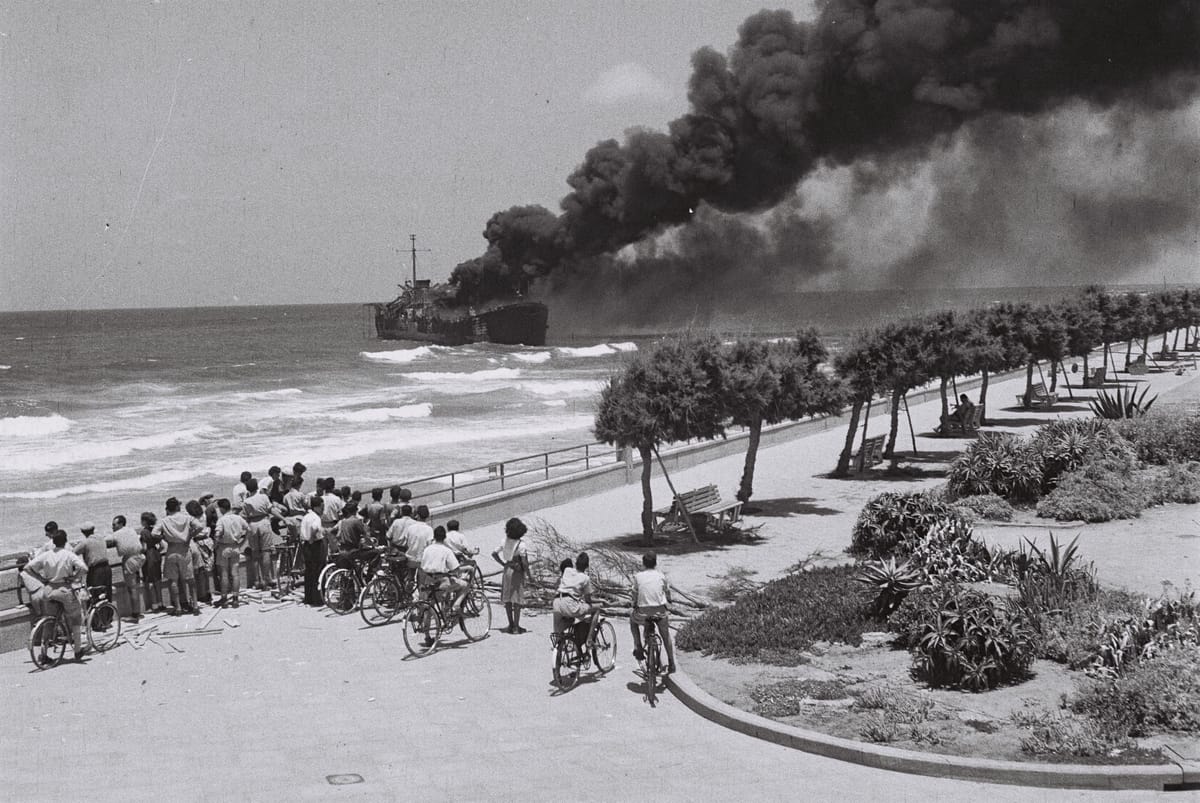
The events leading to that dissolution, centered on the Altalena arms ship, also feature Yitzhak Rabin in a significant role. He has been described as the officer in charge of "the sacred cannon" that set the vessel ablaze.
For accuracy's sake, it should be noted that according to an analysis published in Haaretz examining participants' memoirs, Rabin himself did not operate the cannon. The order to open fire came from David Ben-Gurion, and other artillerymen carried out the actual bombardment.
Nonetheless, Rabin commanded IDF forces that morning protecting Palmach headquarters at the Ritz Hotel on Tel Aviv's beachfront. He arrived at the Altalena scene by chance with his wife, but was actively part of the forces operating there—not merely an observer. Notably, he did not refuse orders, unlike the Mahal (foreign volunteer) pilots who were asked to carry out the mission, declined to attack, and only then did the General Staff shift to planning a shore-based bombardment.
Forty-six years after the Irgun's dissolution, the same Hebrew date returned, 17 Elul in the year 5754 (1993). Thirty-two years ago from today, the left was again in power, led by the same Yitzhak Rabin who had been present on Tel Aviv's beach during that fateful day in 1948 when the Altalena was shelled.
On that 17 Elul, an initial agreement was signed between Israel and the PLO, part of the Oslo process, enabling partial Palestinian self-rule in the territories of Judea and Samaria (the West Bank).
One date on the Hebrew calendar. Two deeply controversial moves by the same political camp.