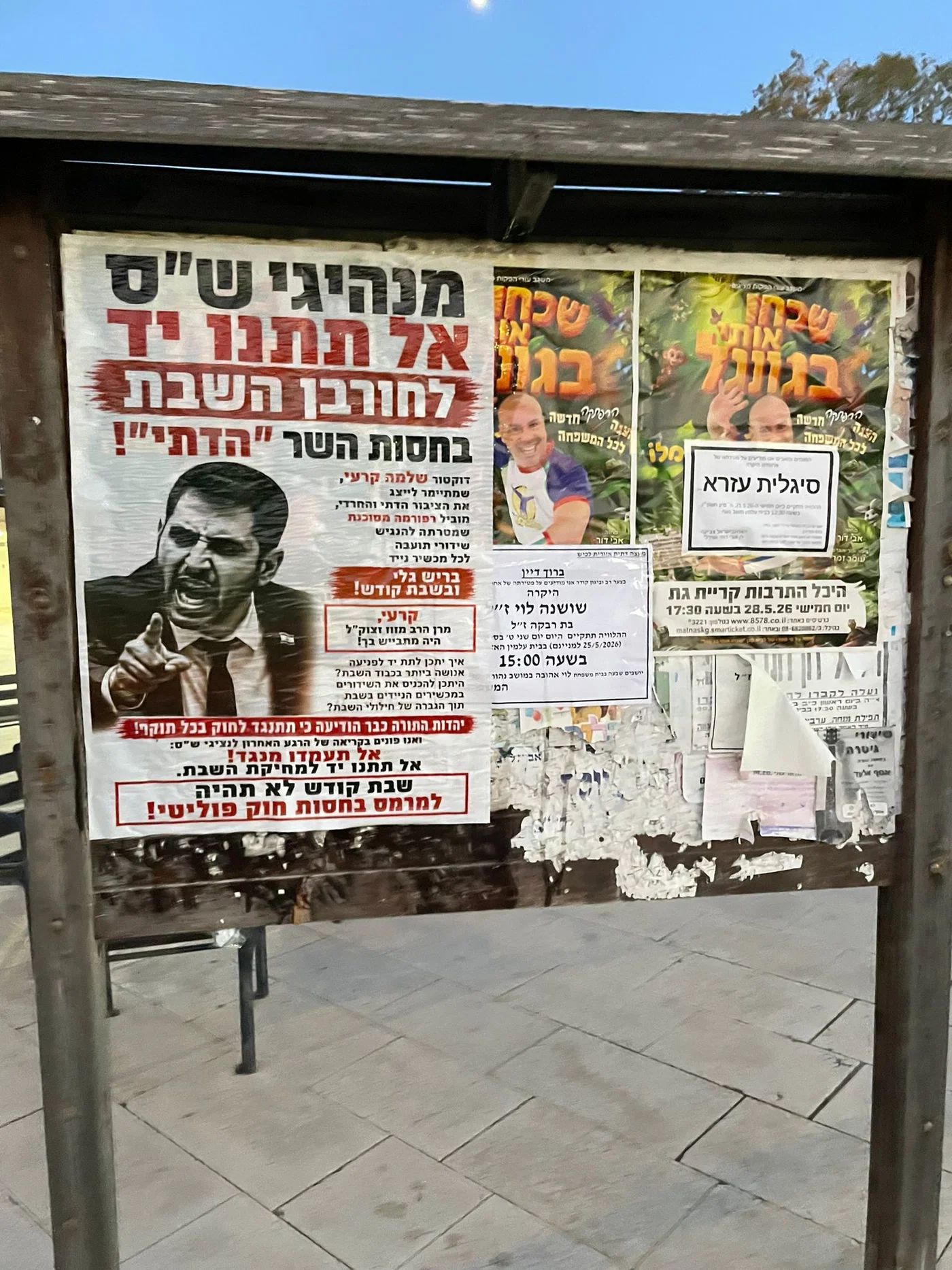
SHABBOS SHOWDOWN: Rabbinical Committee Issues Striking Ultimatum to Religious MKs on Karhi’s Media Reform
Vaad HaRabbanim publishes sharp letter detailing dangers in proposed legislation • Warns of unprecedented Chiullul Shabbos, expanded sports broadcasts, and immoral content | 'Must oppose this law until corrected' (Haredim)

As Communications Minister Shlomo Karhi's controversial broadcasting reform advances toward a critical Knesset vote, the Vaad HaRabbanim L'Maan HaShabbos (Rabbinical Committee for Shabbos) has issued a forceful directive to Haredi and religious Knesset members: oppose this legislation until fundamental corrections are implemented.
The committee's letter, sent Monday evening to Minister Karhi and the heads of Haredi and religious parties, including Yitzchak Goldknopf, Moshe Gafni, Aryeh Deri, Itamar Ben-Gvir, Bezalel Smotrich, and Avi Maoz, bears a stark headline: "Opposition to Support for the New Communications Law."
The directive comes after the legislation was removed from Monday's Knesset agenda following objections from United Torah Judaism, only to be rescheduled for a vote Tuesday. According to sources familiar with the matter, the renewed vote became possible after efforts to persuade some Haredi MKs to support the controversial measure.
Four Critical Pitfalls Detailed
In the letter, published exclusively by Kikar HaShabbat, the Vaad HaRabbanim meticulously outlines what it characterizes as "the primary pitfalls" embedded in the proposed communications reform.
The first concern centers on institutionalized Shabbos desecration funded by the state. "In the new reform, the government becomes an initiator, producer, and financier of an advanced digital application, representing an unprecedented expansion of Shabbos desecration through institutionalized governmental initiative," the committee stated.
The second issue addresses enhanced availability through "Catch-Up" technology. "According to the proposed law, the platform will enable retroactive viewing of up to 90 minutes. This feature significantly increases the availability and temptation for Chillul Shabbos," the rabbinical body noted.
Third, the committee expressed alarm over expanded sports broadcasting on Shabbos. "Within the framework of the new platform, a wide variety of sports content and events will be broadcast during Shabbos, content that was not accessible in this manner until now," the letter clarified.

Concerns Over Immoral Content
The fourth pitfall identified by the Vaad HaRabbanim addresses what it termed "breaking boundaries and adding channels." The committee warned that "the new law permits the removal of barriers and the addition of channels in an extensive manner, such that virtually any channel can join the government application and broadcast without limitation on Shabbos and Jewish holidays."
The rabbinical body emphasized an additional dimension of concern: "Beyond the fact that the law opens a wide gateway for channels that broadcast indecent and abominable content, financed and encouraged by the Government of Israel."
This concern echoes warnings previously issued by prominent Sephardic educators, who cautioned that the reform would provide yeshiva students with unprecedented access to inappropriate material through a single government-sponsored application.

Clear Directive to Legislators
Based on these concerns, the Vaad HaRabbanim issued an unequivocal directive: "In light of the above, the Vaad HaRabbanim announces that it is necessary to oppose this law, until the matters are corrected and approved by the Vaad HaRabbanim."
The committee's position aligns with the stance taken by United Torah Judaism, whose chairman MK Yitzchak Goldknopf previously sent a sharp letter to Minister Karhi accusing him of attempting to "hijack" the legislation by advancing it rapidly while violating understandings reached with Haredi parties.