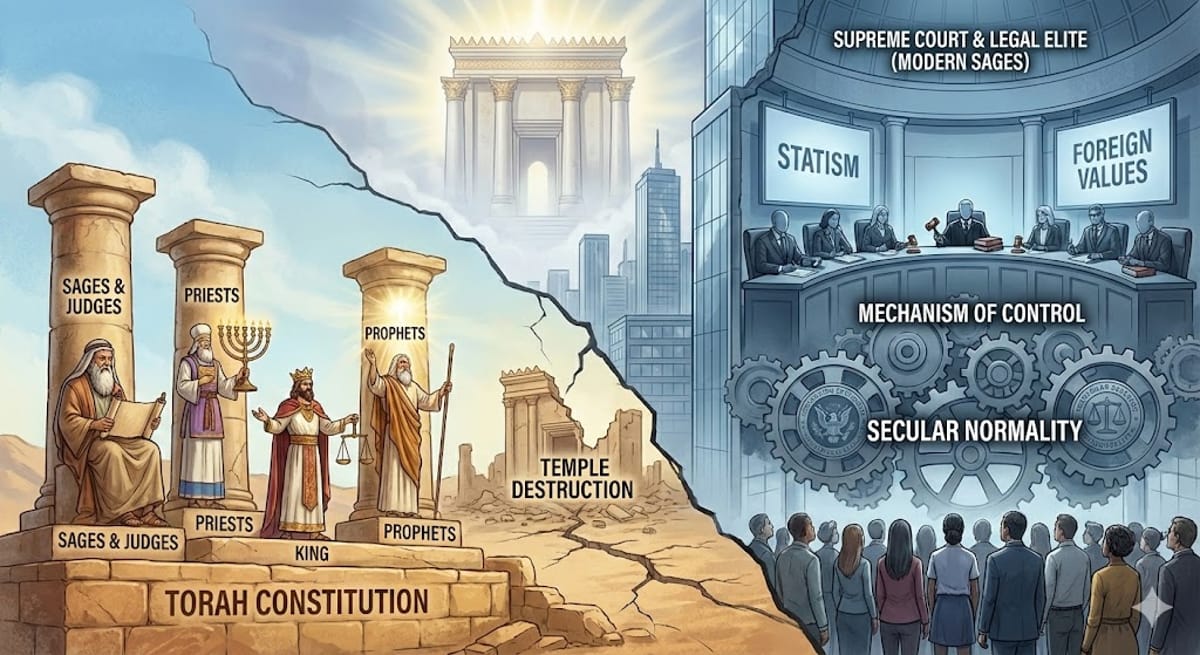
In ancient times, the government of the Jewish people relied on a triangle of power: Sages and Judges, Priests, and Prophets. All three were equally subject to the constitutional law of the Torah, yet each held a different type of authority.
However, at a decisive historical moment when prophecy ceased, a vacuum emerged that raised an inevitable question: Who would lead the people now? This marked the beginning of a covert struggle between the Priesthood and the Wisdom tradition of the Sages. As long as a king reigned in Judea, this struggle was restrained and fought mainly for the hearts and minds of the common people.
The King served as the balancing factor. As was the case during the First Temple era, the King understood that moral and legal authority belonged to the successors of the Judges and Prophets sitting in the Great Assembly, known as the Sanhedrin. Meanwhile, the authority of holiness and ritual belonged to the Priests.
The King was forced to make constant compromises with the Judges and Sages on one hand, and with the Priests and Prophets on the other. This was done out of an understanding that the Great Assembly was the institution most respected by the people. It alone combined the elements of Jewish sanctity: judgment according to Mosaic Law, and leadership in the spirit of prophecy and priestly ritual.
Thus, the King created a pure systemic synthesis. It was a combination of leadership sociology and graded authority where everyone found shelter under the rule of Torah law.
However, the destruction of the Temple by the Romans tipped the scales and crushed this delicate balance. With the loss of the ritual center and the exile of the King, the Priests lost their power base. The Sages remained the exclusive heirs to law and leadership. Consequently, Jewish law became the sole domain of a specific intellectual elite.
Over centuries of exile, that same elite of legal scholars understood that a community cannot survive on spirit alone. They were forced to share power with the wealthy and the city administrators. This created a dual elite in Jewish communities: the spiritual leaders who controlled the legal and intellectual sphere, and the men of action who controlled finance and management.
Simultaneously, a class system based on lineage developed, granting prestige to those from scholarly families, which further fortified the status of the Rabbinic elite.
The great fracture arrived in the eighteenth century. With the spread of the Enlightenment and the new possibility for Jews to mingle with the nations, alternative elites began to grow and challenge the old Rabbinic hegemony.
These included the new Zionist elite, the Rabbinic elite which split in its attitude toward Zionism, and the secular assimilationist elite. Due to historical circumstances, this secular group managed to acquire a significant foothold in the leadership of the people upon their return to the Land of Israel.
The ruling elite in Israel today has managed to exploit the Zionist idea of the Return to Zion that so many longed for. They have combined it with a yearning for "normality," or the desire to be a nation just like any other. Yet, regarding the mechanism of control, the system remained as Jewish as it ever was.
It is a legalistic elite. It is a leadership that forces the people toward secular normality within a framework that claims to protect the state.
Many observers today claim that the phenomenon of excessive legalization in Israel, specifically the immense power of the Supreme Court and legal advisors, proves that the Jewish people are still mentally in exile. They argue that Jews are incapable of managing themselves as a sovereign nation without a "responsible adult" overseeing them.
But the truth is the opposite. This dominance of the legal system proves that the Jewish people remain loyal to their structural and historical nature as a people who defer to the authority of "Sages." This remains true regardless of the content that these modern sages inject into their authority in an era of spiritual emptiness.
The only change is in the identity of those sages. The institution of "Wisdom" has simply been conquered by foreign values. In terms of how they manage themselves, the Jews remain as they were in ancient times. They are a people seeking to follow the ruling of the Wise Man.
The modern secular founders attempted to break the authority of the Torah Sages just as the destruction of the Temple once broke the Priesthood. They utilized the spiritual fracture of the eighteenth century Enlightenment to do so. They now try to normalize this fracture within the framework of modern political Zionism in order to subjugate the people.
This is fundamentally an act of wickedness.
In doing so, they are exploiting a deep Jewish psychological archetype that admires intellectuals and expresses itself in a desperate yearning to grant them a holy status.
This is the source of the primal fear held by the secular "wise" elite. They are terrified that the Israelis, who inherited the character of obedience to the law from the Rabbis, will eventually rebel against their secular masters. To prevent this, they created the concept of "Statism." This is a bureaucratic system designed to decentralize the centers of power, including enforcement, policing, law, and security. The goal is to ensure that the rule of the original Torah Sages never returns.
And this fear is justified. It stems from a knowledge of Jewish history. The secularists understand that if the Rabbis return to the position of supreme authority, they will not settle for being merely a religious court.
Their deep aspiration will be full restoration. This means the establishment of a Temple and the rehabilitation of prophecy. In a situation where these three forces of Wisdom, Priesthood, and Prophecy unite anew under one leadership, the secular elite will crash. They will become nothing more than the servants of the sages and kings of Israel.