Get our mobile app
Download on the App StoreGet it on Google Play

Religious Thought

Rabbi Kook on Purity in Public Discourse

As Israel's 2026 election campaign fills social media with negative messaging, the late Chief Rabbi's words offer an alternative approach to political engagement

Old and new. Rabbi Kook's House

As Israel's election season intensifies, political candidates across the spectrum claim to represent justice and moral purity.

The teachings of Rabbi Abraham Isaac Kook, the first Ashkenazi Chief Rabbi of Isreal who died in 1935, offer a different perspective on what true righteousness means, one that has little connection to the often toxic nature of contemporary political discourse.

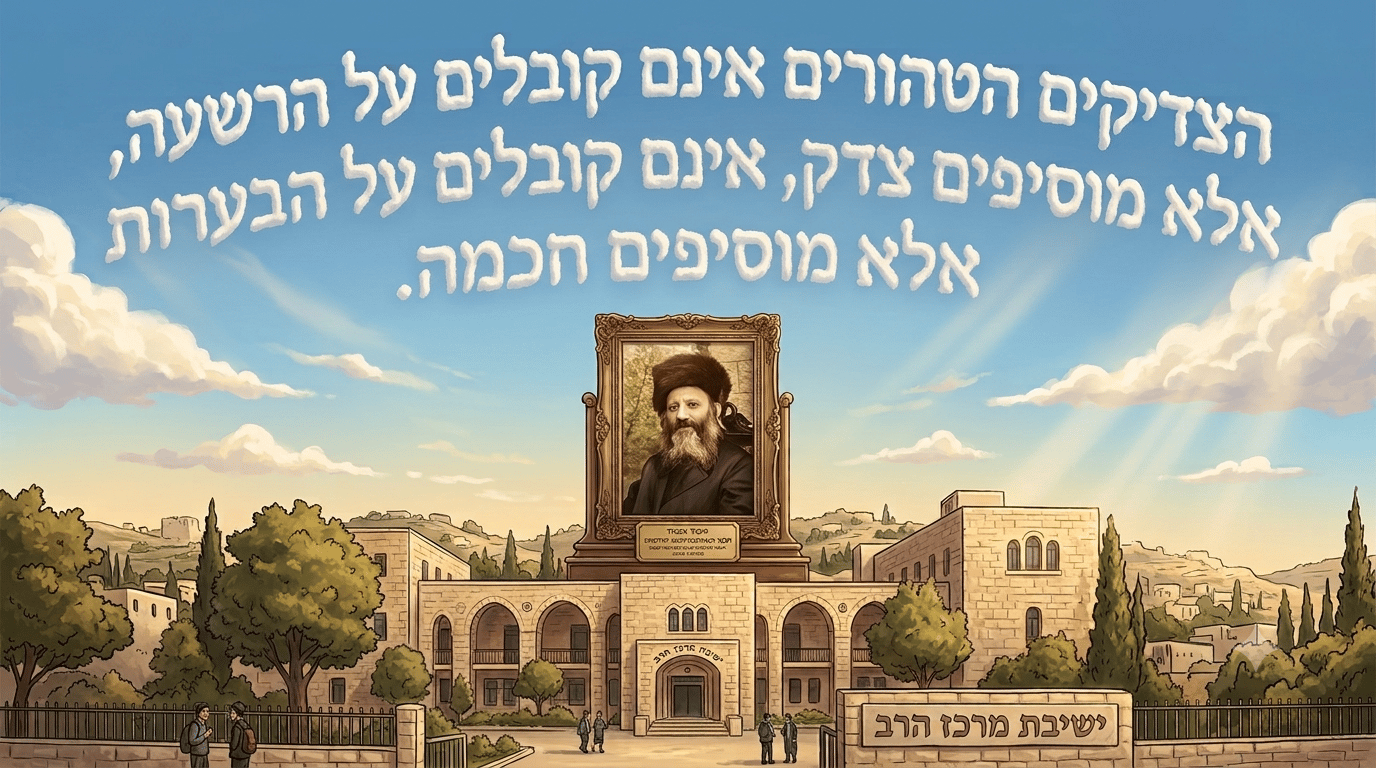
"The pure righteous" rabbi kook famous sentence
"The pure righteous" rabbi kook famous sentence (AI Illustration)

A Different Standard for Righteousness

In his book "Arpilei Tohar" (Clouds of Purity), Rabbi Kook wrote: "The pure righteous do not complain about wickedness, but add justice; they do not complain about heresy, but add faith; they do not complain about ignorance, but add wisdom".

Contrasting this ideal with current campaign rhetoric, the article argues that a survey of recent weeks' headlines and social media videos reveals candidates doing the opposite: speaking wickedly rather than acting justly toward others and themselves, condemning those they view as heretics not from love and faith but from divisiveness and hatred, and sanctifying ignorance rather than embracing the wisdom of silence and creating space for opposing voices to be heard.

The Ballot Prayer
The Ballot Prayer (Photo: Chaim Goldberg / Flash90)

Historical Recognition Across Divides

Ninety-one years ago, on the day of Rabbi Kook's death, the labor movement newspaper "Davar" published a tribute that acknowledged both criticism and appreciation. The paper wrote that "the workers' public, even if it cannot ignore the aspects of religious coercion practiced upon it, will remember favorably this man who knew how to find the aspect of holiness in the workers' deeds within his field of contemplation".

The fact that a secular newspaper could praise Rabbi Kook's remarkable ability to see those different from him in a positive light, even while criticizing religious coercion in the same breath, offers a slim but real hope that today's society might also find time and space to add justice and faith, replacing words that inflame hatred with wise actions of closeness and love.


Ready for more?

Join our newsletter to receive updates on new articles and exclusive content.

We respect your privacy and will never share your information.

Enjoyed this article?

Yes (38)
No (2)
Follow Us:

Unmissable content


Loading comments...

Also of Interest