Before you line up the kids with an apple in hand and start begging for a "nice smile," it's worth knowing a few tricks from professional children's photographers. Some are surprising, some are technical, and almost all of them can make the difference between just another cute holiday photo and a picture you'll actually want to keep.
The apples are gleaming, the matching outfits have been chosen carefully, you've found a wall or backdrop that looks reasonably scenic, and the kids are even still clean. Just one small thing left: to photograph them.
Then the event begins.
One makes a face, the second looks at his brother instead of the camera, the youngest has decided he's not ready to stand anywhere, and the one who usually smiles all day suddenly looks like you asked him for an ID photo.
So before you start calling to the kids "Look here, come on, smile, nice smile," we've collected tricks that professional children's photographers rely on—including some small technical details that can make a big difference.
And the first one is a bit counterintuitive.
Don't Start With the Photo You Want Most
You have a perfect image in your head: all the kids together, holiday clothes, apple in hand, everyone looking at the camera.
That's exactly the one you shouldn't photograph first.
The first few minutes are an adjustment period. A child placed in front of a camera and told in the first second exactly where to stand, where to put his hand, and what to do with his face, usually gives you his "photo face."
Instead, give him a task.
"Bring me the prettiest apple."
"Show me how you smell it."
"Hide it behind your back so your brother doesn't see."
"Whisper in his ear what you want to get for the new year."
The child stops thinking about how he looks and starts doing something. And there, between the first task and the second, is often where the really good pictures come.
The Phrase to Delete From Your Vocabulary: "Make a Nice Smile"
Some children have a special smile for photographs. You know the one. Teeth out, eyes frozen, joy minimal.
The problem is: a smile is a result, not an instruction.
If you want a real smile, you need something to happen just before it.
Instead of "smile," try giving the child something to react to. Tell the older sibling to whisper something funny to the younger one. Ask who can hold an apple on his head. Announce that absolutely no one is allowed to laugh. Ask them to get close until their noses almost touch.
Then pay attention to this important point: don't photograph only at the peak of laughter.
The second after, when the child has settled and the smile still lingers in his eyes, that can give a much more beautiful and natural expression.
A Two-Year-Old in the Picture? He Sets the Schedule
You can choose a perfect location and wait for beautiful golden hour light, but if at that time the toddler is tired, hungry, or has reached that point in the day where every apple is cause for a constitutional crisis --- the lighting won't save you.
When photographing small children, the child's good time is more important than the sun's good time.
If you know he's at his peak after breakfast, photograph then. If it's after a nap, do it then. Better slightly less dreamy lighting and a happy child than "golden hour" with tears.
And when photographing multiple siblings together, you build the photo around whichever child has the shortest patience. Prepare the older kids first, and only when everything is ready do you bring the little one into the frame.
Don't waste his four good minutes on experiments.
The Small Mistake That Makes a Photo Look Amateur
Say you found a beautiful wall. The instinct is to press the kids against it.
Don't.
Try to move them away from the wall, the bush, or the background behind them. Even a meter or two if you can.
Suddenly two things happen: the background becomes softer and more pleasant, and the kids "pop" out of it instead of looking like they're stuck to it.
This is especially true if you're photographing on a camera, but even on phones, the distance between the subject and background makes a significant difference in the sense of depth.
One more small detail: before you photograph, take a second to look behind the child.
A pole sticking out of his head? A bag on the floor? A colorful plastic chair at the edge? A branch coming in behind his ear?
Often a photo doesn't look professional not because of what's missing—but because of one unnecessary thing we didn't notice.
Don't Photograph Children Close Up With a 0.5x Lens
The wide angle distorts what's close to the lens, and in a face portrait it can enlarge a nose, forehead, or outstretched hand. For a classic Rosh Hashanah photo, it's usually better to stay at 1x and back up a bit yourself.
And yes, before all of this, clean the lens.
A camera can cost thousands of shekels and produce a photo that looks like it was taken through a sandwich bag, just because of one fingerprint.
If They Move, Stop Asking Them Not To
Children move. Instead of fighting it, you can build the photo around it.
Ask them to walk toward you. Run three steps and stop. Turn around and then look. Walk hand in hand. Get closer to each other.
Someone photographing on a camera can increase the shutter speed. For children in fast movement, around 1/1000 second is a good starting point. For children who are standing but not really standing, 1/500 can also save a lot of photos from blur.
Someone photographing on a phone can use burst mode when that option is available, and then choose the exact frame afterward.
Don't wait for the perfect moment and then press. When there's movement—photograph through the moment.
Several Children Together? There's a Reason One Looks Sharp and Another Doesn't
This is a mistake that happens a lot in cameras with very open aperture.
One sibling is standing a bit forward, the other a bit back, you're shooting at f/1.8 and then you discover at home that only one pair of eyes is actually sharp.
If you're photographing multiple children, try to bring their faces to roughly the same line. And if you control the camera settings, don't be afraid to close the aperture a bit, for example to f/4 or f/5.6, depending on how many children there are and the distances between them.
A photo where everyone is sharp is worth more than an especially blurred background.
Don't Station an Encouragement Committee Behind the Photographer
This is one of the classic situations in children's photography: the photographer stands in front, and three adults behind him are waving, calling the child's name, and promising candy.
The result? Every child looks at a different person.
If you need someone to make a child laugh or draw their attention, choose just one person. And position them as close as possible to the lens.
Otherwise you end up with a photo where theoretically everyone is "looking here," but four pairs of eyes are looking at four different spots.
Already Hate Being Photographed? Actually, Stop Trying With That One
Older children are already very aware of cameras. Sometimes the moment it comes up, they immediately arrange themselves, change their expression, or announce they don't want to.
Don't try to convince them they "turn out great."
Let them know it's brief.
"I need three minutes from you."
Suddenly there's a clear end to the event.
And you can give them a bit of control: choose which side to stand on, which photo to do first, or whether to hold an apple or not.
When a child feels like he's part of the shoot and not an accessory in it, cooperation looks completely different.
And Save the Honey and Pomegranate for the Very End
Here's a tip we've all learned the hard way.
If the kids are dressed for the holiday and you want to photograph with Rosh Hashanah symbols, build a shooting order.
First the clean photos.
Then an apple.
Then a pomegranate, if you want.
And only at the end comes the honey.
Don't start the shoot with an open bowl of honey next to a three-year-old in a white shirt and hope for the best.
And pomegranate, for all its photogenic qualities, knows how to leave an impressive souvenir on holiday clothes.
Don't Build a Holiday Table. Choose One Detail
Another apple, another pomegranate, a jar of honey, a shofar, a basket, a tablecloth, leaves, a "Happy New Year" sign, and a flower wreath—at some point the child becomes the least prominent thing in the photo.
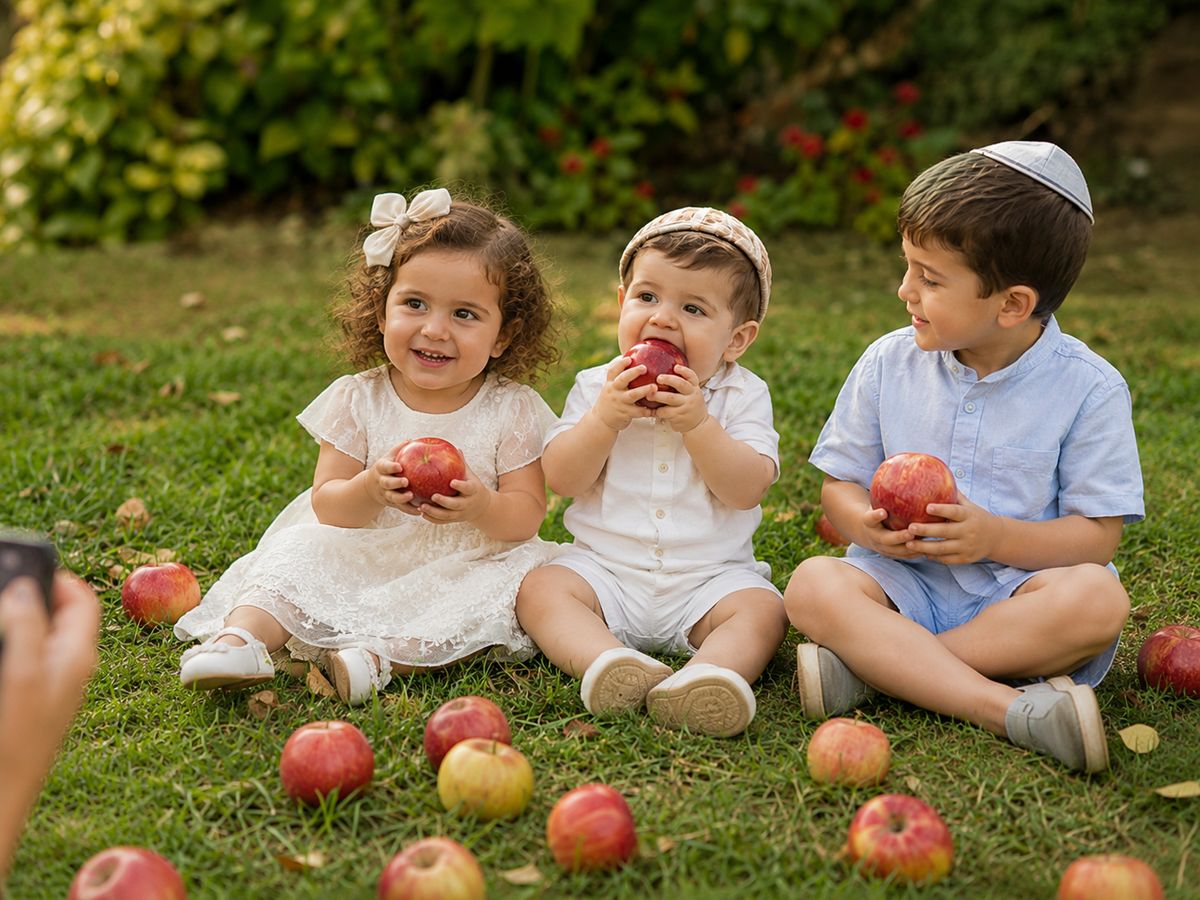
Choose one or two elements. An apple in hand. A jar of honey on a small table. A few pomegranates next to them.
That's enough for the eye to understand "Rosh Hashanah." Everything else can stay out of frame.
The Tip That's Maybe the Most Important: Photograph the Child, Not the Image
We're used to thinking that a good photo is one where everyone is arranged, looking at the camera, and smiling.
But in ten years, maybe that's not the photo you'll linger over.
It will be the one where the little one holds the apple in both hands the way he always does. The older brother trying to make him laugh. The serious child giving his familiar half-smile. Two siblings looking at each other instead of at the camera.
Good children's photographers look for exactly these things, the small gestures the child makes without knowing he's making them.
So yes, do one photo "for Grandma": straight clothes, eyes on camera, everyone in the frame.
And then let them go.
Let them walk, talk, argue a bit about the apple, laugh, and be themselves.
And there's a good chance that's exactly when you'll photograph your most beautiful Rosh Hashanah photo.