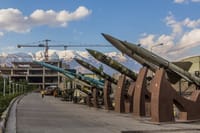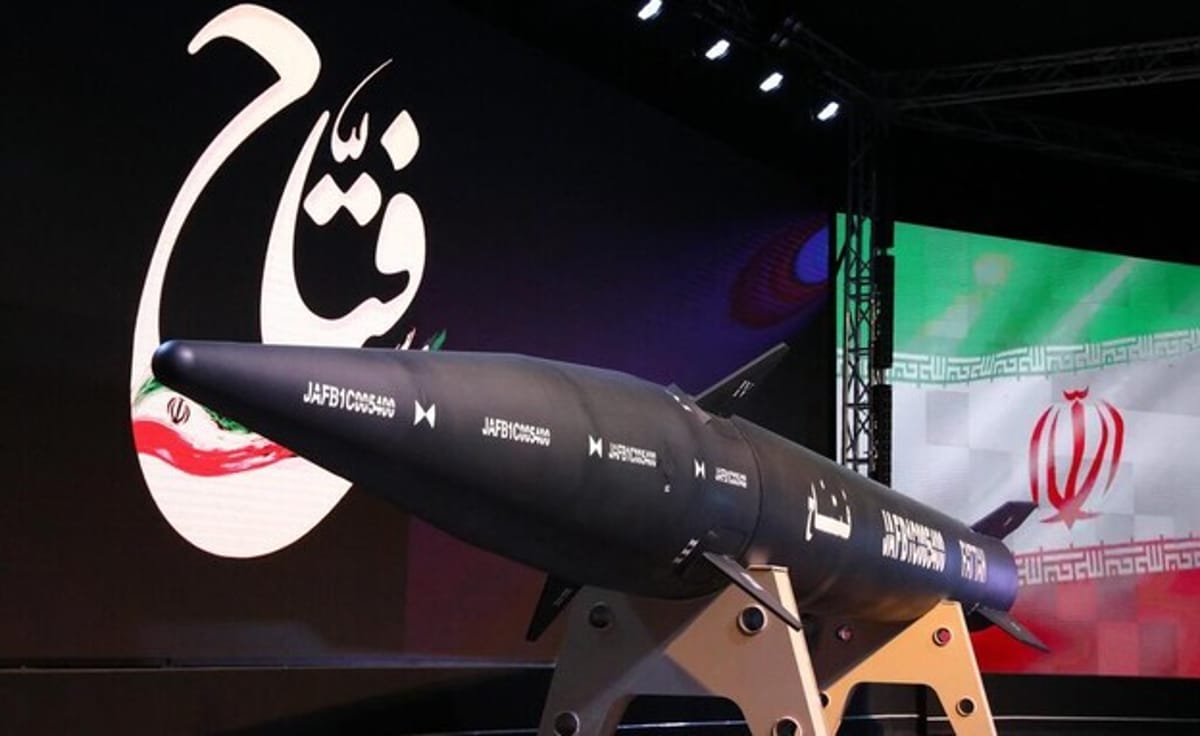
The Hezbollah terrorist organization escalated its campaign against the Israeli home front on Monday afternoon by launching a Fateh-110 precision surface to surface missile toward the center of the country. This heavy, Iranian manufactured weapon represents one of the most significant threats in the group's arsenal, possessing the capability to strike targets with extreme accuracy at ranges of up to 500 kilometers. While the Israeli air defense network successfully engaged the threat, shrapnel and debris fell across several locations in central Israel, resulting in light injuries to four people. This specific missile has been a high priority target for the Israel Defense Forces for over a decade, as its 300 kilogram warhead and precision guidance systems are designed to cripple strategic national infrastructure.
A Lethal Iranian Import
The Fateh-110 is not a typical rocket, it is a sophisticated weapon system that brings Iranian military power directly to Israel’s northern border. For years, officers within the Iranian Revolutionary Guard have boasted about supplying these missiles to Hezbollah. Unlike the smaller, unguided rockets used in previous wars, the Fateh-110 is built to hit specific high value assets. During this current war, the terrorist group even published footage of such a missile being fired toward the Tzrifin base. Former Air Defense Command chief, Brigadier General Zvika Haimovich, highlighted the severity of the weapon, stating, "This is a 300 kilo rocket, it is very heavy and accurate. Its lethality potential is almost equivalent to missiles from Iran." Haimovich noted that because Hezbollah possesses hundreds of these missiles and can launch them from north of the Litani River, their ability to threaten the Israeli heartland remains a critical concern.
Targeting Strategic Infrastructure
In a statement released after the barrage, Hezbollah claimed that the intended target for the Fateh-110 was a satellite station located in the Elah Valley. This aligns with the known tactical purpose of the missile, which is to strike airports, ports, power plants, and military command centers. By utilizing precision guidance, Hezbollah hopes to bypass traditional statistical fire and achieve "surgical" hits on Israeli national assets. The IDF has spent years attempting to preempt this threat through a policy of active prevention, frequently striking warehouses and production sites in Syria and Lebanon to stop the transfer of these missiles or their components from Iran.
Defense and Detection
Dealing with a missile as heavy and fast as the Fateh-110 requires a multilayered defense strategy. When such a weapon is detected, Israeli intelligence works to provide the earliest possible warning, calculating the missile’s trajectory in seconds to coordinate an intercept. The goal is to destroy the warhead at an altitude high enough to minimize the risk of falling debris. Despite the successful interception on Monday, the incident serves as a grim reminder of the high stakes involved in the current war. As long as Hezbollah maintains a stockpile of these precision Iranian weapons, the Israeli air defense arrays will remain on the highest possible alert to protect the nation's civilian population and its most sensitive strategic sites.