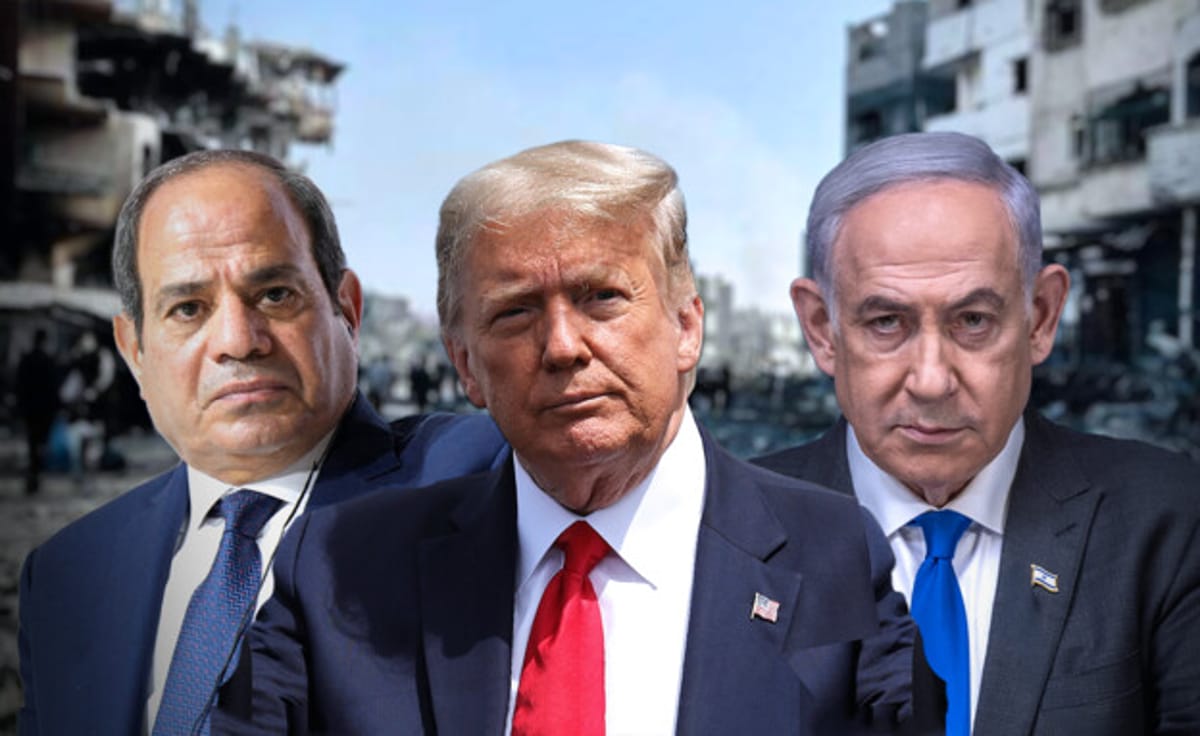
Nearly a week after the ceasefire in Gaza took effect, the anticipated obstacles to a lasting resolution are beginning to surface, creating significant tension regarding the implementation of the next phase of the plan. Prime Minister Benjamin Netanyahu and US President Donald Trump held a discussion this evening (Thursday) focused on the future steps concerning Gaza.
Despite the release of all living captives by Hamas, the fate of 19 Israeli bodies still held in Gaza remains a major point of contention. Cairo officials acknowledge that the path to Phase Two is fraught with difficulties, ranging from the issue of the deceased captives to the crucial question of demilitarization and the potential deployment of an international force.
The Crisis of the Deceased Captives
Although Hamas fulfilled the obligation to release the living captives, it has yet to return the bodies of 19 deceased Israelis. The terror organization claims that some of the bodies have not been located due to the extensive destruction and difficult ground conditions in the Gaza Strip.
Egyptian Information Service head, Diaa Rashwan, commented on the difficulties, stating: "I foresaw that the first phase itself would encounter ambiguity and problems. According to the agreement, Israel was supposed to return 15 bodies of Palestinians for every Israeli captive. That is a total of about 450 bodies. In practice, only five bodies were handed over."
Rashwan, however, suggested that these hurdles may not completely derail the agreement, though they could cause delays: "These are indeed expected obstacles, but in my assessment, they will not lead to a complete explosion of the agreement. At most, they may cause a delay in the subsequent phases of the plan, and that is exactly what Trump wants, and it is also what Netanyahu wants: to buy time to allow Israeli society to adapt to the new situation."
US Pressure on Sanctions
The United States is currently exerting heavy pressure on Israel to hold off on imposing sanctions against Hamas. Washington is urging Jerusalem to fully explore the potential for recovering the bodies of the remaining deceased captives from the Strip before escalating punitive measures.
A small security discussion was held at the Prime Minister's residence today, focusing on the leverage Israel can employ against Hamas. Two key avenues were discussed: Egypt delivered a firm message to Hamas, emphasizing the terror group's commitment to upholding all terms of the agreement. Simultaneously, Cairo requested that Jerusalem refrain from immediate sanctions against Hamas to maximize the chances of locating additional deceased captives.
Egypt has also proposed sending search teams into the Gaza Strip. Officials in Washington and Israel are currently reviewing whether to approve the deployment of these teams, a move that, if authorized, could commence as early as next week.
Phase Two: Stuck on Paper
In practical terms, only the first phase of the agreement, concerning the return of the captives, was finalized. The subsequent stage, which addresses the demilitarization of Hamas and the deployment of international forces, remains merely an intention. The way forward is riddled with deep disagreements, necessitating intensive negotiations to bridge the vast gaps between Israel and Hamas.
An Egyptian source familiar with the talks told the Saudi newspaper A-Sharq Al-Awsat: "The negotiations on the second phase have not yet practically begun, but are only theoretically on the table, overshadowed by the difficulties on the ground and Israel's clear exploitation of several loopholes, including the crisis of the bodies. The path to it is complicated and by no means easy. There are no favorable conditions that would allow us to claim we are in the second phase."
The source added: "Unlike Phase A, which was achieved within hours of negotiations in Sharm el-Sheikh, the subsequent phases will take time. Hamas and Israel must act with great responsibility to complete the agreement as presented."
The Demilitarization Dispute
Cairo and Washington are pushing for the rapid demilitarization of Hamas, yet the terror organization is vehemently rejecting this demand. Walid al-Kilani, a senior Hamas official abroad, emphasized the group's stance: "The resistance has clearly stated that this weapon is connected to the Palestinian state, and that the Palestinian weapon is connected to the occupation. As long as there is an occupation, there is resistance, and this is guaranteed by all religions and international law, including Article 51 of the UN which states that any people under occupation has the right to resist, including the use of weapons... We are a people under occupation. We have the right to fight and resist. We are a national liberation movement. If Hamas relinquishes its weapon, others will rise to continue the path and destroy the occupation." He concluded: "Therefore, we say: the Palestinian weapon is a 'Palestinian treasure'."
The Egyptian source noted the complexity of the issue: "The matter is not limited to disarmament, which will not be easy. Israel raised the idea of destroying the tunnels. These are complex and difficult things to resolve at the moment. Therefore, we are facing an ambiguous situation, and it is unknown what will happen tomorrow in the Gaza Strip."
A possible compromise, discussed by Palestinian-American mediator Bishara Bahbah this week, involves Hamas only being required to surrender "heavy weapons", a category of arms that the group currently possesses in very small numbers. This is defined by some in the US as "a weapon that can kill five or more people at the same time. That is, rockets, artillery, and the like, whether locally made or foreign." Israel, however, is expected to demand a far broader definition of "heavy weapons" to ensure any demilitarization is meaningful.
International Force: A Distant Prospect
While Egypt says the idea of deploying an international force is being advanced in discussions with other nations, they admit it is "difficult to set a date for it." Hamas insists that control of the Strip must remain solely with Palestinian entities, thereby securing its direct influence over any future governing mechanism. Al-Kilani stated: "Hamas explicitly said it is in favor of a technocrat committee of experts to manage the Gaza Strip. That they should be Palestinians from the Gaza Strip, and they will manage this phase and the reconstruction. This committee will be supported and coordinated with all factions, as agreed in Cairo and Beijing... There must be someone to enforce security, especially in the phase after the army's departure, when aid enters and requires supervision so that the situation stabilizes."