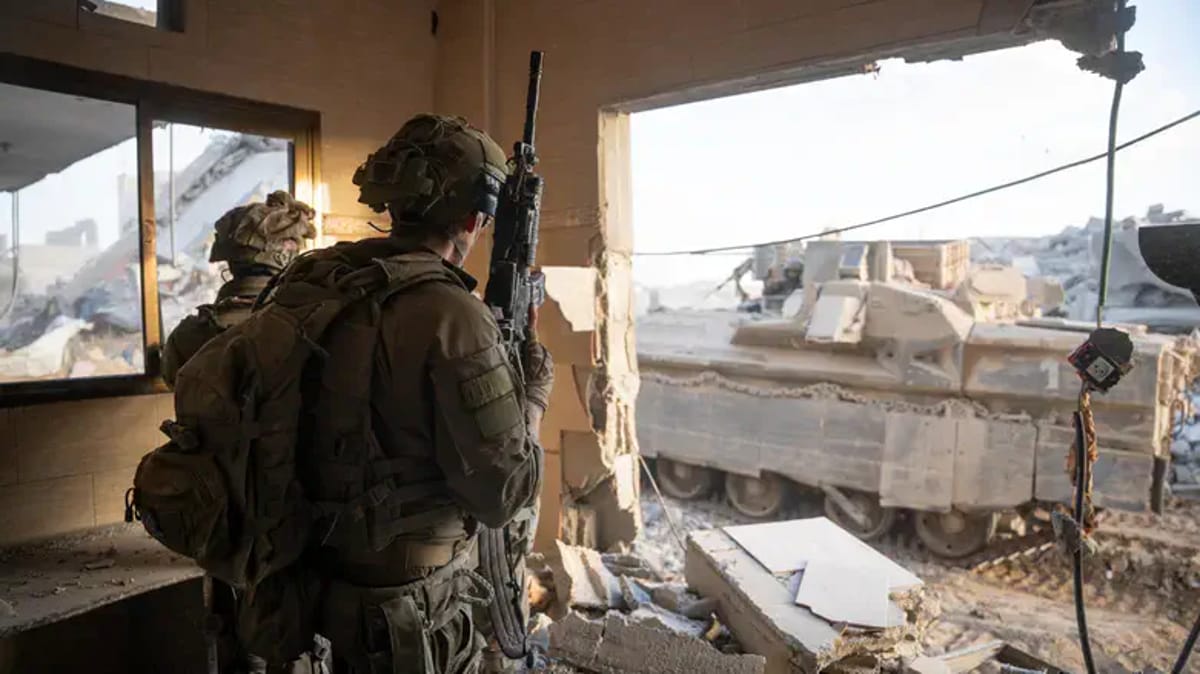
An explosive device detonated Tuesday afternoon in the Khan Yunis area of southern Gaza, in a sector firmly under Israeli Defense Forces control beyond the newly established Yellow Line, prompting an urgent investigation into whether the blast signals a brazen new violation of the fragile ceasefire or merely the lingering hazard of wartime debris. The incident unfolded without reported casualties, but it has heightened tensions just two days after Hamas terrorists ambushed IDF troops in a similar controlled zone, firing anti-tank missiles and small arms that killed two soldiers, Major Yaniv Kula, 26, and Staff Sergeant Itay Yevetz, 21, and shattered the brief calm following the U.S.-brokered truce that took effect on October 11. The IDF, emphasizing its commitment to enforcing the agreement while safeguarding its forces, has launched a thorough probe to ascertain if the device was planted in recent days as part of ongoing terrorist sabotage efforts or if it dates back to the pre-ceasefire chaos, when Hamas littered the region with improvised explosive devices to target Israeli patrols.
Khan Yunis, once a bustling southern hub now scarred by repeated offensives, has become a hotspot for such remnants of destruction since Israel's renewed push into Gaza under Operation Gideon's Chariots in May 2025. That campaign, aimed at dismantling Hamas's command structure after earlier incursions in Rafah and northern Gaza, saw intense urban combat where terrorists rigged buildings and roads with explosives, leading to tragic losses like the June 6 ambush that claimed five soldiers when a booby-trapped structure collapsed on them east of the city. More recently, on October 19, the very ambush that felled Kula and Yevetz involved Hamas gunmen emerging from tunnel shafts to unleash a hail of fire, an attack that prompted a massive IDF retaliation: over 100 airstrikes on terror infrastructure, including former hostage-holding tunnels, and a complete halt to humanitarian aid convoys until Hamas complies with body return obligations. This latest detonation, echoing those perils, underscores the Yellow Line's precarious role, a temporary demarcation enforced with concrete barriers and patrols to delineate Israeli-held territory from Hamas-influenced zones, allowing limited civilian movement while curbing terrorist incursions.
The IDF's inquiry is critical amid a ceasefire already fraying at the edges. Established to facilitate hostage exchanges, all 20 living captives freed and 12 of 28 bodies returned so far, the truce has been marred by mutual recriminations. Hamas has accused Israel of overreach, while Israeli officials decry the terrorists' refusal to accelerate recoveries and their persistent low-level provocations, such as sporadic rocket fire near aid routes that disrupted convoys from the Kerem Shalom crossing. In Khan Yunis specifically, the area has witnessed a surge in intra-Palestinian clashes, including a October 3 raid by Hamas on the al-Mujaida clan that drew unexpected IDF air support for local anti-Hamas fighters, killing 11 terrorists in a rare alignment against the group's iron-fisted control. Such fractures highlight Gaza's unraveling social fabric, where over 220 intra-Palestinian violent incidents since October 2023 have claimed around 400 lives, per security assessments, as armed clans and militias challenge Hamas's dominance amid widespread hunger and displacement affecting 1.9 million residents.
If investigators confirm a recent planting, it would mark yet another flagrant breach by Hamas, whose military wing has vowed to "resist" the truce terms while denying involvement in border skirmishes. The group has already delayed body extractions, citing "Zionist escalations" as barriers, a tactic that stalled aid flows and drew sharp rebukes from Defense Minister Israel Katz, who warned that "Hamas will pay a heavy price for every violation." For IDF troops navigating this minefield, literally and figuratively, the blast serves as a grim reminder of the war's unfinished business. Since the October 7, 2023, massacre that ignited the conflict, over 700 Israeli soldiers have fallen, with Khan Yunis alone accounting for dozens in booby-trap incidents. As the probe unfolds, Israeli security officials are bracing for potential escalations, coordinating with U.S. mediators to salvage the deal while underscoring that any confirmed sabotage could trigger renewed operations to neutralize threats. In a strip where tunnels snake for kilometers and unexploded ordnance litters the landscape, this detonation not only tests the ceasefire's viability but also the resolve to unearth every last remnant of terror, ensuring no soldier pays the ultimate price for a terrorist's hidden trap.