
The Christian concept of resurrection possesses a distinctly Jewish preface, largely appropriated from the Book of Ezekiel. As is well known from various New Testament accounts, the Greek and Jewish authors of the Gospels sought to personify the idea of "Israel’s Chosenness" within the figure of Jesus.
In Christian theology, it is claimed that many witnessed Jesus’s alleged return following his death. Today, the faithful essentially await yet another return, what should be termed the "Third Coming", and not the "Second Coming", as it is usually called.
In this framing, Jesus arrived once (his earthly life), revealed himself a second time (the Resurrection), and then departed, leaving his followers to claim that we all wait for his final, third appearance.
The Theology of Frustration
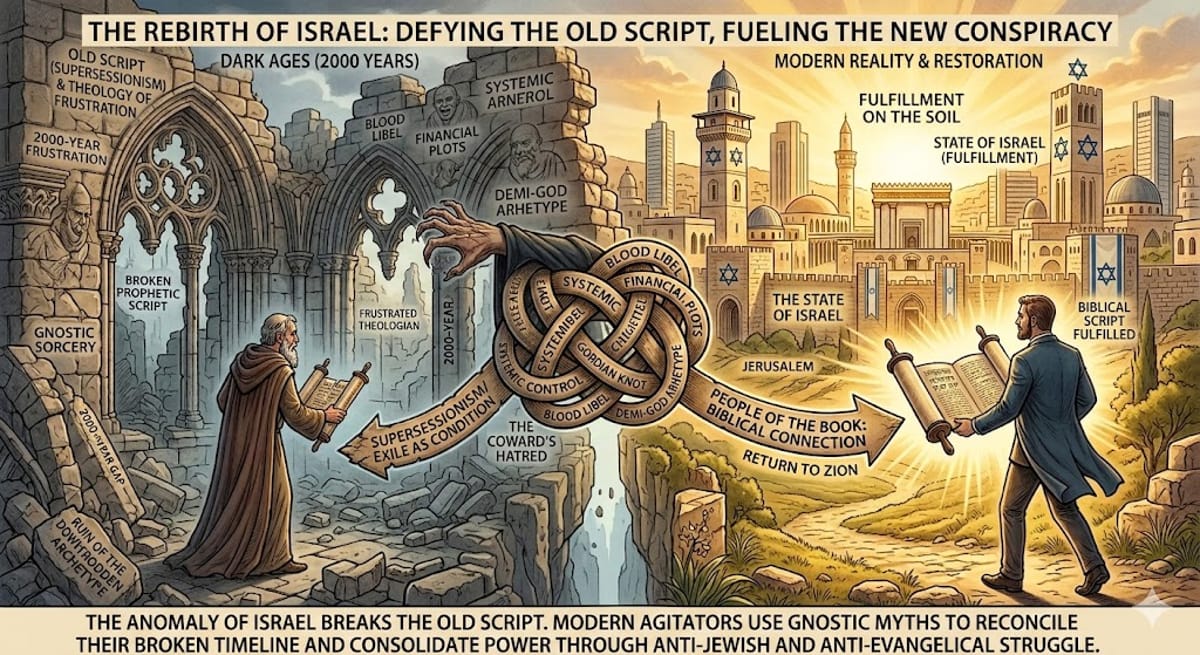
Within Christian theology, today's antisemitism, unlike that of the ancient days, often stems from a profound level of frustration triggered by the rise of the State of Israel, an event that occurred before the "Third Coming" could be realized.
Thus the Jew is not only bad for what he did in the past, but also for his future redemption being realized before Jesus returns...
Yet, only those who believe that the rebirth of Israel is an inherent part of the divine prophetic process can view Zionism as a positive development. Meanwhile, those who do not see the Return to Zion as a prophetic milestone find themselves facing a challenge that is more than just a historical anomaly; it is a theological threat. For these thinkers, Jewish "downtroddenness" and exile are the necessary conditions for their own theology.
To reconcile the Jewish return with the absence of the "Third Coming," these groups resort to the antisemitic conspiracies forged during the 2,000 years between the Second and Third appearances, the era of Catholic hegemony. They project this ancient hatred onto the present to explain away the "impossible": how the Jews could have returned to their land before the final Christian redemption.
This is merged with an "aesthetic" and "morphological" caricature of the Jew. It connects archetypes to a conceptual architecture of blood libels, hygiene, victim dynamics, sin, financial plots, sexual deviance, and systemic control.
This entire "demi-god" apparatus is designed to prove that the Jews are inherently evil, to assert the Church's superiority over them, and to argue that the rise of Israel is, at the very least, a work of the devil.
Antisemitism as a Tool of Consolidation
As I have noted elsewhere, much of this antisemitic content serves a vital socio-political purpose: consolidation.
Antisemitism possesses a uniquely powerful consolidating force, perhaps more than any other form of hatred in history.
While the Catholic Church largely abandoned this tool after 1965 (Nostra Aetate), new actors, particularly in the United States, are now attempting to reclaim it, recognizing that antisemitism remains a superb political weapon. What we are witnessing today is a convergence: an anti-Jewish struggle that is simultaneously an anti-Evangelical or anti-Protestant struggle.
Protestantism, and to a greater extent Catholicism, have reached a point where their debate over Israel serves as a proxy for their own identity crises. Instead of returning to necessary questions regarding the Jewish roots of Jesus and the fact that his successors often distorted his original message, they use Israel as a shield.
Ultimately, this exposure reveals a singular truth: the only point of objective "truth" within the Christian faith is the biblical connection it maintains with Judaism.
This is why, on a theological level, Protestants are generally closer to us.
Their proximity to the "Book" naturally leads to an alliance with the "People of the Book."
The closer one stays to the text, the harder it is to deny the reality of the Jewish restoration.