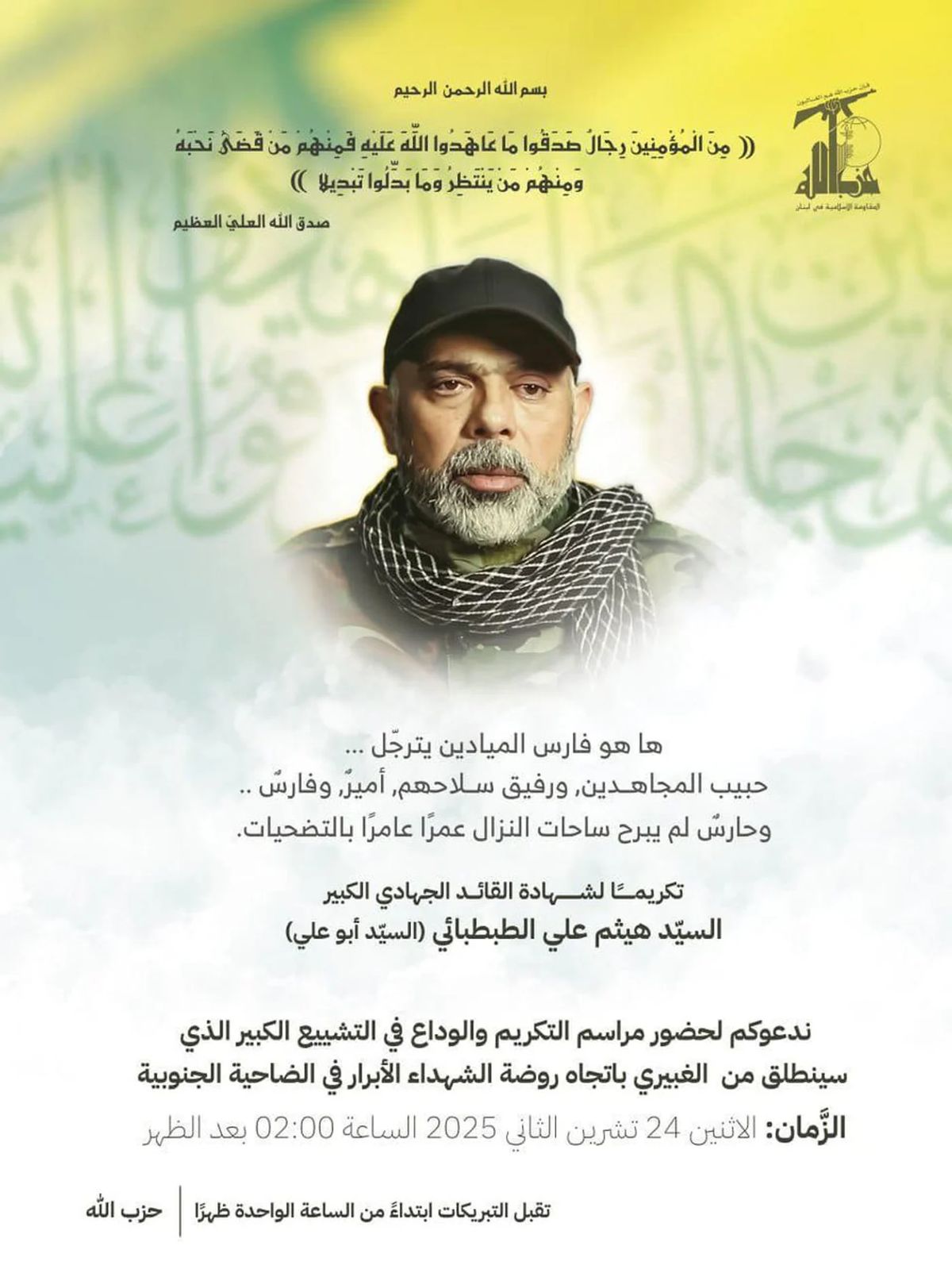
Hezbollah Secretary-General Naim Qassem on Friday delivered his first public remarks since the dramatic assassination of the group’s military chief, Ali Tabatabai, in a strike in Beirut’s Dahiyeh neighborhood earlier this week. Despite the group’s conspicuous silence since the killing, Qassem insisted that Hezbollah reserves the right to respond.
“The attack was blatant. It is a clear crime, and we have the right to retaliate. We will determine the timing,” Qassem said, offering no further details on how or when the group might act.
Seeking to downplay the impact of the loss on Hezbollah’s morale, he framed Tabatabai’s death as martyrdom and assured supporters that the organization would continue on its path.
He also delivered a striking message to Hezbollah members and spokespeople who frequently appear in the media: do not attempt to interpret his words.
“Repeat what I said exactly as I said it,” Qassem told them. “Let the Israeli enemy and its supporters interpret it however they choose.”
Qassem acknowledged the asymmetry between Hezbollah and Israel in military capabilities. “Of course, we are not equal to the Israeli enemy in bombs or munitions,” he said. “We do not have their intelligence or their air superiority.”
The comments come as tensions along the Israel–Lebanon border remain high, with Israel bracing for potential retaliation following the high-profile killing in the heart of Hezbollah’s stronghold.
Kan News reported,
"Israeli assessments remain cautious regarding the possibility of any renewed conflict in Lebanon. Officials say that, whether desired or not, Israel may be approaching either a confrontation or a more significant escalation in the northern border region. The concern is compounded by both Israeli and American criticism of the Lebanese army’s current operations.
Despite commitments from Lebanon’s government that Hezbollah will not operate in southern Lebanon, as outlined in previous agreements, officials do not expect full compliance until the end of the year.
Next week, Morgan Ortagus, the U.S. envoy who has focused on the Lebanese issue in recent months under the Trump administration, is expected in Lebanon to advance more effective measures. Recent reports from the new U.S. ambassador in Beirut indicate that while the Lebanese army has expanded its deployment and increased visible operations against Hezbollah, including embedding journalists to showcase its actions, these measures remain insufficient or largely symbolic.
An Israeli official noted that the Lebanese army is reluctant to confront Hezbollah directly. “Every time Hezbollah crosses a line, Israel will respond,” the official said, highlighting the delicate balance along the northern border."