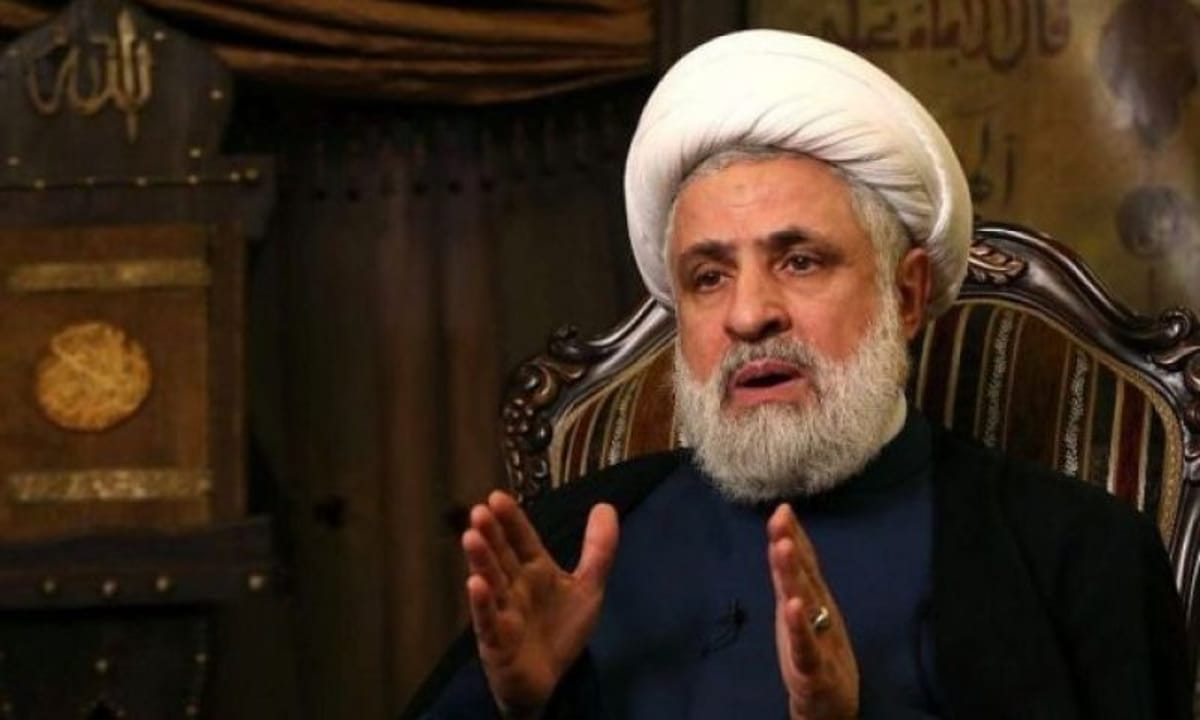
Hours after Israel and Lebanon announced a US-brokered ceasefire agreement Wednesday, Hezbollah Secretary-General Naim Qassem publicly rejected it, calling the terms "surrender and defeat" and vowing that his organization would not halt its attacks or withdraw from southern Lebanon under the current conditions.
Qassem's rejection lands like a thunderclap over a deal that was already fragile on the ground, with IDF strikes and Hezbollah fire both continuing in the hours following the announcement.
What Qassem Said
In a televised address, Qassem laid out his objections in unambiguous terms. The proposed ceasefire, he argued, demands that Hezbollah halt attacks and pull back from southern Lebanon while Israeli military operations continue, an arrangement he dismissed as one-sided capitulation. Any agreement, he insisted, must apply to all of Lebanon simultaneously, require a full Israeli withdrawal, and constitute a complete end to what he called Israeli aggression.
"As long as the occupation exists, the resistance will continue," Qassem said, adding that Iran is working to secure a comprehensive ceasefire across Lebanon as part of the broader negotiations to end the regional conflict.
Qassem also criticized the Lebanese authorities for rushing into what he called a "gratuitous and humiliating concession," one that was unnecessary and amounted to "submission without any return whatsoever." He warned that the Lebanese government's conduct "will serve neither Lebanon nor themselves."
Why This Matters
Qassem's rejection cuts to the heart of the deal's central weakness: it was not immediately clear whether Hezbollah would accept the terms agreed to by the Israeli and Lebanese governments. The ceasefire is conditioned on Hezbollah halting attacks and withdrawing its operatives south of the Litani River, but Hezbollah was not a signatory and has never recognized the Lebanese government's authority to make such commitments on its behalf.
Qassem has previously rejected direct negotiations as "null and void," issuing non-negotiable demands and accusing the Lebanese government of making free concessions to Israel and the United States. His posture has been consistent throughout the conflict: Hezbollah will negotiate on its own terms or not at all.
This creates an immediate problem for the deal's architects in Washington. The agreement, brokered after four rounds of talks convened by the US, commits Lebanon to ensuring only official military and security forces carry arms on its territory, and establishes "pilot security zones" where the Lebanese Armed Forces take exclusive control. Both measures are directly aimed at Hezbollah — without naming it. But if Hezbollah does not comply, neither Lebanon nor the Lebanese Armed Forces has demonstrated the capacity or political will to force it to do so.
The Pattern Holds
Qassem's position is not new. He has previously said that Israel "clearly states that the goal of these negotiations is to disarm Hezbollah," and asked rhetorically: "So, how can you go to negotiations whose objective is already clear? We will not rest, stop, or surrender."
The formula is familiar: Hezbollah rejects the terms, fires continue, international mediators scramble to paper over the gap, and the Lebanese government, caught between Washington and the armed militia embedded in its own institutions, finds itself unable to deliver what it has signed.
Israeli Ambassador to the US Yechiel Leiter said Wednesday that "there is no place in Lebanon that will be immune from an Israeli response if Hezbollah violates the ceasefire." The IDF has not announced any halt to operations. Division 36 remains on the Beaufort Ridge.
Political and security talks between Israel and Lebanon are scheduled to resume the week of June 22. Whether there is anything left to talk about by then depends largely on whether Hezbollah's rejection hardens — or whether Iranian pressure, as part of the broader nuclear negotiations with Washington, quietly brings Qassem back toward compliance.
For now, Hezbollah has said no. And it has said no before.