Smotrich's Dairy Reform
Crying Over Spilt Milk: Dairy Farmers Protest over Proposed Reform | WATCH
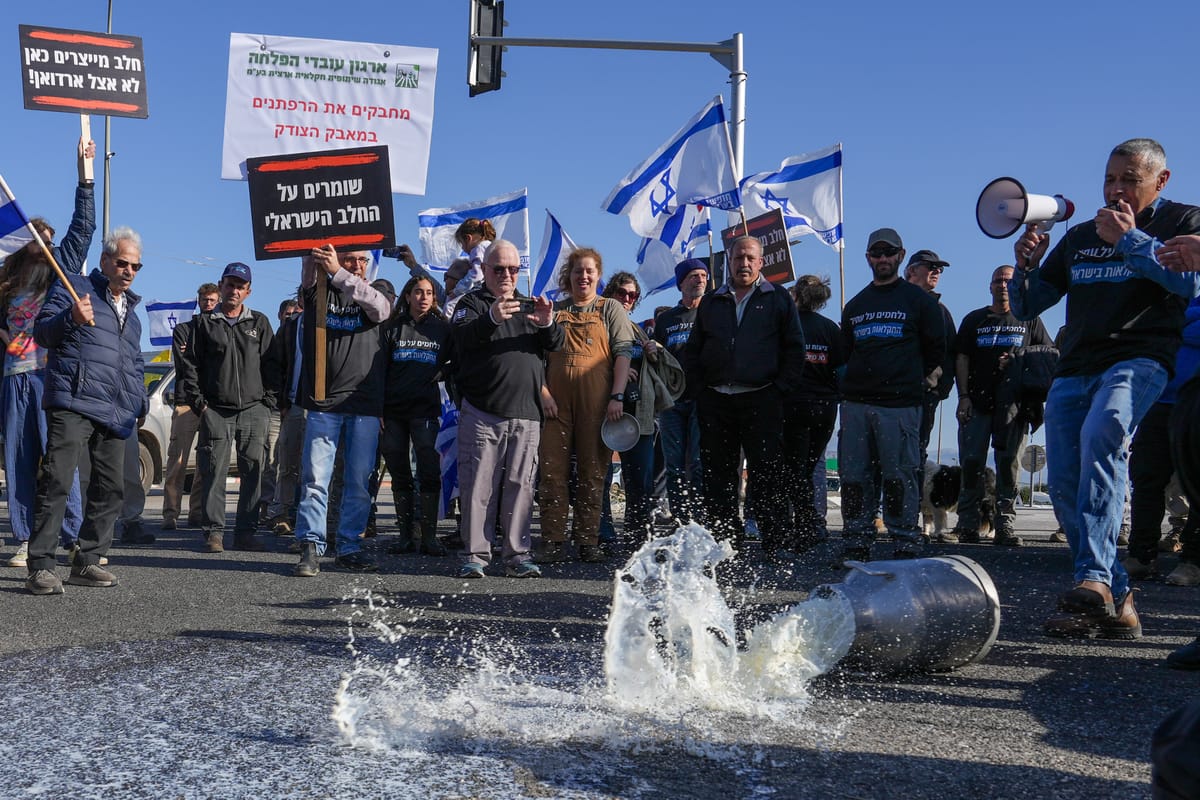
Hundreds of dairy farmers and agricultural workers blocked major intersections across Israel on Monday morning in a coordinated protest against the milk market reform. Demonstrators shut down traffic at roughly ten junctions nationwide. In several locations protesters poured milk onto the roads, and even scattered hay and manure.

Hundreds of dairy farmers blocked major intersections across Israel on Monday morning to protest the Finance Ministry’s milk market reform, spilling milk onto highways even as families across the country continue to struggle with empty shelves and purchase limits on basic dairy products. Tractor convoys shut down traffic at key junctions from the Galilee to the Negev, including Megiddo, Bilu, Goma and Gilat, in a demonstration meant to dramatize opposition to expanded imports that the government says are necessary to end chronic shortages.
The reform, promoted by Finance Minister Bezalel Smotrich and slated to advance through the Arrangements Law, would significantly increase milk imports while reducing protections for domestic producers. The government argues the move is unavoidable after repeated supply disruptions over the past year left supermarkets rationing milk and parents searching multiple stores for regulated cartons. Officials say imports are the fastest way to stabilize supply and prevent future shortages, particularly during wartime and labor crises.
Against that backdrop, images of milk poured onto roadways struck a nerve. While protesters framed the act as a symbol of resistance to what they see as the dismantling of Israeli agriculture, critics pointed out the disconnect between farmers destroying usable milk and consumers unable to reliably buy it.

Farmer organizations warn that the reform could lead to the closure of roughly 400 small and medium-sized dairies, primarily in border and peripheral regions, and increase dependence on foreign suppliers. They argue that imports may temporarily fill shelves but would hollow out domestic production, leaving Israel vulnerable in future emergencies. Protest leaders described the reform as a false solution that sacrifices long-term food security for short-term relief.
The government, however, maintains that the current system has already failed. Despite emergency measures and limited imports, milk shortages have persisted for months, with uneven distribution and repeated supply gaps. Finance Ministry officials say the protests themselves highlight the imbalance: milk exists, but the system cannot deliver it efficiently or at scale under current regulations.
By midday, traffic disruptions were gradually cleared, but the political clash remained unresolved. The protests exposed a widening gap between agricultural producers fighting to preserve an existing model and a public increasingly frustrated by shortages of a basic staple. As the reform moves forward, the central question is no longer abstract economics but something far simpler: whether Israel can afford to keep milk off store shelves while it is being poured onto its roads.