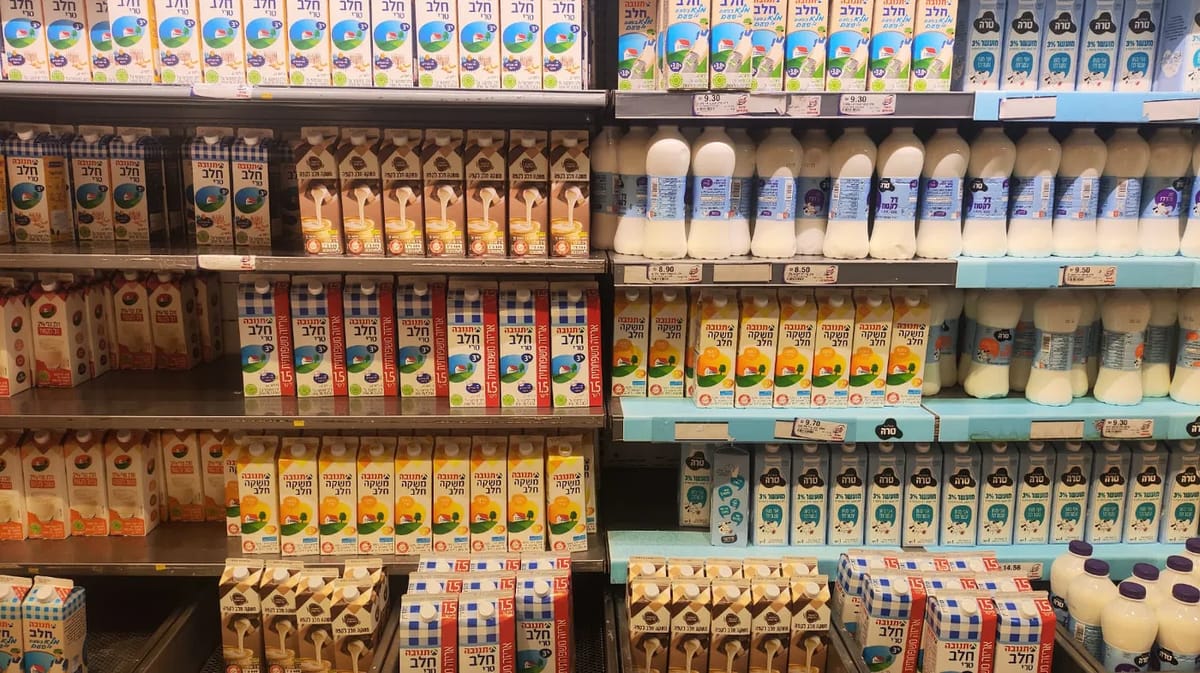
Dairy farmers across Israel walked away from their supply lines Tuesday morning, cutting off milk deliveries to the nation's supermarket chains in a dramatic escalation of a dispute over a sweeping government reform that threatens to reshape the country's agricultural sector.
The immediate impact was stark. Shelves stripped of milk products appeared across multiple retail locations, and several chains moved to impose a two-unit purchase limit per customer to manage dwindling inventory. The disruption arrived without a buffer, industry insiders say farmers entered the crisis with no stockpile reserves.
At the center of the standoff is a provision in the 2026 budget bill championed by Finance Minister Bezalel Smotrich that would eliminate production quotas and open Israel's dairy market to greater competition. The government has framed the move as a way to bring down consumer prices. Farmers see it differently, as a death sentence for smaller operations.
"We are holding Israeli citizens hostage," said Israel Tuti, chairman of the Israel Milk Producers Association, in a sharp rebuke, a line that drew an equally sharp response from Smotrich, who turned the accusation back on the industry. "Israeli citizens will not be the hostages of monopolies and pressure groups that threaten every time, for one reason or another, that there will be no milk on the shelves," he wrote in a statement.
Smotrich went further, calling the crisis a perfect illustration of why reform is needed. "As long as the dairy industry operates like a communist economy, threats like these sound 'serious.' In real competition, they would be a joke," he said.
The dispute is already spilling beyond grocery aisles. A large protest is planned for tomorrow (Wednesday) near the Latrun interchange, with demonstrators expected to march toward Jerusalem, a move that could cause major traffic jams on major highways and put additional pressure on the government to negotiate.
Inside the Knesset, the fight has fractured along unexpected lines. The Knesset's legal adviser has called for the dairy reform to be separated from the broader budget reconciliation bill, citing its complexity. Prime Minister Benjamin Netanyahu has directed officials to seek a compromise, but none has materialized. More notably, resistance has emerged within Netanyahu's own Likud party. MK Avi Dychter declared publicly that the reform "will not pass," vowing that he and his colleagues would push to remove it from the budget bill and subject it to a proper professional review. MK Milbatsky also joined the opposition, calling it plainly "a bad reform."
The crisis is drawing comparisons to the agricultural protests that swept France in recent years, where farmers blocked highways in protest over government policy. In both cases, the farmers argue they are fighting for their survival and their ability to continue feeding their families from the land.
For now, the public remains caught in the middle, between an industry demanding protection and a government promising cheaper prices. The question is whether a compromise can be reached before the shelves stay empty for good.