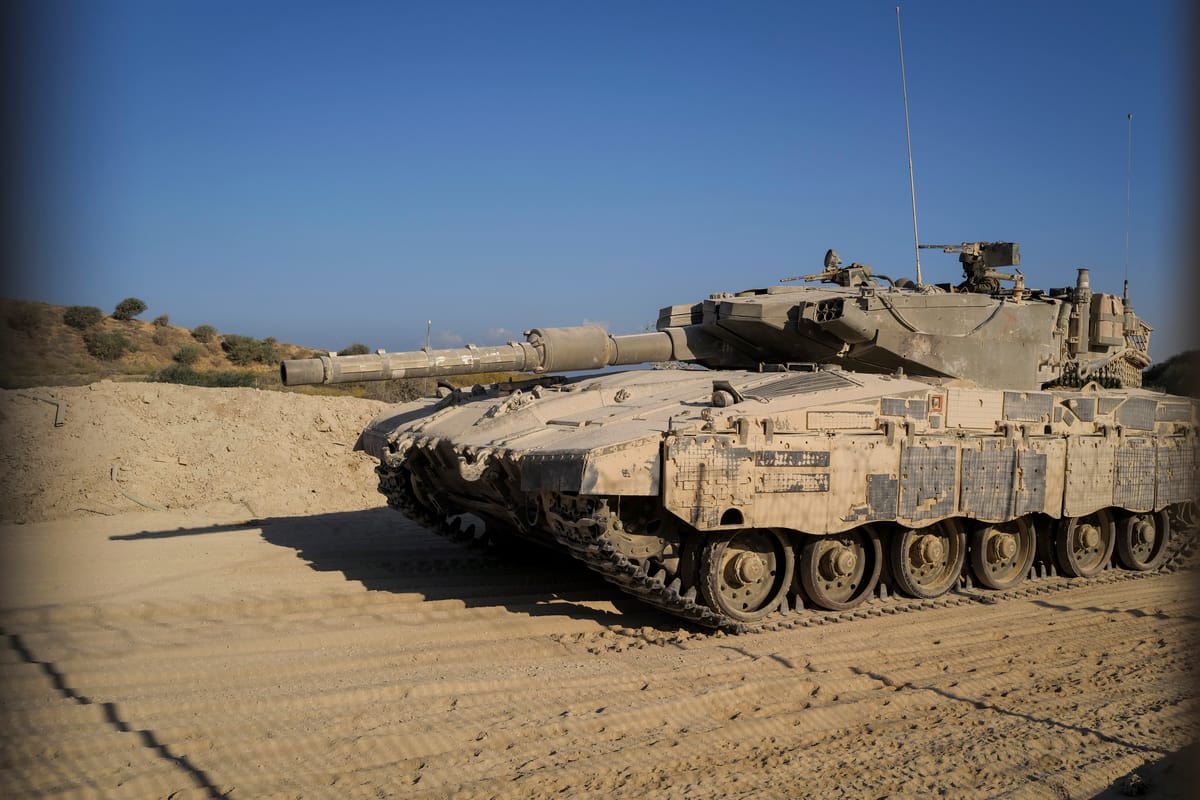
For over 15 years, Israel has led a global revolution in armored warfare. While most tanks rely on thick steel to survive a hit, the IDF relies on active protection, destroying the missile before it even touches the hull.
The primary system, known as Trophy (developed by Rafael Advanced Defense Systems), is mounted on Merkava tanks, Namer armored personnel carriers, and other vehicles. It uses advanced radars to detect incoming ATGMs, RPGs, or rockets within milliseconds, then fires small kinetic projectiles, essentially explosive shotgun-like blasts, to destroy or deflect the threat before it can strike the vehicle. The system provides 360-degree side and rear protection and has been specifically upgraded in 2024–2025 to handle top-attack munitions, including drones and missiles that dive from above.
In real-world combat, Trophy has logged over 2 million operational hours and recorded hundreds of confirmed interceptions, including Iranian-made Kornet ATGMs, RPG-29s, and drone-dropped munitions. The Israel Defense Forces report an interception success rate of approximately 85–90 percent during the 2023–2025 Gaza and Lebanon operations. Earlier campaigns in Gaza saw thousands of ATGM attacks result in zero confirmed total losses of Trophy-equipped tanks.
A parallel system, Iron Fist (developed by Elbit Systems), is being integrated on lighter vehicles and adds enhanced anti-drone capabilities. Israel is also deploying laser-based defenses such as Iron Beam and Or Eitan, which can neutralize ATGMs, drones, and rockets at low cost using directed energy, systems already proven in recent combat.
So why are anti-tank missiles killing our soldiers?
Experts point to several tactical and technical factors: adversaries often employ saturation attacks, firing multiple missiles simultaneously or in rapid succession to overwhelm the system’s capacity. Newer threats include top-attack ATGMs (such as the Iranian Almas) and cheap FPV drones that approach from steep overhead angles. Engagements at very close range, under 50 meters, can occur before the system fully reacts, particularly in urban or forested ambush settings. Not every vehicle is equipped with the system at all times, and it cannot always be activated near friendly infantry due to the explosive nature of its interceptors.
Hezbollah and similar groups have adapted by using tandem-warhead ATGMs designed to defeat both reactive armor and active protection systems, often combining them with drone strikes. Recent fighting in Lebanon (2024–2025) saw higher reported tank losses precisely because of these saturation and top-attack tactics. Even so, Trophy has dramatically reduced casualties and vehicle losses compared to earlier conflicts where we didn't have these kind of defenses.
In short, Israel did create world-leading counters, Trophy is literally being bought by NATO countries now because it works so well. But no defense is 100% perfect in real war. Adversaries evolve (cheap drones and massed cheap ATGMs), so Israel keeps upgrading (lasers, AI, better sensors). It’s the classic cat-and-mouse of modern warfare: the defender stays one step ahead, but never fully untouchable. That’s why they invest billions in these systems and why Merkava tanks are still some of the safest in the world for their crews.