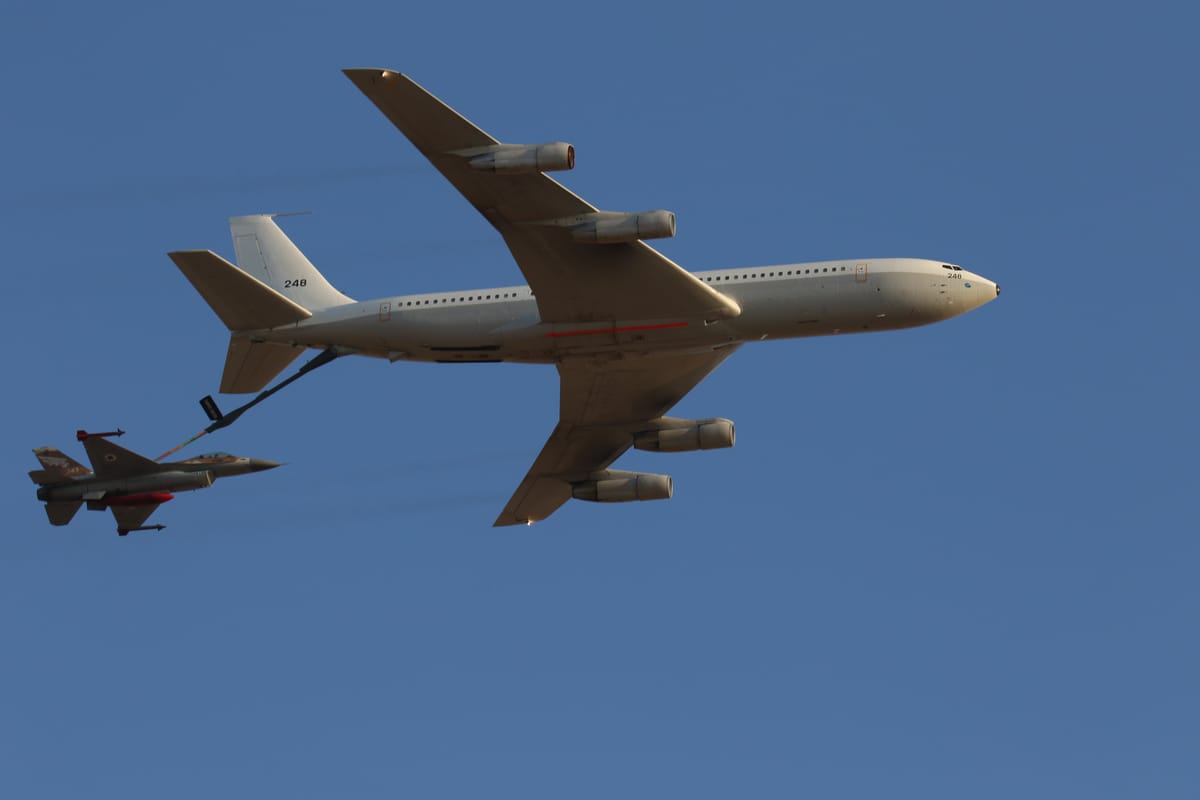
In a stark demonstration of Israel's evolving dominance over the skies of the Middle East, an Israeli Air Force (IAF) aerial refueling aircraft was publicly tracked operating deep inside Syrian airspace.
The Boeing 707 Re’em tanker, bearing tail number 264, transmitted an unencrypted squawk code of 4512 as it cruised visibly over eastern Syria near the border with Iraq. Flight tracking data from aviation enthusiasts and open-source intelligence monitors captured the jet's path in real time, with no apparent efforts to mask its identity or trajectory. The aircraft, a veteran of Israel's long-range strike capabilities, was observed loitering at altitudes typical for in-flight refueling operations, likely supporting fighter jets on extended patrols.
This overt incursion marks a profound departure from the shadows of secrecy that once defined Israeli operations in Syrian territory. Just a few years ago, such a flight would have triggered immediate Syrian air defenses, risking escalation with Damascus's Russian-backed forces or even direct confrontation with Iranian proxies. The skies over Syria were a no-man's-land of electronic warfare, where Israeli jets hugged terrain and jammed radars to evade detection during precision strikes on Hezbollah arms convoys or Iranian entrenchments.
But the landscape has changed irreversibly. The fall of Bashar al-Assad's regime in late 2024, followed by the fragmentation of Syrian military cohesion and the withdrawal of key Russian assets amid Moscow's quagmire in Ukraine, has left the country's airspace as porous as it is precarious. Israel's subsequent normalization pacts with Arab states, coupled with targeted operations that have decimated Iran's "Axis of Resistance," have further tilted the balance. No longer must the IAF operate as an uninvited guest; today, it moves as a de facto sovereign.
Syria's air defenses are a shell of their former selves, and with Iran's supply lines severed, the regime in Tehran watches helplessly as its strategic depth evaporates. Israel's reach now extends unchallenged from the Golan to the Euphrates."
The implications ripple far beyond the tactical. For Iran, whose influence once radiated through Syria as a vital corridor for arming militants in Lebanon and beyond, this openness signals a closing window. Tehran's ability to project power, via precision-guided missiles or drone swarms, relies on safe havens in Syrian territory.
With IAF tankers refueling openly, Israeli F-35s and F-15s can now sustain indefinite loiter times, turning potential threats into neutralized opportunities.
Syrian interim authorities, still grappling with post-Assad chaos, issued no official response to the flight, though unconfirmed reports suggest quiet coordination with Jerusalem to avoid friction.
In a region long defined by hidden wars, Israel's open skies over Syria herald not just military might, but a new chapter of unapologetic deterrence. For the IAF, the message is clear: the arena is ours.