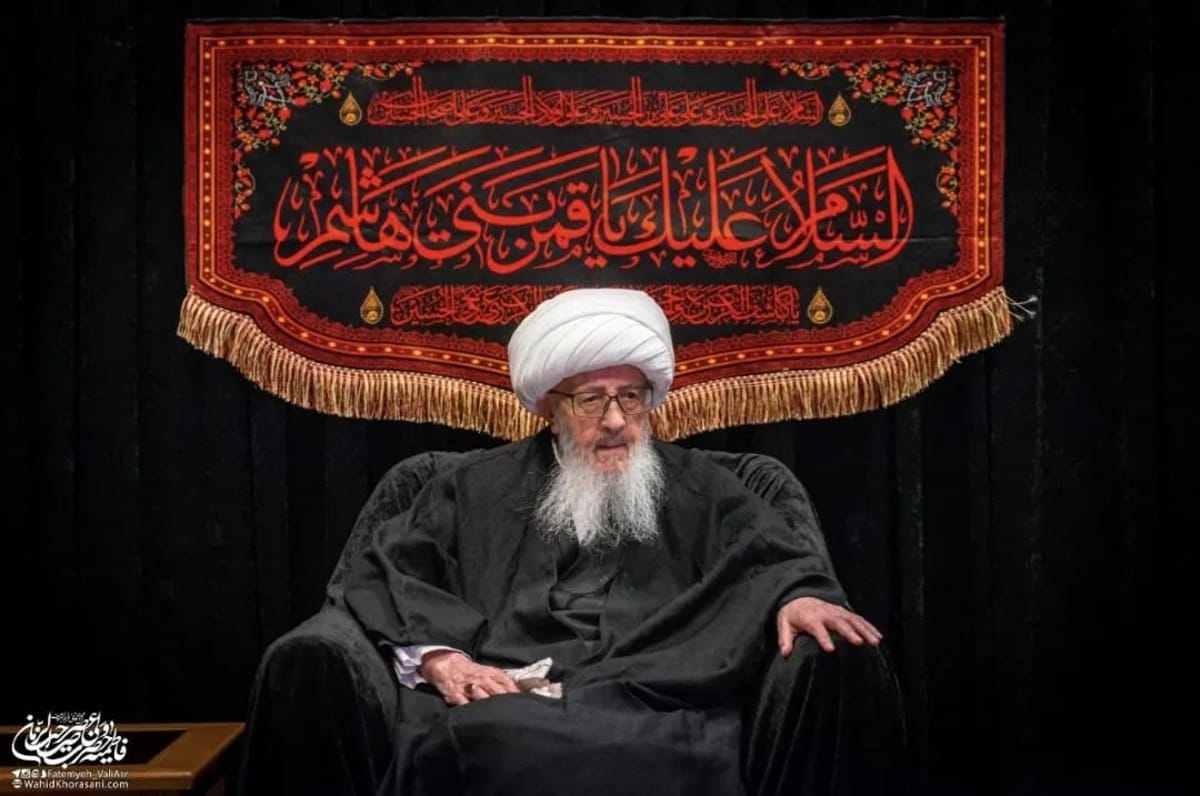
As protests rage across Iran with thousands of opponents reportedly killed in a brutal crackdown, questions arise about potential alternatives to the current regime. One figure emerging as a possible moderate religious option is Ayatollah Hossein Vahid Khorasani, a 105-year-old prominent Shiite scholar in Qom who criticizes Supreme Leader Ali Khamenei and opposes clerics holding political power.
Khorasani, born in 1921 in Nishapur, Khorasan, represents a traditional, conservative, and quietist approach to Shiism, hostile to philosophy and mysticism. He advocates for a focus on Sharia, popular veneration of Fatima and the Imams, and rejects the revolutionary doctrine that turns religious scholars into rulers.
In 1949, Khorasani left Shah-era Iran to study in Najaf, Iraq, under Ayatollah al-Khoei, alongside Ali Sistani, a leading Shiite authority. He returned to Iran in 1972, building a following among professional clerics in Qom, where his lectures draw 2,000 to 3,000 students.Unlike Ayatollah Khomeini, who emphasized political activism, Khorasani concentrates on Sharia study and dismisses politics.
He critiques Khomeini's "Wilayat al-Faqih" (Guardianship of the Jurist), arguing clerics should aid actual orphans through legal rulings, not symbolic ones via force. Their role is to guard the community through heartfelt sermons on the Imams' suffering, spiritual guidance, and advice, not governance.
"The essence of Islam is not politics, but Islam," Khorasani's views emphasize, yearning for the Imams and Fatima al-Zahra, the saint of Qom. He leads mass mourning rituals for Fatima's death, cursing the Sunni-revered caliphs who allegedly mistreated her and the Prophet's heirs, a stance that undermines the regime's claims to unify Muslims.
Khorasani employs traditional rhetoric with pure Quranic Arabic terms, contrasting Khamenei's use of Latin-derived "isms." He openly despises Khamenei, once mocking how "some people toss a coin and become an Ayatollah, toss another and become a Grand Ayatollah, and now they toss a coin and want to become the supreme model for emulation." (Khamenei, seen as a mediocre jurist, assumed high titles unjustly.)
Khorasani has refused meetings with Khamenei during Qom visits, though some occurred and were publicized by state media to downplay divisions. The regime claims Khorasani supports obedience to authority to avoid anarchy and clerical guardianship in Sharia matters. In 2009, Khamenei appointed Khorasani's son-in-law, Sadeq Larijani, as head of the judiciary, a move seen as an embrace. Rumors persist that Khorasani demanded Larijani refuse; after acceptance, Khorasani criticized him sharply on issues like Sharia violations and protester suppression.
Despite his extreme conservatism, Khorasani supports reformist jurists and politicians, including Khomeini's descendants in the reform camp. He argues against suppressing legitimate opinions, aiding power decentralization. Critics note he did not explicitly back protesters in past unrest.Khorasani's family holds significant influence in Iran, with discussions of a successor to continue his halakhic, conservative, quiet, and oppositional path.
Historical Roots: Najaf vs. Qom
Khorasani is not a Western-style reformer but embodies a model where the state could be democratic or national while Iranians return to mosques.
Post-regime, his approach might bridge religious traditionalists to a new secular government without betraying faith.This stems from 19th-century Shiite splits: Traditional "quietism" held that pre-Mahdi political rule is illegitimate, so clerics avoid politics and focus on community guidance.
Khomeini's 1979 revolution inverted this, challenging Najaf's separation of religion and state.As al-Khoei's disciple, Khorasani upholds this "original tradition." Mixing politics with religion is not just strategic error but desecration, eroding clerics' public standing. In his book "Principles of Faith," faith is a moral compass granting inner peace and freedom from worldly fears, restraining one's ego for harmonious society via "philosophy of reconciliation," not violent enforcement. He distinguishes political "rule of the jurist" from infallible Imamate.
He models Imam Ali as living modestly, prioritizing justice over personal gain.This tension echoes Iran's 1906 Constitutional Revolution, where liberal and conservative clerics debated the state's form. Khorasani links to eras when the religious establishment critiqued the state externally, not ruling it. Khorasani exemplifies dominant voices among Qom's clerics, many distancing from the regime for varied reasons, continuing ancient Shiite debate culture.