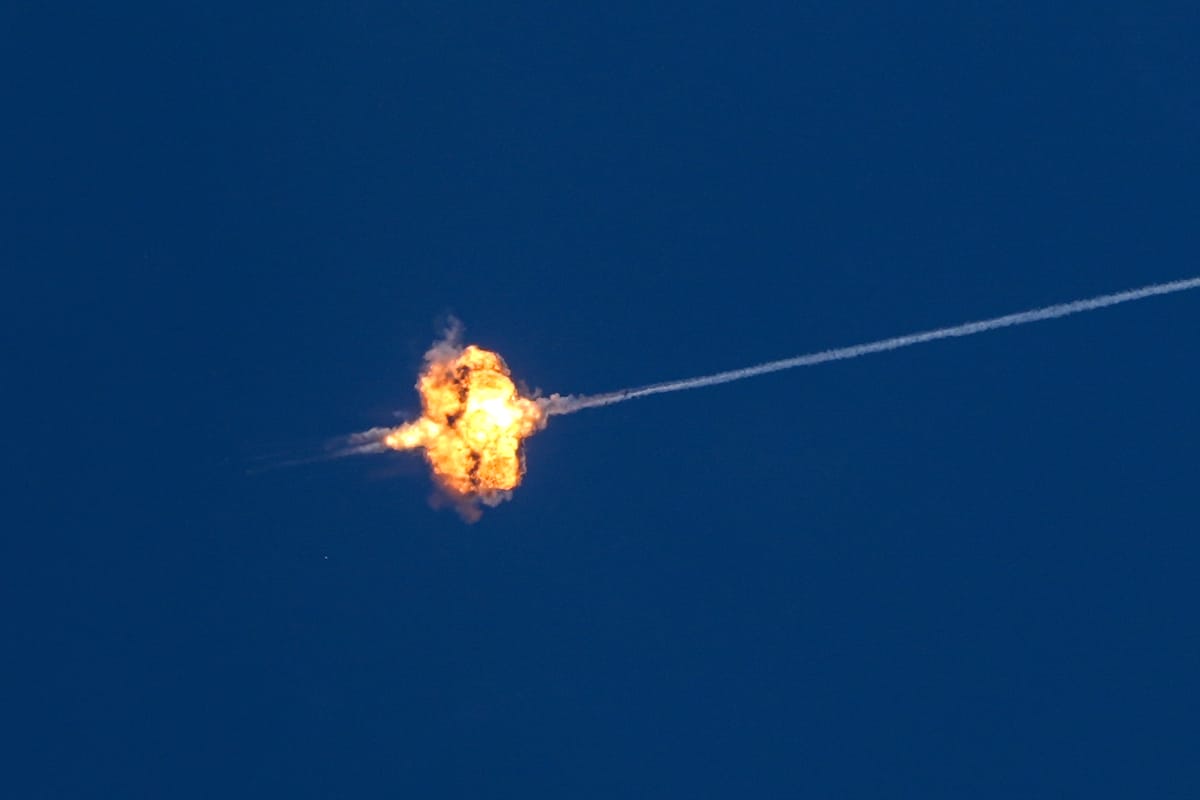
Iran launched seven ballistic missiles at American military installations in Kuwait and Bahrain on Friday night, hours after U.S. Central Command shot down four Iranian attack drones over the Strait of Hormuz and struck Iranian surveillance radar sites on Qeshm Island, in the sharpest overnight exchange between the two sides in days.
The flare-up ended what had been a 24-hour pause in direct U.S.-Iran hostilities. It was, by any measure, a bad night for the ceasefire.
CENTCOM said its forces shot down four Iranian one-way attack drones launched toward the Strait of Hormuz, assessing that the drones posed an immediate threat to regional maritime traffic. U.S. forces then struck Iranian coastal surveillance radar sites in Goruk and on Qeshm Island to defend against further maritime attacks.
Iran's response came within hours. Six of the seven missiles were intercepted, while a seventh failed to reach its intended target. CENTCOM reported no injuries among U.S. personnel and flatly rejected Iranian claims that the headquarters of the U.S. Fifth Fleet in Bahrain had been damaged, calling those assertions false.
Air raid sirens sounded across Bahrain. Kuwait activated air defenses. For residents of both countries, it was a grim and familiar sound.
Iran's Justification, and Its Warning
Tehran did not dispute firing the missiles. Iran's IRGC said the strikes against "enemy bases" were in response to U.S. action against the Iranian city of Sirik and Qeshm Island, and warned that its enemies face a "complete closure" of the Strait of Hormuz if attacks continue.
The IRGC also claimed it fired on four tankers attempting to cross the Strait of Hormuz without Iranian authorization. If confirmed, it would mark a direct escalation against commercial shipping, the very flashpoint that has made the Strait the most consequential geographic chokepoint in the war.
The Strait remains effectively closed to nearly all commercial traffic since the conflict began in late February, with both the U.S. counter-blockade and Iran's restrictions keeping global energy markets on edge. Roughly 20 percent of the world's oil supply passes through the narrow waterway.
A Pattern of Escalation
Friday's exchange was not an isolated incident. It was the second Iranian strike wave against Gulf states since June 3, when Iranian drones and missiles struck Kuwait, killing one person, injuring 63 others, heavily damaging a passenger terminal at Kuwait International Airport, and briefly closing the airfield.
Qeshm Island, in particular, sits close to the shipping lanes and has served as a forward base for Iranian surveillance and drone operations. Each round of strikes raises fears that the ceasefire could collapse entirely.
The Diplomatic Backdrop
All of this is happening while U.S.-Iran nuclear negotiations remain technically alive. As recently as Friday, the IAEA's Rafael Grossi signaled that the U.S. and Iran appeared close to agreeing on a nuclear framework. President Trump told ABC News just days ago that he believed a deal was close, describing the situation as "looking good."
Reopening the Strait of Hormuz is widely seen as the central issue in the talks. President Trump had said the pause on U.S. strikes was conditioned on the "complete, immediate, and safe opening" of the Strait, while Iran has described the U.S. counter-blockade as a potential "prelude to a violation of the ceasefire." Neither side has removed its blockade.
CENTCOM said its forces "remain vigilant and postured to continue responding to unwarranted Iranian aggression in self-defense."