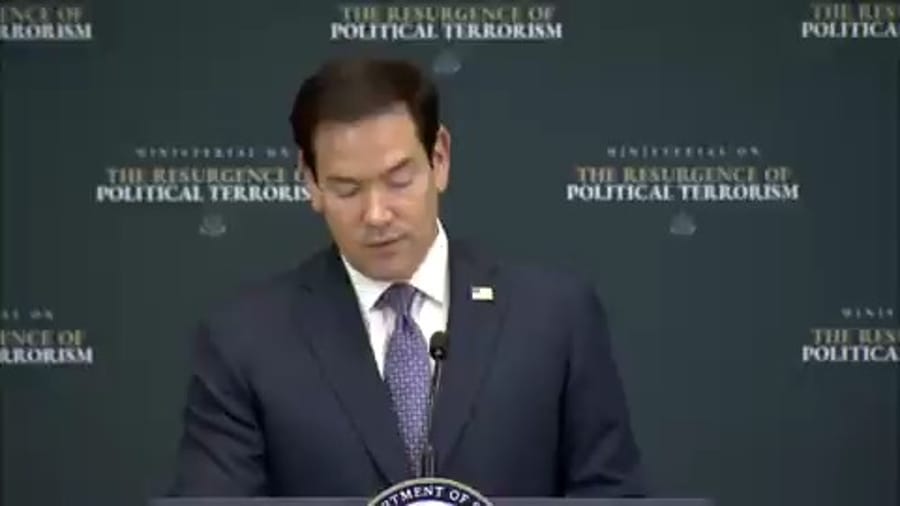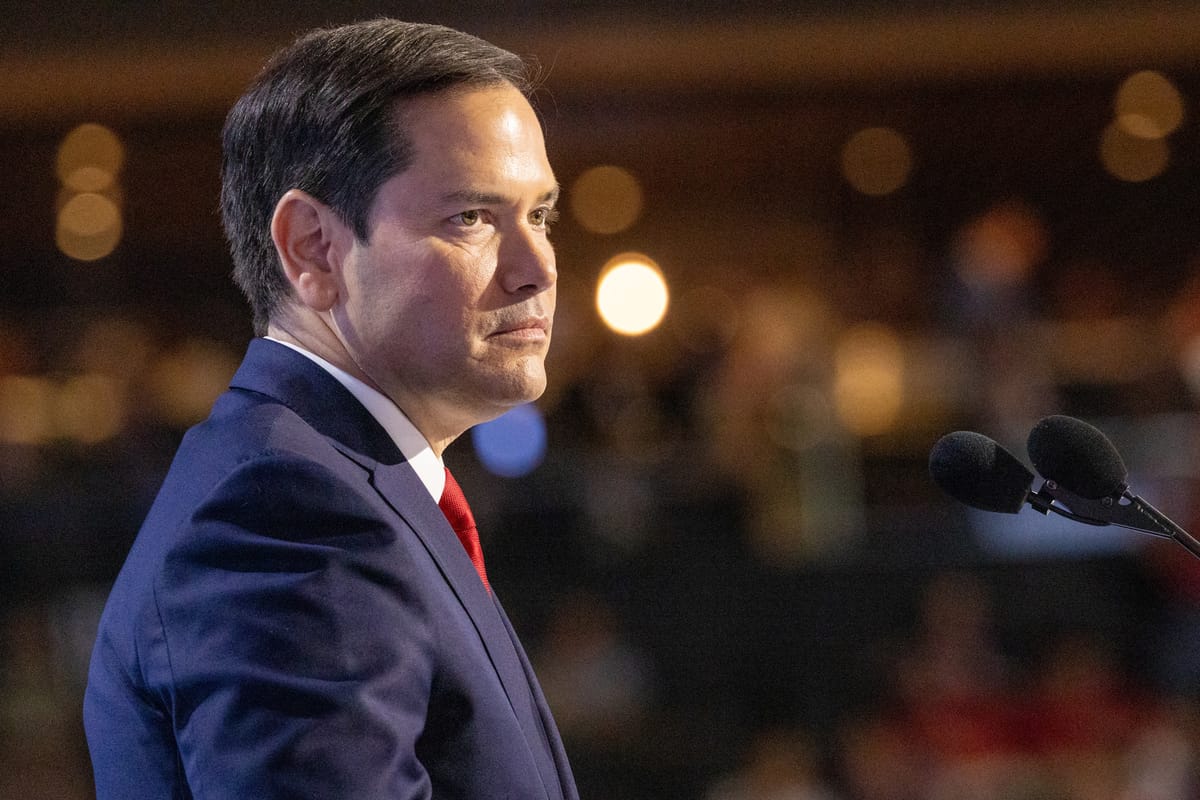
Secretary of State Marco Rubio delivered a searing indictment of what he called far-left political terrorism on Thursday, telling representatives from 67 countries gathered at the State Department that radical leftist violence stems not from political conviction but from a deep resentment of achievement and civilization itself.
Rubio's remarks came at the opening of the "Ministerial on the Resurgence of Political Terrorism," a summit convened to build what officials described as international infrastructure for combating far-left extremist networks. He was joined by Treasury Secretary Scott Bessent, White House Deputy Chief of Staff Stephen Miller, and Deputy Secretary of State Christopher Landau.
Rubio told the assembled diplomats that this is "a distinctive and unique evil," always driven by "a hatred for civilization itself," which he characterized as "a revolt of the worst against the best, a revolt of the weak and the cowardly against the strong and the good."
The secretary argued that this character remains constant regardless of the label attached to it. He noted that adherents may call themselves anti-capitalists, anti-imperialists, communists, anarchists, or Marxists, but insisted the underlying impulse never changes: a resentment cloaked in the language of equality and justice that seeks to tear down what others have built.
Rubio directly challenged a common defense of communism, that it fails only in practice despite sound theoretical foundations. He rejected that framing outright, describing the ideology's vision as one stripped of exceptionalism, ambition, heroism, and ultimately, of God.
Rubio pointed to a wave of violence he said has already materialized: attacks on immigration officers, sniper assaults, explosives, and armed ambushes. He cited a shooting at a Catholic elementary school, the killing of a healthcare executive, multiple assassination attempts against a sitting president, and the murder of a prominent conservative activist, a husband and father of two, shot while addressing a crowd of students.
Rubio also pointed to Greece, where he said more than 80 percent of radical violence today is now driven by far-left and anarchist actors, framing the phenomenon as a transnational threat rather than one confined to the United States.
The secretary argued that leftist actors position themselves as the sole arbiters of right and wrong, answerable to no legal, historical, religious, or democratic authority, acting as judge, jury, and executioner of their own cause.
Rubio also addressed critics who have historically downplayed left-wing violence, saying too many people in positions of power dismissed such acts as legitimate political expression so long as they served a left-wing cause. He framed this tendency as an outdated dogma that no longer reflects reality.
He argued that ideological prejudice has long shaped public discourse around political violence, dismissing the notion that far-left terrorism poses as serious a threat as violence from the right.
The summit doubled as a policy rollout. The Trump administration unveiled a new visa policy specifically targeting individuals linked to far-left terrorism. Separately, Bessent detailed Treasury Department investigations into radical left-wing groups and nonprofits accused of abusing tax-exempt status to fund or enable violent action against political opponents.
Rubio said additional designations of far-left groups as terrorist organizations would follow in the coming weeks, framing the act of destruction as inherently easier than the act of creation, and casting America's adversaries on the left as capable only of the former.