
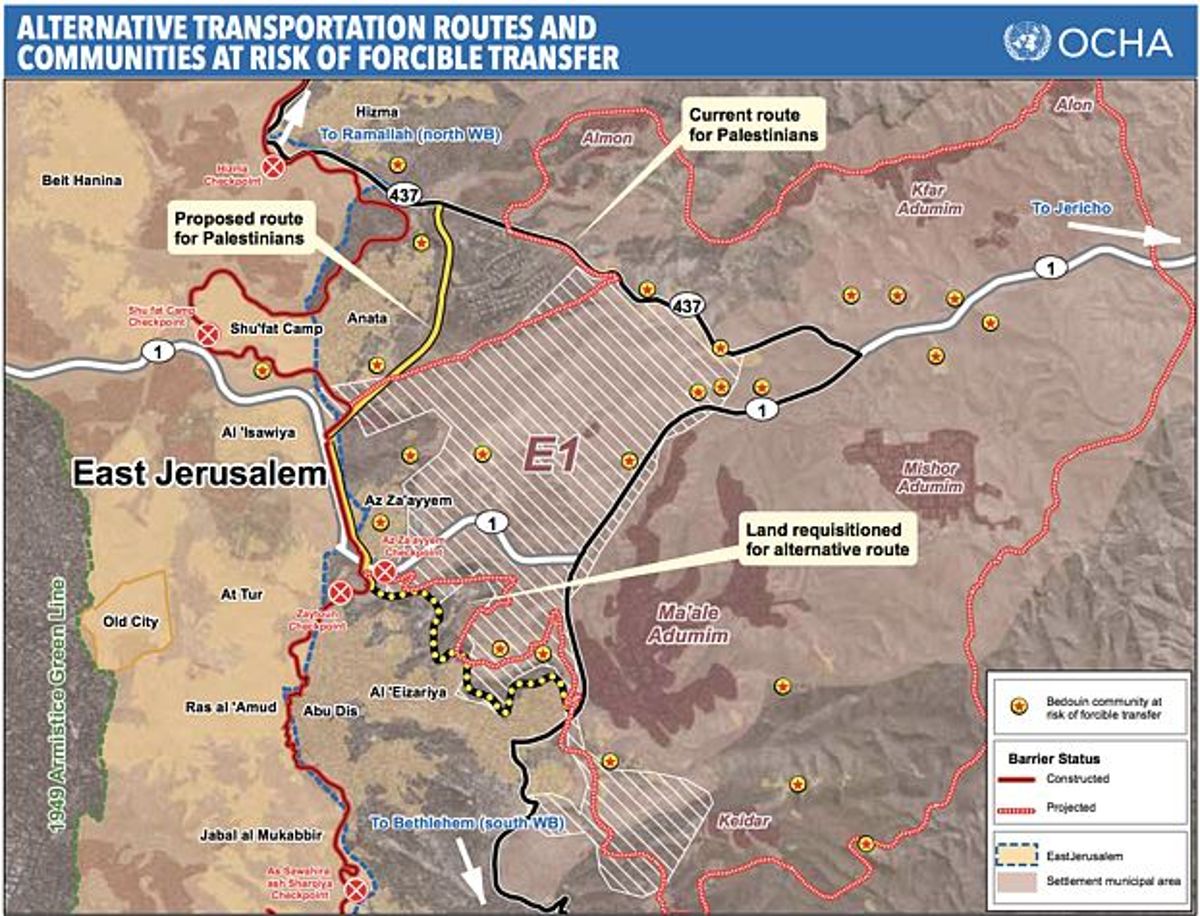
Three sources told The New York Times that Foreign Minister Gideon Sa'ar clearly hinted no E1 tenders would be issued before the October 27 election. A week later, Israel announced 1,200 additional housing units in the area.
Israel told Britain it would halt construction in the strategic E1 area, The New York Times reported over the weekend. Israel has denied the report.
According to the newspaper, British Foreign Secretary Ed Miliband spoke with Foreign Minister Gideon Sa'ar four weeks before London announced sanctions on settlements in Judea and Samaria. The report described the call as tense. Three sources said Sa'ar clearly hinted that no construction tenders would be opened for E1 before the October 27 election.
A week after the call, Israel announced the construction of an additional 1,200 housing units in E1.
Israel's public position has been that nothing new was decided. When the British measures were unveiled, Sa'ar said E1's advancement was "not a new decision," noting that formal approval was finalized in 2025 and that the tender process had been underway for months. He also rejected the claim that the project would sever Palestinian territorial contiguity, calling it baseless. Sa'ar has described the British measures as anti-Israel and called Miliband's accusations "outrageous lies."
E1 covers roughly 3,000 housing units northeast of Jerusalem, near Ma'ale Adumim. London regards the area as essential to a future Palestinian state, and Miliband told lawmakers in August that Israel's issuing of the E1 tenders crossed a red line.
Britain announced its package in the House of Commons on September 8. It bans imports of all goods produced in the settlements and bars British companies from providing services to them, including financing, construction, infrastructure, real estate and advertising. Miliband described the move as a "comprehensive reset" of British policy, said the sanctions regime targets settlements and settlement expansion rather than Israel, and announced an extension of the existing human rights regime aimed at preventing E1's development. He also announced sanctions on Hezbollah's financing arm, Al-Qard al-Hasan, and said Britain would reimpose sanctions on Iran. France and Canada said they would take similar action.
Shortly before the announcement, however, Bloomberg reported that British diplomats had privately assured Washington that the trade ban was largely symbolic and would have no material impact on Britain's wider trade and security relationship with Israel. British trade with the settlements is a small fraction of the roughly 6 billion pounds in annual trade between Britain and Israel.
Miliband, who has described himself as a proud British Jew whose grandmother found a home in Israel after the Nazis killed relatives, told the Commons that Britain's argument "is with the conduct of its government," not with the Israeli people.
Israel responded by announcing the closure of the British consulate in Jerusalem, and removed British officials from the International Gaza Support Center in Kiryat Gat. Britain said that step undermined implementation of President Donald Trump's 20-point plan for Gaza and was not a constructive response.
Washington also objected. Secretary of State Marco Rubio said, "Obviously we're not going to do what the UK did," adding that the British move had implications for progress on the Gaza plan and the Board of Peace.
British Jewish leaders had urged the government not to proceed. UK Chief Rabbi Ephraim Mirvis said the measures would be "counterproductive and even endanger such a vision of peace," warning that they risked spiraling into a de facto boycott of Israel and threatening the livelihoods of tens of thousands of Palestinian workers. The Board of Deputies of British Jews and the Jewish Leadership Council raised similar concerns about the damage to relations and the impact on British Jews.
Britain has also signaled that the timing matters. A British official said the conduct of the next Israeli government could affect the scope of the sanctions, which gives added weight to the report's claim about pre-election tenders. Relations remain strained at the top: Prime Minister Benjamin Netanyahu has not spoken with British Prime Minister Andy Burnham, despite contacts between foreign ministers.