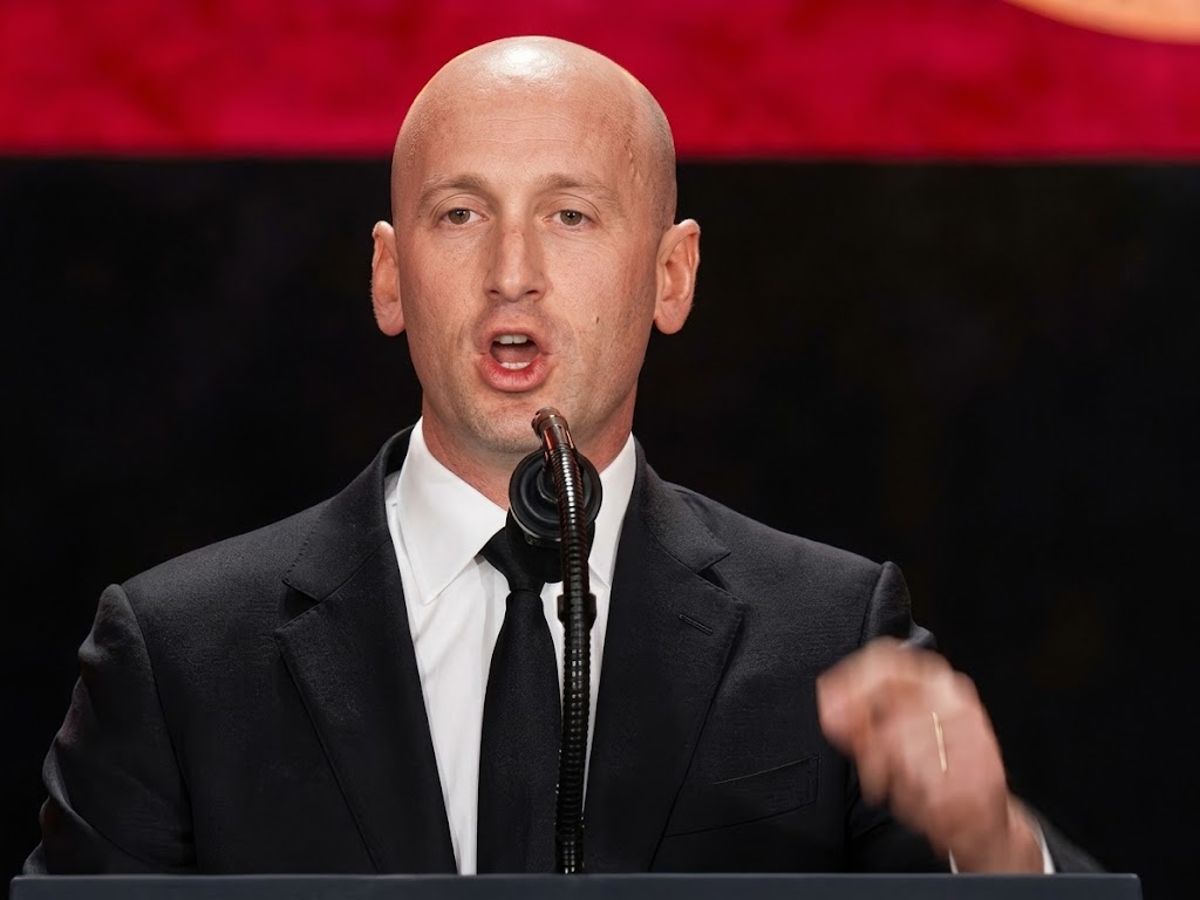
Stephen Miller’s appointment as White House chief of staff elevates one of Donald Trump’s most influential advisers to the center of his administration. Miller, 41, has served as deputy chief of staff for policy and homeland security adviser. He replaces Susie Wiles and takes up the post on November 9.
Trump announced the move on Friday, days after Republicans lost control of both houses of Congress in the midterm elections, and called Miller one of his closest and most loyal advisers. It is more than a personnel change. Miller has shaped Trump’s agenda since the 2016 campaign, and he is the aide most responsible for turning the president’s slogans into government policy.
A Jewish family that fled Europe
Miller was born in 1985 to a Jewish family in Santa Monica, California, and grew up in a politically liberal household. His father was a lawyer in the family real estate business and his mother was a social worker. His mother’s family, the Glossers, fled pogroms in Eastern Europe. His great-grandfather arrived in the United States in 1903 with eight dollars.
That history is at the heart of a public feud with his uncle, neuropsychologist David Glosser. In a 2018 Politico essay, Glosser accused his nephew of hypocrisy, arguing that if the immigration restrictions Miller champions had been in place a century ago, their family might never have found refuge in America.
Miller is married to Katie Miller, who is also Jewish and previously held communications roles in the Trump administration. The couple married in February 2020 at the Trump International Hotel in Washington, with Trump in attendance, in a ceremony officiated by Rabbi Aryeh Lightstone, then a senior adviser to U.S. Ambassador to Israel David Friedman. They have four children.
Israel and the war with Iran
Miller is regarded as one of the most hawkish voices in Trump’s inner circle on using American force against Israel’s adversaries. He publicly defended the joint U.S.-Israeli strikes on Iran that began in February, and claimed in the war’s opening weeks that they had devastated Iran’s leadership and military capabilities.
He later backed the ceasefire effort. In a July interview with Fox News, he said: “There are elements in the country, in the government, that are desperate to make a deal with the United States.”
Miller has also defended the administration’s efforts to deport foreign nationals accused of supporting Hamas, part of a broader crackdown that has targeted pro-Palestinian student activists. His opposition to anti-Israel campus activism dates back to his days at Duke University.
The man who turns Trump’s ideas into policy
Miller made his name at Duke as an outspoken conservative student and campus newspaper columnist. He went on to work for Republican lawmakers including Rep. Michele Bachmann and Sen. Jeff Sessions, where he focused on fighting immigration reform.
He joined Trump’s campaign in January 2016 as a senior policy adviser, wrote his Republican convention speech, and helped write the “America First” inaugural address.
In Trump’s first term, Miller was a driving force behind the travel ban on several Muslim-majority countries and the 2018 “zero tolerance” border policy that separated thousands of migrant families, as well as efforts to restrict legal immigration.
After Trump’s 2020 defeat, he founded America First Legal, a conservative legal group that advanced the Trump agenda from outside government. He returned to the White House in January 2025.
In Trump’s second term, he became the chief architect of the mass deportation campaign. He pushed ICE to make at least 3,000 arrests a day and to target undocumented immigrants with no criminal records. He also championed ending birthright citizenship for children of non-citizens. The Supreme Court struck down Trump’s original order, and Trump has since signed new orders on the issue.
A worldview built on power
Miller’s influence reaches well beyond immigration. He is part of a small circle involved in vetting presidential executive orders and helped drive the administration’s moves against diversity and inclusion programs.
On foreign policy he takes a similarly hard line. After the U.S. capture of Venezuelan leader Nicolás Maduro in January, he said the United States was “running Venezuela by definition.” That same month he said “obviously Greenland should be part of the US” and argued that no one would fight America over it.
He summed up his outlook in a CNN interview that month, saying the real world “is governed by strength, that is governed by force, that is governed by power.”
What it means for Israel
As chief of staff, Miller will shape not only immigration policy but the president’s wider agenda and the White House’s relationship with federal agencies. He takes the job at a politically difficult moment, with Democrats set to control both chambers of Congress in January.
For Israel, Miller is a figure to watch closely: a Jewish aide whose family story is bound up with the history of Jewish immigration to America, a firm backer of military action against Iran, and one of the people closest to the president. Choosing a hawk for the post right after the midterm defeat suggests Trump is not looking to soften his approach, including on Iran.