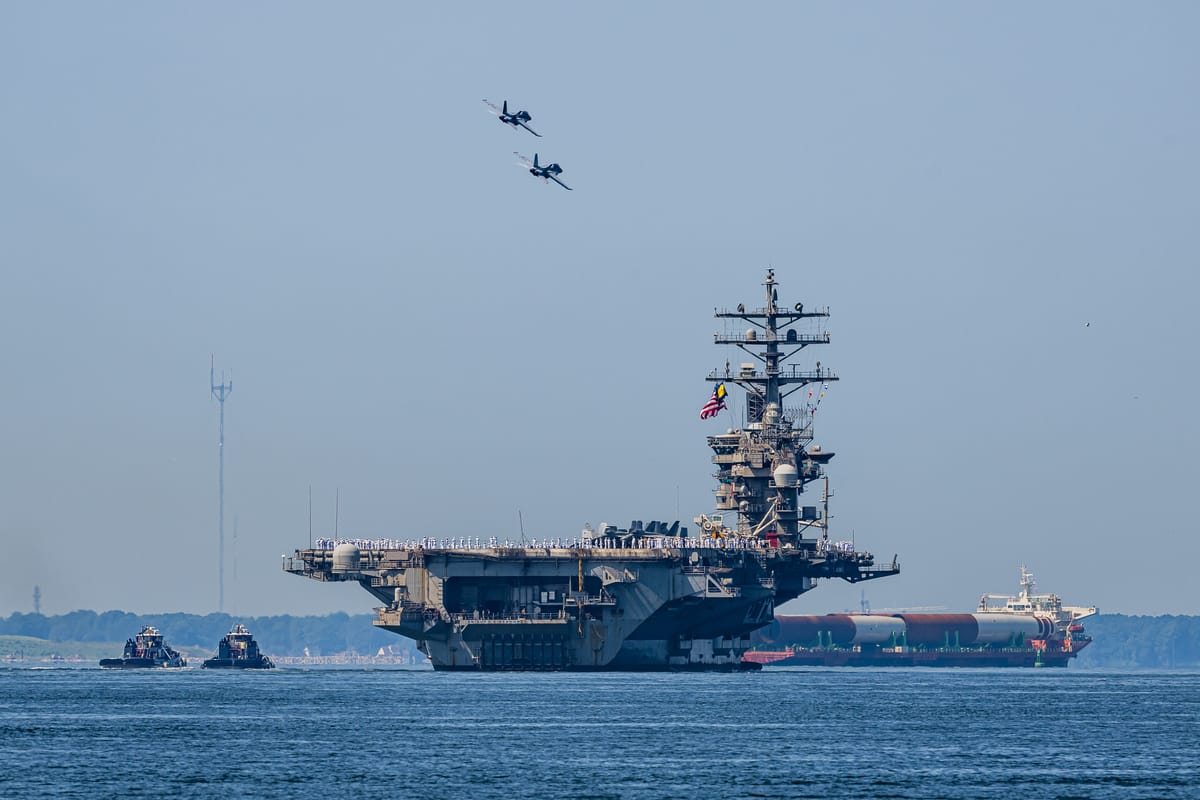
President Donald Trump has signaled that the window for a diplomatic resolution with Iran remains open, even as a massive American military buildup in the Middle East reaches its peak. In a revealing interview with N12, the President described the current security landscape as "still fluid," refusing to take the military option off the table following the regime's brutal killing of thousands of protesters. While the USS Abraham Lincoln and its carrier strike group have now entered the Central Command's area of responsibility, Trump emphasized that the Iranian leadership has reached out repeatedly in hopes of securing a new deal. Despite the tension, the President maintained that his administration’s firm stance has already prevented a nuclear catastrophe, asserting that without his intervention, the Iranian regime would already possess atomic weapons and would have likely launched a devastating first strike against Israel.
The Armada and the Option of Force
The military pressure on Tehran is now more visible than ever. President Trump highlighted the deployment of additional F-15 and F-35 fighter jets, refueling aircraft, and advanced air defense systems to the region. "We have a large armada near Iran. Larger than we had in Venezuela," Trump stated, emphasizing the sheer scale of the force currently under his command. This buildup follows his decision two weeks ago to delay a kinetic strike intended to punish the regime for its internal massacres, a delay that White House officials stress is not a cancellation.
The President is expected to hold further consultations this week to review a variety of operational plans. While he declined to specify which military path he prefers, the arrival of the Lincoln carrier group provides him with a broad array of sea-based and aerial strike capabilities. The coordination between Washington and Jerusalem has also intensified, with Admiral Brad Cooper, commander of CENTCOM, visiting Israel on Saturday to meet with Chief of Staff Eyal Zamir. Their discussions focused on synchronizing defense plans to neutralize any potential Iranian retaliation against Israeli territory.
Diplomacy and the Shadow of the 12-Day War
Despite the talk of war, Trump insists the Iranian regime is feeling the squeeze and is looking for an exit strategy. "They want to make a deal. I know it. They called many times. They want to talk," the President remarked. American officials have reiterated that the terms for a deal have been clear since the first day of the Trump administration, and while the U.S. remains open to negotiation, it will not lower its demands regarding Iran's nuclear program or its support for regional terrorism.
Reflecting on the 12-Day War that occurred last June, Trump argued that the preemptive strikes allowed by his administration saved Israel from a massive surprise missile attack. According to the President, that war crippled the regime’s offensive capabilities. "They would have attacked... but the first day was brutal for them. They lost a large part of their leaders and many of their missiles," he explained. Trump concluded by warning that the alternative to his "maximum pressure" campaign would have been a nuclear-armed Iran, stating that "if there was another president, Iran would already have atomic bombs, and they would have attacked first." As the armada sits off the coast, the ball remains in Tehran’s court to either accept American terms or face the consequences of the "fluid" military situation.