The United States appears to be actively concealing the movement of its military aircraft in the Middle East, with daily tracking tables no longer being published due to many planes flying with transponders switched off, rendering identification challenging in numerous cases.
Several notable shifts have been observed in recent OSINT reports:
At Al Udeid Air Base in Qatar, the number of KC-135R “Stratotanker” aerial refueling aircraft has decreased from 20 to 7.
At Prince Sultan Air Base in Saudi Arabia, the number of KC-135 tankers has increased from 2 to 14.
Regarding F-16 fighters, 12 of the aircraft that arrived in the Middle East last week are stationed at Muwaffaq Salti Air Base in Jordan, while the location of the remaining jets remains unclear.
Groups of 12 aircraft were previously tracked departing from Aviano, Spangdahlem, and McEntire, with CENTCOM imagery showing 12 aircraft already in-theater before further reinforcements from Aviano.
Six EA-18G “Growler” electronic warfare aircraft are based at Muwaffaq Salti Air Base.
Two RC-135V “Rivet Joint” signals intelligence aircraft have been observed at Chania Airport in Crete.
At least two MQ-4C “Triton” maritime surveillance drones have reportedly departed from Al Dhafra Air Base.
Six E-3G “Sentry” (AWACS) airborne early warning aircraft and five E-11A BACN communications relay platforms are positioned at Prince Sultan Air Base.
C-17 and C-5 transport aircraft continue flying without interruption, likely delivering air defense components, spare parts, munitions, and other equipment to support deployed forces.
The withdrawal of tankers from Al Udeid and other assets from Al Dhafra may be precautionary, as these bases are close to Iran with no neutral or allied territory in between for layered air defense systems.
Iran has previously demonstrated the ability to strike targets in Qatar, so reducing assets at vulnerable bases could minimize the need for emergency evacuations in the event of a sudden attack.
Confirmed combat assets in the region include:
48 F-16C/CJ fighters
30 F-35A fifth-generation stealth fighters
36 F-15E strike fighters
6 EA-18G Growler electronic warfare aircraft
12 A-10C attack aircraft
12 F-22 Raptor fighters expected to deploy from RAF Lakenheath
These figures exclude carrier air wings from the USS Abraham Lincoln and the incoming USS Gerald R. Ford, which could add roughly 100 additional aircraft, including F-35C, F/A-18E/F Super Hornets, and EA-18G Growlers.
U.S. forces appear to be in full readiness to execute any order from the White House.
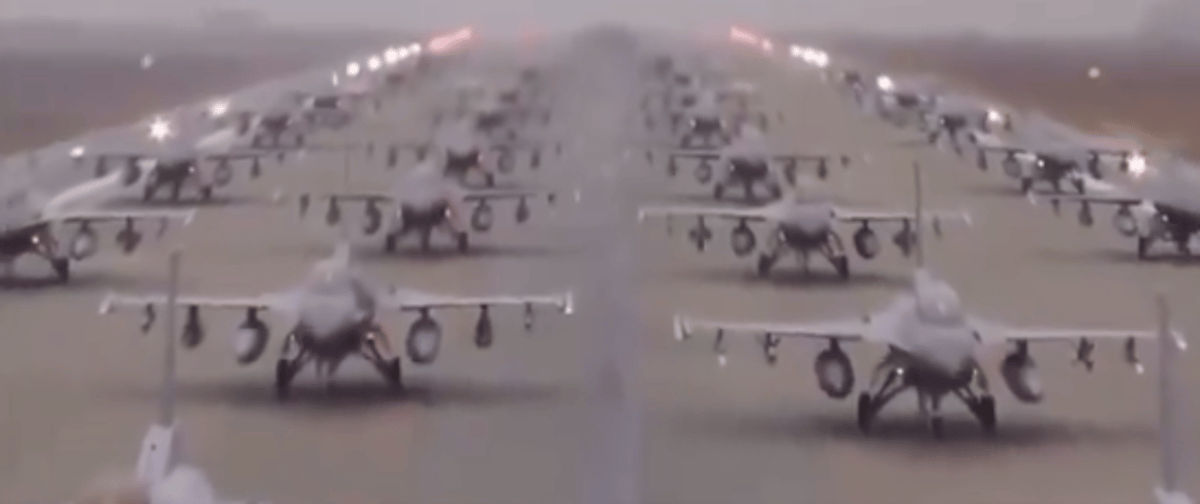
At this stage, more than 240 U.S. strike aircraft are reportedly positioned across Middle Eastern and surrounding air bases, with the actual number potentially approaching 300, as tanker redeployments from Europe and the Middle East indicate possible escort operations for additional fighter aircraft flying with transponders turned off.
This buildup comes amid escalating tensions with Iran, with no official statements from the Pentagon on the specifics of these movements.