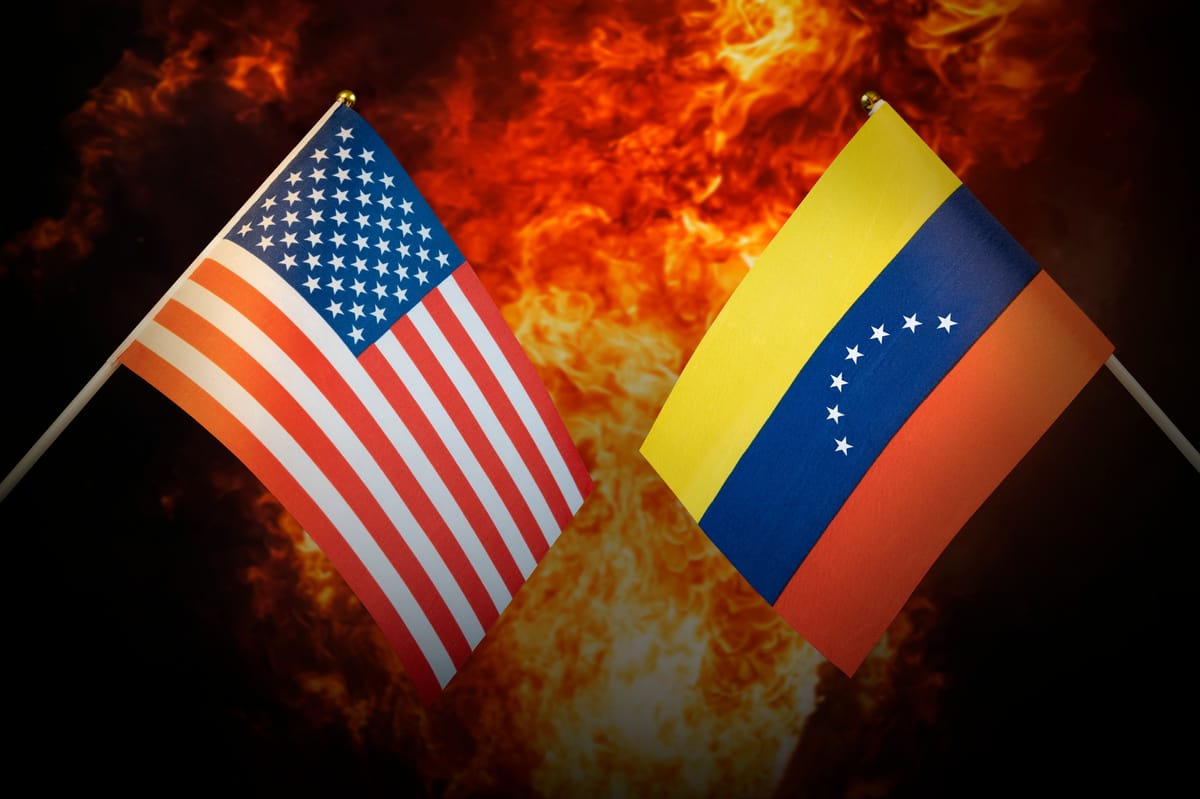
The U.S. just removed highly enriched uranium from a dormant Venezuelan reactor and declared it a triumph. To understand why that's more complicated than it sounds, you have to follow the story backward, all the way to Eisenhower.
The Announcement
On Friday May 8, 2026, the U.S. Department of Energy's National Nuclear Security Administration (NNSA) issued a triumphant statement: it had completed the removal of all remaining highly enriched uranium from a legacy research reactor in Venezuela. The quantity was 13.5 kilograms, about 30 pounds. NNSA Administrator Brandon Williams called it "a win for America, Venezuela, and the world," and credited President Trump's leadership for compressing what would normally take years into a matter of months.
The material is now at the Savannah River Site in South Carolina, where it will be processed through the H-Canyon chemical separations facility into high-assay low-enriched uranium (HALEU), fuel for next-generation civilian reactors. A Cold War stockpile, in short, repurposed for what the DOE is calling "America's nuclear renaissance."
The announcement landed with maximum political effect. It came precisely as U.S. negotiations with Iran over that country's far larger uranium stockpile, an estimated 440 kilograms according to IAEA assessments, had reached an impasse. The Trump administration has demanded Tehran surrender, export, or dilute its enriched uranium. Iranian officials have rejected those terms as "maximalist," insisting enrichment is a sovereign right under the Nuclear Non-Proliferation Treaty. Against that backdrop, the Venezuela operation offered Washington a rare, unambiguous win to point to, however different in scale and context the two situations actually are.
The Operation
The extraction itself ran from April 18 to April 29. Teams from the NNSA's Office of Defense Nuclear Nonproliferation, the Venezuelan Institute for Scientific Research (IVIC), the U.S. State Department, the United Kingdom, and the IAEA jointly secured the uranium, packed it into a spent fuel cask, and drove it roughly 160 kilometres overland from the reactor site in Miranda state to the port of Puerto Cabello. A specialised vessel operated by the British firm Nuclear Transport Solutions then carried it northward to South Carolina, arriving in early May.
By any technical measure, the operation was a success, completed in under six weeks from the first site visit, with the IAEA supervising every stage of transport. The agency confirmed the "safe and secure transport of a 13-kilogram shipment of highly enriched uranium by land and sea from South to North America."
But Venezuela's transitional government, installed after U.S. forces captured President Nicolás Maduro in January on narcoterrorism allegations, offered a notably different account of why the operation had become urgent. In a statement issued by Foreign Minister Yván Gil on May 7, Caracas said that a U.S. military strike on January 3 had landed just 50 metres from the IVIC campus, the very site housing the old reactor. That proximity, Venezuelan officials said, "objectively increased the level of risk and confirmed the urgency" of removing the nuclear material. The NNSA's official statement made no mention of this.
The Political Backdrop: Venezuela, 2026
The uranium removal sits within a larger and still-unresolved geopolitical story. In January 2026, U.S. forces captured Maduro, redrawing the Venezuelan political map overnight and installing a transitional government led by Delcy Rodríguez. Washington and Caracas, previously deep adversaries, began cooperating almost immediately. Energy Secretary Chris Wright visited Caracas in February; Secretary of State Marco Rubio's office developed a "three-phase plan" for Venezuela, of which nuclear security was one element.
The Venezuelan operation, then, is best understood not as an isolated nonproliferation mission but as one component of a sweeping and deeply contested U.S. intervention in South America. The uranium removal was genuinely overdue. Whether the political circumstances surrounding it represent a restoration of order or an exercise of imperial power depends, to a considerable extent, on who is telling the story.
Thirty-Five Years of Surplus
Long before any of that, the uranium had simply been sitting there. When the RV-1 reactor ceased operations in 1991, it left behind 13.5 kilograms of HEU, material enriched above the 20 percent threshold that separates low-enriched from high-enriched uranium. Venezuela and the IAEA agreed in 1997 to formally close the facility, removing some spent fuel at that time. The remainder stayed in secured storage for nearly three more decades.
This was, by global standards, not unusual. Since 1996, the NNSA and its predecessors have been systematically cleaning up Atoms for Peace legacies around the world, removing or confirming the disposition of over 7,350 kilograms of HEU and plutonium from dozens of countries. Venezuela was simply the latest entry on a long list: a dormant reactor, surplus fuel, and a window of political opportunity that had finally opened.
Where the Reactor Came From
To understand the RV-1, you have to go back to December 8, 1953, when President Dwight D. Eisenhower stood before the United Nations General Assembly and delivered what became known as the "Atoms for Peace" speech. The miraculous inventiveness of man, he said, should not be dedicated to his death but consecrated to his life. The speech was, as the Science History Institute has documented, both a genuine moral vision and a calculated Cold War maneuver: a way to extend American influence and compete with Soviet prestige by supplying research reactors to allied and neutral nations across the globe.
Venezuela, then under the dictatorship of Marcos Pérez Jiménez, was an early taker. The government purchased a reactor from General Electric in 1956, the RV-1, a pool-type material testing reactor with a capacity of 3 megawatts. The U.S. contributed $300,000 toward construction. The reactor reached criticality in 1960, making it one of the first in Latin America, and for three decades served genuinely peaceful ends: physics research, radiochemistry, isotope production for medical and industrial use.
Then, in 1991, the research ended. The reactor went dark. The uranium did not go anywhere, until now.
What This Was, and What It Wasn't
Stripped of its political packaging, the Venezuela operation was something the nonproliferation community had long regarded as overdue. Any stockpile of weapons-usable uranium, however small, carries long-term risks: theft, trafficking, diversion. The IAEA-supervised removal was coordinated, transparent, and technically sound. The material is unambiguously safer in South Carolina than sitting in a shuttered facility outside Caracas.
But the operation was never publicly linked to any imminent proliferation threat. Even at the height of Washington's hostility toward Maduro, U.S. accusations against Venezuela centered on drug trafficking, not nuclear weapons. The dramatic announcement language, a victory for "America, Venezuela, and the world," served a political audience as much as a security one.
Eisenhower's Atoms for Peace was itself both a genuine vision and a Cold War instrument, simultaneously a moral proposition and a tool of containment strategy. Seventy years later, an operation to clean up its leftovers has become, in miniature, something very similar: a real security achievement, freighted with geopolitical theater.
Sources: U.S. Department of Energy / NNSA official statement (May 8, 2026); MercoPress; Latin Post; Wikipedia (RV-1 nuclear reactor; Nuclear power in Venezuela; Atoms for Peace); Science History Institute; Eisenhower Presidential Library.