
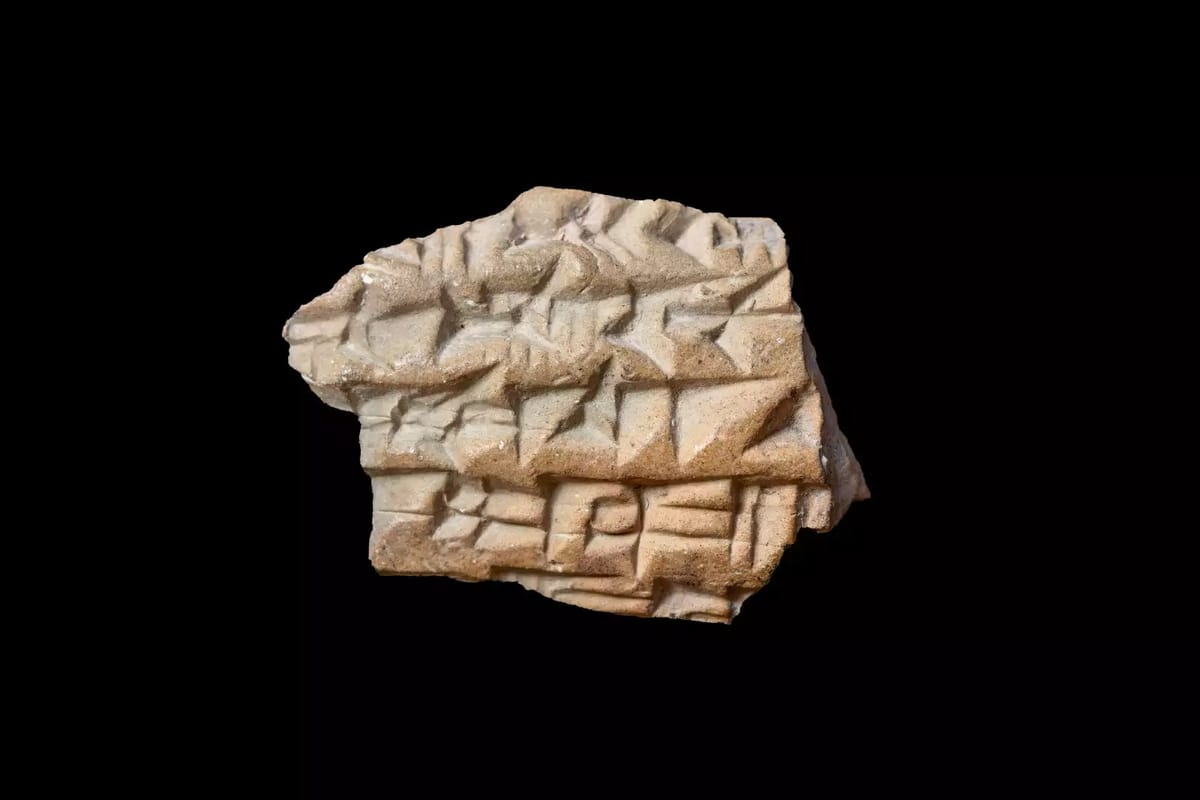
In a discovery that bridges the gap between biblical lore and hard archaeology, excavators have unearthed a minuscule pottery shard etched with 2,700-year-old Assyrian cuneiform near Jerusalem's Western Wall, potentially the smoking gun of a royal tax revolt against the mighty Assyrian Empire.
The 2.5-centimeter artifact, found in the Davidson Archaeological Park at the foot of Jerusalem's ancient western hill, bears Akkadian script hinting at a deadline for tribute payments from the Kingdom of Judah.
Experts believe it fragments a royal bulla, a sealed tag authenticating official dispatches from Assyrian kings to their Judean vassals.
Dated to the 8th-7th centuries BCE, the First Temple era, this is the first such inscription ever uncovered in the city, illuminating the shadowy diplomacy that kept tiny Judah in line with the era's superpower.
The shard surfaced during routine digs by the Israel Antiquities Authority (IAA) and the City of David Foundation, sifted from soil washed into a Second Temple-era drainage channel. It likely tumbled from a collapsed First Temple structure nearby, in what was once a bustling hub for high-ranking officials overlooking the Temple Mount.
"I sifted the dirt and suddenly noticed a potsherd with a strange decoration," recounted Moriah Cohen, the "Archaeological Experience" worker who spotted it at Emek Tzurim National Park.
"I looked closely, and it seemed like cuneiform script, but it seemed so illogical. After realizing it wasn't decoration but really cuneiform, I screamed with excitement. The thought that after 2,700 years, I'm the first person to actually touch this potsherd, it's a very moving thought. This is a once-in-a-lifetime find."
Deciphered by IAA Assyriologists Dr. Philip Vukosavović and Dr. Peter Zilberg, alongside Dr. Anat Cohen-Weinberger, the partial text nods to the first day of the month of Av and a chariot officer, "the one who holds the reins", overseeing the missive. Chemical analysis ties the non-local clay to the Tigris River basin, pinpointing origins in Assyrian heartlands like Nineveh or Nimrud.
While no Judean king is named, timing aligns with Hezekiah's defiance of Assyrian King Sennacherib (as chronicled in 2 Kings 18:7: "And he rebelled against the king of Assyria and did not serve him"), or the reigns of Manasseh or early Josiah.
"The very existence of such an official appeal may indicate some point of friction," Zilberg and Vukosavović noted, suggesting the delay could signal rebellion or bureaucratic snag.
Excavation director Dr. Ayelet Zilberstein hailed it as "direct evidence of official correspondence between the Assyrian Empire and the Kingdom of Judah." She added, "It strengthens our understanding of the extent of Assyrian footprint in Jerusalem... This area served as a center for the activities of ministers and high-ranking figures."
Displayed publicly for the first time Thursday at the IAA's archaeology conference in Jerusalem, the find rewrites chapters of ancient power plays, validating scripture while exposing the gritty underbelly of vassalage.
Echoes of ancient defiance.