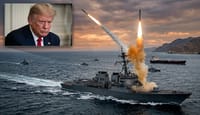
When President Trump went to war against Iran, we were told Iran would be broken, its nuclear sites rubble, its proxy armies defunded, its stranglehold on the Strait of Hormuz shattered forever.
Three months later, the Islamic Republic is still standing, still enriching, Hezbollah is still firing rockets into Israel, and Donald Trump is on Truth Social announcing a deal. What does this deal contain? Sanctions relief for Tehran. Billions in unfrozen Iranian assets. Oil sales resumed. And the nuclear file, the entire moral and strategic justification for the war, declared by Iran to be completely off the table. They took everything. They gave a 60-day pause. And we're supposed to applaud.
Iran's foreign ministry spokesman Esmaeil Baqaei stated on record that nuclear issues are "not part of current talks" and will be subject to "separate discussions" at a later stage. Translation: we'll talk about the bomb after you've already given us the money, lifted the blockade, and let us regroup. And the White House is calling this deal "largely negotiated."
"Everything accomplished by Operation Epic Fury would be for naught." -Sen. Roger Wicker (R-MS), Chair, Senate Armed Services Committee
The criticism isn't coming from the left. These aren't anti-war progressives or Biden apologists. It's Lindsey Graham, chairman of the Senate Budget Committee, warning the deal would be a "nightmare for Israel." It's Roger Wicker, who chairs the Senate Armed Services Committee, saying a 60-day truce, predicated on the belief Iran will ever negotiate in good faith, would be "a disaster." These are Trump loyalists, men who backed the war, men who don't criticize this president lightly. When they're sounding the alarm, something has gone badly, visibly wrong.
The Hormuz illusion
Trump has been loudest about one thing: the Strait of Hormuz will reopen. Gas prices will drop. Markets will stabilize. He'll take the win. But here's the problem, and Sen. Lindsey Graham said it himself, Iran retains every military capability needed to close Hormuz again the moment it suits them. Iran's chief negotiator, Mohammad Bagher Ghalibaf, bragged publicly that Tehran used the ceasefire period to rebuild its armed forces. They aren't surrendering the ability to strangle global energy flows. They're agreeing, temporarily, not to use it. In exchange for cash. That's not a strategic victory. That's a hostage situation with extra steps, and we just paid the ransom.
Iranian media directly contradicted Trump's triumphant framing, stating that the Strait will remain "under Iran's management." Under Iran's management. The world's most critical oil shipping lane, through which roughly 20 percent of global petroleum passes, stays in the hands of the regime we just went to war with.
Israel left exposed
Now look south and west to Lebanon, where Hezbollah has spent these same months doing exactly what Iran's proxy networks always do during a ceasefire window: rearming, repositioning, waiting. The reported deal ends fighting on "all fronts," including Lebanon, but leaves Israel facing a Hezbollah that has not been disarmed, not been defunded, and not been forced to retreat beyond striking range of Israeli civilians. And it's worse than that, because under this 'bold' new deal, Israel isn't allowed to attack or respond to Hezbollah either, no matter how many citizens and IDF soldiers it slaughters.
Maybe if America truly got hold of Iran's enriched uranium, outting the nuclear threat to bed once and for all, it would be worth it. But who knows what will happen after the 60 day pause? Trump is under massive pressure not to re-start the war and Iran are masterful negotiators, highly skilled at putting off issues indefinitely, while pretending to work towards a solution.
Israel, undertsandably, sees this deal as, in their own words, a "very big problem," Netanyahu was reportedly frozen out of critical negotiations. Trump told reporters his call with Netanyahu "went very well." Netanyahu's government privately described the emerging terms as catastrophic.
Someone is not telling the truth, and given Iran's negotiators are publicly boasting about retaining Hormuz control and keeping nukes off the table, it probably isn't Jerusalem.
The nuclear vanishing act
This is the part that should make every serious person furious. Trump demanded "zero enrichment." He demanded the dismantling of Natanz, Fordow, and Isfahan. He demanded Iran surrender its stockpile of 60%-enriched uranium, material sitting at the threshold of weapons-grade.
His own Vice President said the core goal of this administration was an "affirmative commitment" from Iran to never seek a nuclear weapon and never seek the tools that would enable one quickly. Former Secretary of State Mike Pompeo, watching the emerging terms, didn't mince words: this deal will let Tehran "terrorize the world." He compared it directly to Obama's 2015 JCPOA, the very deal Trump spent years condemning as the worst in American diplomatic history.
Iran's nuclear file, the entire justification for the war. has been punted to a future negotiation that may never happen, contingent on goodwill from a regime that just used a ceasefire to rebuild its military and is publicly insisting enrichment is "non-negotiable." The Carnegie Endowment for International Peace noted this week that despite U.S. strikes on Iranian nuclear infrastructure, Iran has used every interval between confrontations to advance its knowledge and grow its stockpiles. There is no reason to believe this interval will be different, especially when the deal hands Tehran the sanctions relief needed to fund the continuation of exactly that program.
A deal that rewards aggression
Let's be honest about the incentive structure this deal creates. Iran closed the Strait of Hormuz. Iran launched counter-strikes against Israel, against U.S. military bases, against civilian and military targets across the region. Iran used its proxy network to bleed Israel from Lebanon. And Iran has now received: sanctions lifted, billions in frozen assets unfrozen, oil sales resumed, ports reopened, its nuclear program protected from the negotiating table, and a 60-day window to rebuild, with America's blessing. If you wanted to design a lesson teaching the world that aggression against U.S. interests pays, you could not do better than this deal.
This isn't appeasement dressed up as realpolitik. It isn't even clever dealmaking. It is a hostage payment that leaves the hostage, regional stability, Israeli security, the non-proliferation regime, still in captivity. Trump launched a war. And three months later, the Islamic Republic of Iran is still standing, still enriching, still controlling Hormuz, still funding Hezbollah, and now flush with cash to keep doing all of the above.
If this is what winning looks like, God help us when we lose.