On the afternoon of June 8, the entire Israeli Air Force was ready to launch. Hundreds of targets in the heart of Iran. Pilots in their squadrons, being briefed. Engines warming. Everything prepared for what would have been the most significant Israeli military operation in the country's history, a strike designed to shatter what remained of Iran's military and strategic infrastructure after weeks of war.
One hour before takeoff, it was cancelled.
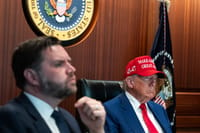
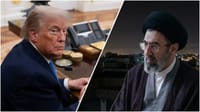
Not because of an intelligence failure. Not because of a military calculation. Not because the targets were wrong or the timing was bad. It was cancelled because Donald Trump called Benjamin Netanyahu and told him to stand down. Washington needed to pursue a deal. The planes stayed on the ground.
IAF commander Maj. Gen. Omer Tischler confirmed this himself Tuesday in a letter to his pilots, writing with the restrained fury of a commander who watched history slip through his fingers: "The entire Air Force was ready to take off for a broad strike sortie. Hours from the order to take off, hundreds of targets in the heart of Iran. The strike was stopped while we were being briefed in the squadrons, one hour before departure."
One hour.
Now fast-forward to today. Hezbollah, which by every measure has continued operating as though no ceasefire exists, fired on Israeli forces in southern Lebanon and triggered sirens in Metula, a sovereign Israeli community on Israeli soil. Metula's mayor, David Azoulay, said the obvious out loud: "If you thought, following the prime minister's declaration, that quiet has returned to the Middle East, tonight has again proven otherwise."
He is not wrong. He is, in fact, understating it.
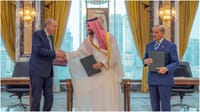
Because here is the situation Israel now finds itself in: bound by a secret MOU whose contents Trump says he will release "some time after Friday," which reportedly extends the Iran ceasefire to Lebanon, which apparently envisions an end to Israeli military operations in a theater where Hezbollah is still firing anti-tank missiles at IDF soldiers and still sending ordnance into Israeli territory. A senior U.S. official briefed reporters Monday that the MOU is "not conditioned on Israel withdrawing from Lebanon," but that it "still envisions a ceasefire that covers Lebanon." What that means in practice, no one outside a very small circle of officials in Washington and Jerusalem is permitted to know.
The Kornet is worth dwelling on. This is not a homemade rocket lobbed in a general direction. The Kornet is a precision Russian-made laser-guided anti-tank missile, operated by a trained crew, aimed deliberately at a specific target. Firing it at IDF forces is not an accident or a rogue actor's provocation. It is an operational decision made by a military organization that has concluded, correctly, that it can keep shooting because the political environment now protects it from meaningful consequences.
Hezbollah has reached that conclusion because the evidence supports it. The ceasefire of April 17 didn't stop them. The Statement of Principles of June 3 didn't stop them. The U.S.-Iran MOU signed Sunday hasn't stopped them. Neither the ceasefire agreement nor the Statement of Principles prevented Hezbollah from continuing to conduct high-intensity attacks against Israeli territory and IDF forces in southern Lebanon. An Alma Research report covering just one week in early June documented four IDF soldiers killed, Hezbollah maintaining a "consistently high operational tempo," and June 1 recording the highest single-day attack count since the ceasefire began.
None of this is happening in a vacuum. It is happening in the context of a diplomatic arrangement that Israel's own opposition leader Yair Lapid described as one that "doesn't achieve any of Israel's war goals." It is happening while Netanyahu delivers prerecorded video addresses defending his decisions without taking questions. It is happening while the Metula Regional Council chief publicly accuses the prime minister of leaving the north to burn.
And it is happening one week after Israel's air force was one hour from potentially ending the strategic threat from Iran for a generation.
The question that no one in the Israeli government seems willing to answer publicly is this: what exactly did Israel get in exchange for standing down? What is in the MOU that justifies absorbing Hezbollah fire in Metula while the document that supposedly governs the situation remains classified? What did Washington promise Jerusalem that was worth calling back those pilots?
Maybe there are answers. Maybe the deal contains security guarantees that genuinely serve Israel's long-term interests in ways that aren't yet visible. That is possible. But the Israeli public, whose sons are in southern Lebanon absorbing Kornet fire right now, deserves to know. And the fact that they don't, the fact that Trump is promising to release the text "some time after Friday" while Hezbollah fires on Israeli territory today, is not a minor procedural detail. It is a fundamental question about who is actually making decisions about Israeli security, and on whose behalf.
Maybe it's the fact we all though Trump was a great savior who had come to svae us from iran and its proxies.
Tischler ended his letter with a carefully measured line: "It is too early to know how global developments will affect the security reality."
For the soldiers in Lebanon who had rockets and anti-tank missiles aimed at them today, the security reality is not abstract.
Same goes for the residents of Northern israel, including Metula, Misgav Am and Zar'it.
It is immediate. And the planes are still on the ground.