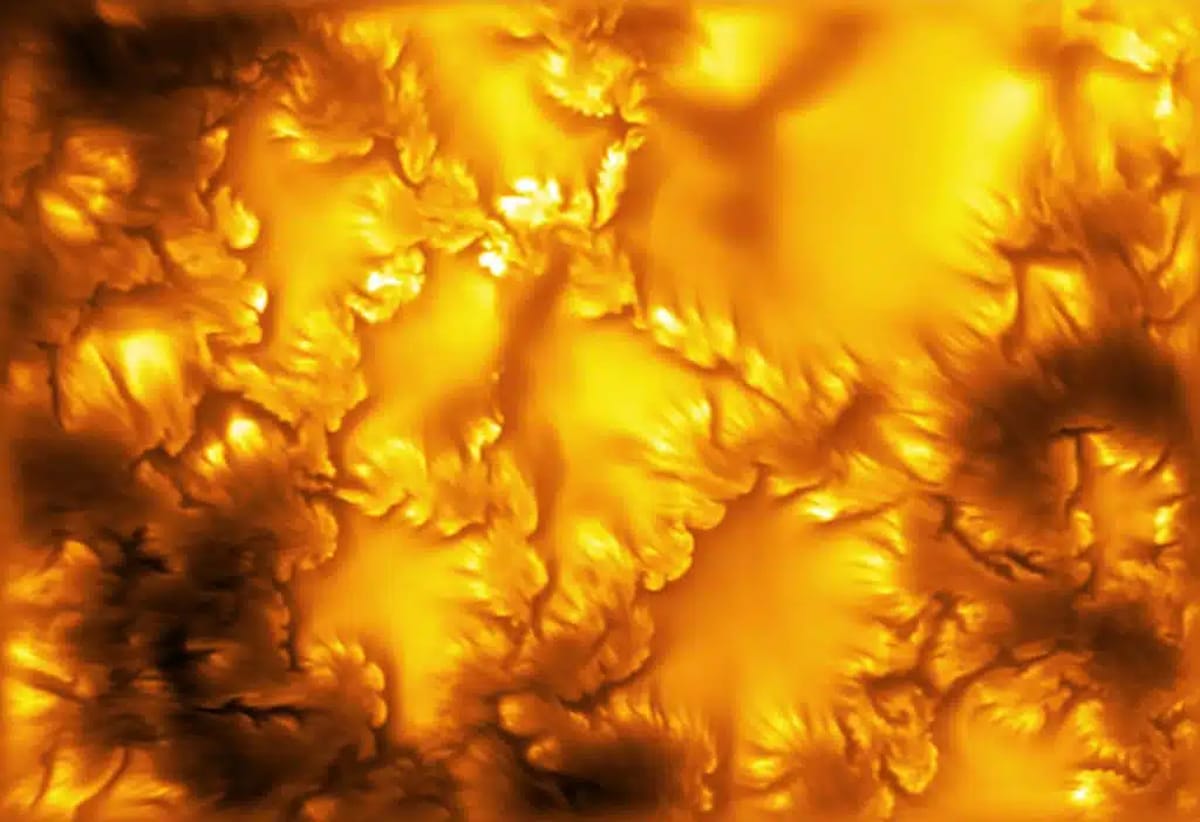
American research institutions have released what they describe as the sharpest images ever captured of the sun's surface, revealing a phenomenon scientists had previously known mainly from theoretical models: tiny vortices that form where magnetic regions meet streams of plasma, the electrically charged gas that surrounds them. Some of the observed structures span just a few dozen miles, minuscule dimensions compared to the sun's enormous size.
The exceptional footage came from the Daniel K. Inouye Solar Telescope, located on the Hawaiian island of Maui and considered the world's largest of its kind. The telescope, equipped with a 13-foot diameter mirror, photographed an active region near a sunspot in April 2025. Using high-speed cameras, researchers were able to distinguish features measuring approximately 12 miles across.
The images showed dark streaks and curved structures along the edges of areas where magnetic flux concentrates. Viewing the sequence of photographs revealed that these structures develop and roll in a manner reminiscent of ocean waves breaking near shore.
Researchers concluded they were observing "Kelvin-Helmholtz instability," a phenomenon that occurs when two layers of fluid or gas move past each other at different speeds. It's familiar from water currents, wave-like cloud formations, and even planetary atmospheres, but this marks the first time clear observational confirmation has been obtained of its existence in the photosphere, the visible layer of the sun.
In total, scientists analyzed 47 vortices, ranging in size from approximately 16 to 106 miles. The typical distance between them was about 40 miles, and their movement speeds ranged from 0.4 to nearly 2 miles per second. Computer simulations of the plasma and magnetic fields produced vortices similar in shape and motion, reinforcing the assessment of the phenomenon's identity.
Despite their small dimensions, the vortices may play an important role in the movement of matter and energy within the sun. According to researchers, they mix magnetized plasma with plasma that is magnetically weaker, affecting field lines in ways that could transfer energy to the upper layers of the solar atmosphere.
The finding may provide clues to solving one of the major questions in solar research: how the sun's corona reaches temperatures of millions of degrees while the photosphere beneath it is much cooler, at around 10,000 degrees Fahrenheit. However, researchers emphasize that it has not yet been proven that the vortices transfer significant amounts of energy upward.
The discovery, published in the scientific journal Nature, may also contribute in the future to understanding solar flares, coronal mass ejections, and space weather—phenomena that can affect satellites, communication systems, and power grids on Earth.