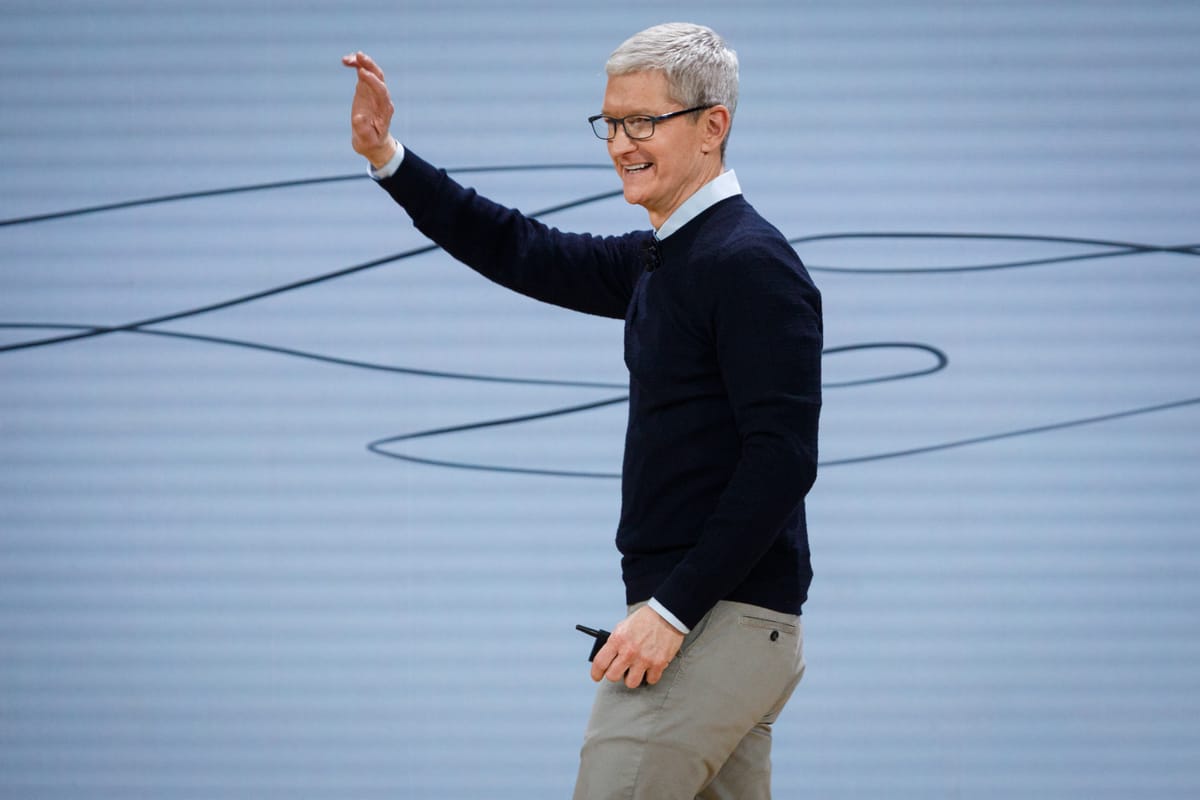
Apple's board of directors has unanimously approved a leadership transition that will see Tim Cook step down as chief executive on September 1, ending a 15-year tenure that transformed the company into one of the world's most valuable corporations. Cook, 65, will remain with Apple as active chairman of the board, while John Ternus, currently the company's senior vice president of hardware engineering, will assume the CEO role and join the board immediately. The announcement came on April 20.
Cook took over from Steve Jobs in August 2011, when Apple's market capitalization stood at approximately $350 billion. Under his leadership, the company's value has grown to approach $4 trillion, marking one of the most successful executive tenures in technology history. During these years, Apple expanded iPhone distribution globally, launched the Apple Watch and AirPods, and built a services business that now generates roughly $120 billion annually, according to company reports. The wearables, home products, and accessories segment alone reached approximately $36 billion in annual revenue.
Yet the leadership handover comes at a moment of significant challenge. In Apple's most recent earnings call, where the company reported record third-quarter revenue of $109.4 billion, Cook described the surge in memory chip costs as a "once-in-a-century flood." The spike in component prices forced Apple to raise prices on Mac computers, iPads, and Vision Pro headsets by $150 to $300, he explained.
Markets reacted sharply: Apple's stock fell more than 7 percent in the trading session following the earnings release. Cook indicated that memory costs would likely remain elevated through the September quarter, though savings on other components and existing inventory might partially offset the impact on profitability.
Ternus brings 25 years of Apple experience to the role and is considered one of the key architects behind the company's hardware development. He oversees product lines including iPhone, iPad, Mac, and AirPods, experience that may prove critical as Apple seeks to expand artificial intelligence capabilities built directly into its devices.
The company also maintains long-term commitments to custom chip development, including an agreement with Broadcom extending through 2031. This underscores Apple's emphasis on controlling its technology supply chain, particularly in an era when AI capabilities, power consumption, and hardware performance have become central competitive factors.
Cook offered public backing for his successor with the appointment announcement: "John Ternus has the mind of an engineer, the soul of an innovator, and the heart to lead this company with integrity and dignity." Board chairman Arthur Levinson added that Ternus is "the best possible leader" to succeed Cook.
The incoming CEO inherits a company with strong demand, iPhone sales contributed to 17 percent revenue growth in early 2026, according to the figures, but also exceptionally high investor expectations. Apple trades at a price-to-earnings ratio of approximately 35, a valuation that leaves limited room for missteps or sharp erosion in profitability.
Ternus will face a dual challenge: maintaining the growth engines Cook built, particularly the iPhone and services businesses, while simultaneously navigating a complex supply environment and extraordinary component costs. The open question is whether the veteran engineer can turn the generational leadership transition into a new growth catalyst for Apple.