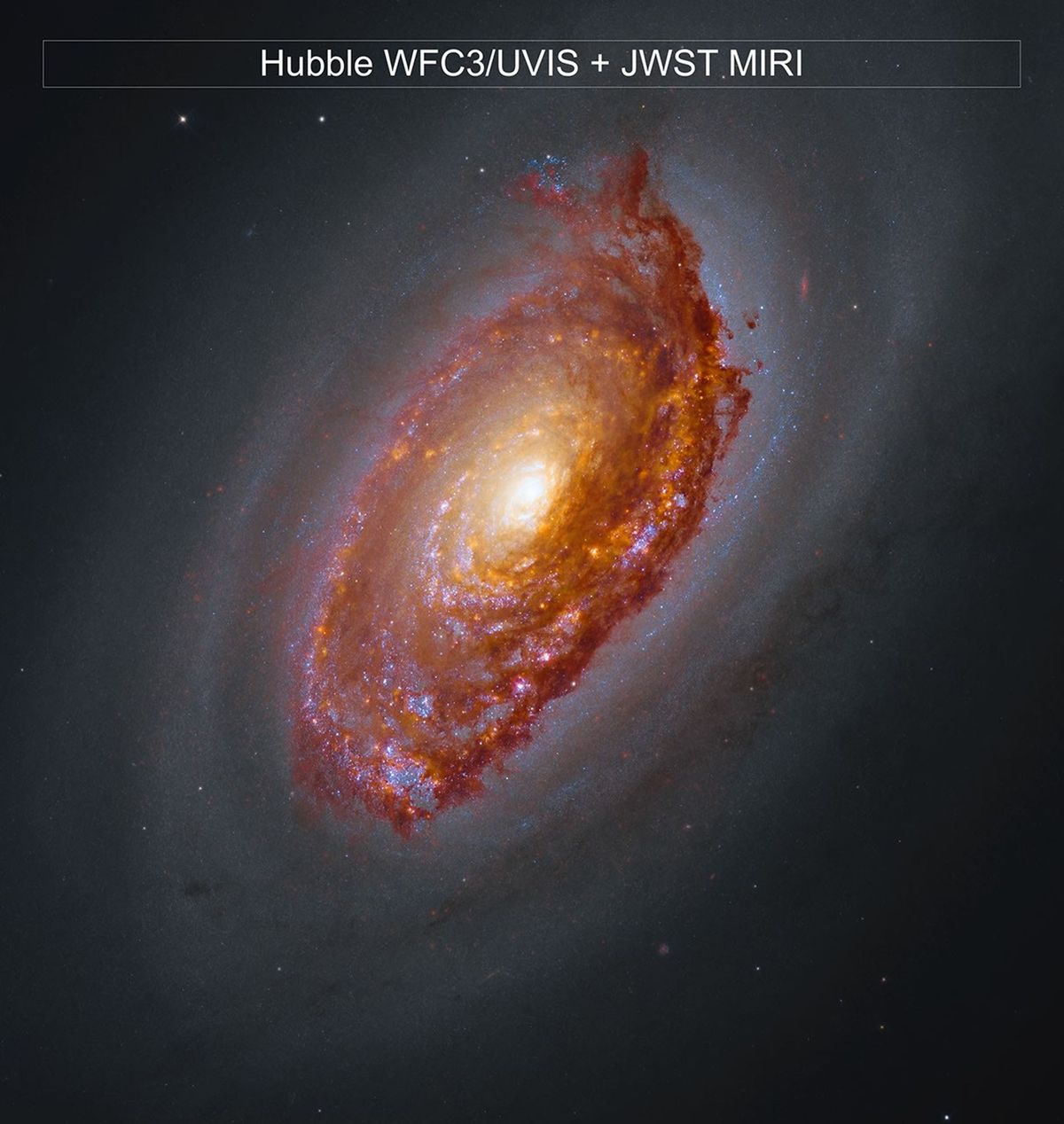
NASA released an extraordinary view of one of the sky's most intriguing galaxies on September 16 as part of its "Astronomy Picture of the Day" series: Messier 64, or M64, better known as the "Black Eye Galaxy." The nickname stems from a massive band of dark dust covering part of the bright region surrounding the galaxy's core, creating an appearance reminiscent of an eye encircled by a dark bruise.
The image combines observations from the Hubble Space Telescope with data from the James Webb Space Telescope. While Hubble's images show portions of the dust band as dark regions blocking the light behind them, Webb's MIRI instrument can observe mid-infrared radiation and reveal the dust itself. In the combined image, the dust appears in reddish hues after absorbing radiation from young stars in its vicinity and re-emitting it at infrared wavelengths.
Behind the beauty lies an exceptionally unusual phenomenon. Gas in M64's outer regions rotates in the opposite direction from the gas and stars in its inner sections. Where the gas streams moving in opposite directions meet and compress, conditions form that encourage enhanced formation of new stars.
The accepted explanation for this strange motion is a violent event that occurred in the distant past. According to NASA, M64 may have merged with a smaller satellite galaxy long ago. Material that arrived from the smaller galaxy continued moving in a different direction from parts of the original galaxy, leaving behind the unusual rotation structure that astronomers observe today.
M64 has also played an important role in changing how astronomers think about spiral galaxies. In the past, it was more common to imagine them as systems that developed relatively peacefully. This galaxy provided evidence that even spiral galaxies can undergo significant collisions and mergers during their lifetimes, a process relevant to understanding the history of the Milky Way as well.
M64 is located in the constellation Coma Berenices, approximately 17 million light-years from Earth. Researchers hope that Webb's observations will provide more precise information about the structure, motion, and composition of the dust in the galaxy, thereby helping to better reconstruct the story of the ancient merger and the way it shaped the M64 we see today.