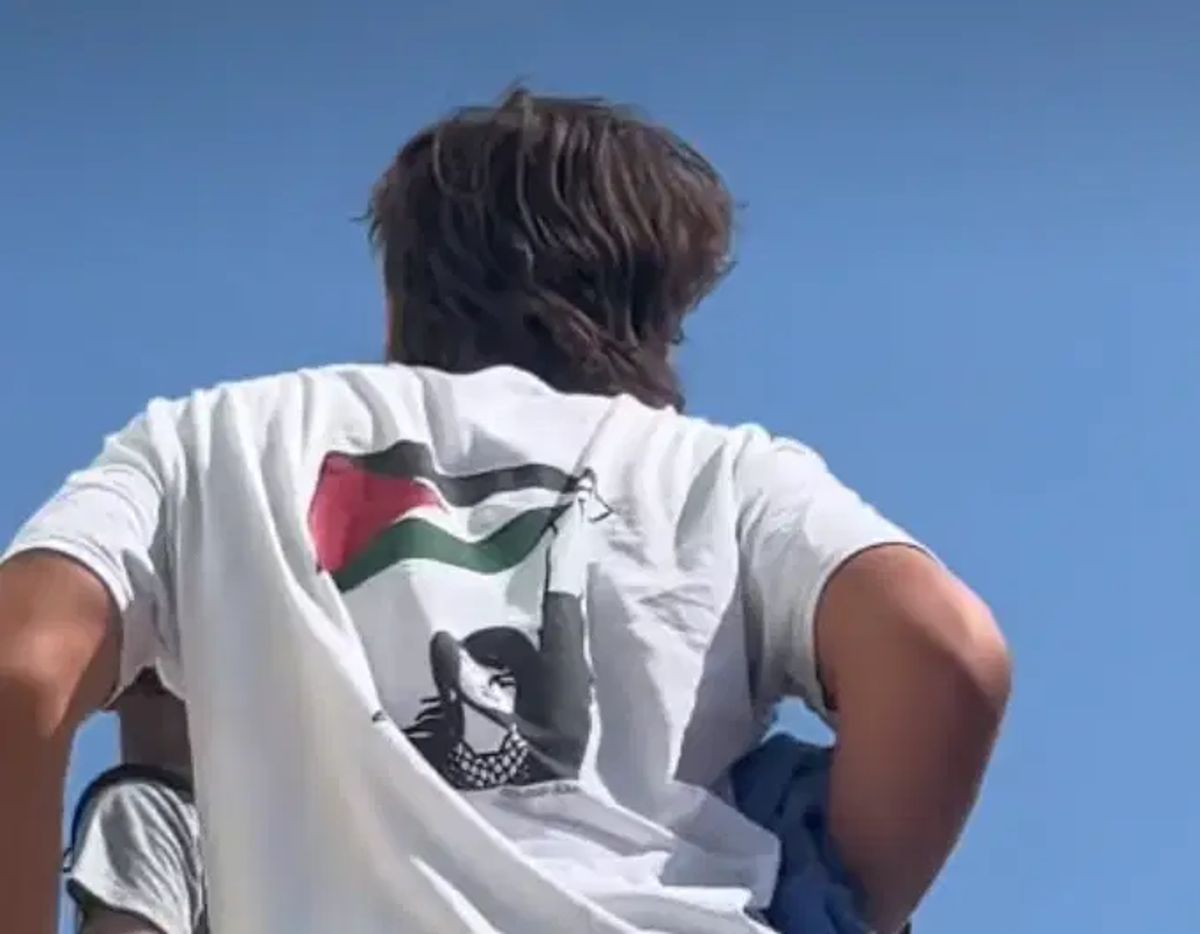
A visitor to Austria's Mauthausen concentration camp memorial site reported that a group of young people arrived wearing clothing that combined Palestinian political messaging with an image identified as depicting Dalal Mughrabi, a Palestinian terrorist who led a 1978 attack that resulted in the deaths of 38 Israeli civilians.
The image appeared on a "Free Palestine" shirt worn by one of the visitors. According to accounts of the incident, a Jewish woman visiting the memorial confronted the group over the appropriateness of wearing such imagery at a Holocaust remembrance site.
Mauthausen, established by Nazi Germany in 1938, served as one of the Third Reich's most brutal concentration camps. According to estimates, more than 100,000 people were murdered at the site, including Jews, prisoners of war, political prisoners, and members of other targeted groups.
The Jewish woman who witnessed the display, identified as Jordana, recorded the confrontation and posted documentation of the incident on social media. According to her account, she challenged the group's decision to bring political messaging to the Holocaust memorial, stating that wearing such imagery at the site was disrespectful to Holocaust victims.
"You come to a concentration camp and call for war against genocide," Jordana said, according to her social media post. "This is a place where actual genocide occurred. You learned nothing. You should be ashamed."
Group members and instructors who accompanied them responded to Jordana's criticism by stating that in their view, Israel was committing genocide in Gaza. Jordana disputed that characterization, arguing that the military operation in Gaza constitutes war rather than genocide and that comparing contemporary military operations to the Holocaust diminishes the memory of those who died at Mauthausen.
Dalal Mughrabi, depicted on the shirt worn by the visitor, was the leader of the March 11, 1978 attack along the Israeli coastal highway known as the Coastal Road massacre. According to accounts of the operation, Mughrabi led 12 fighters who infiltrated Israel and attacked an Israeli military bus, resulting in the deaths of 38 Israeli civilians, including 13 children. Mughrabi and eight other attackers were also killed during the operation.
Mughrabi is characterized by Israel and the United Nations as responsible for a terrorist attack. The attack is among the deadliest terrorist attack in Israeli history.
According to Jordana's social media account of the incident, memorial staff at Mauthausen ultimately called police in response to the group's conduct. The post stated that staff determined the group's behavior and messaging violated standards for respectful conduct at the memorial site.
The incident comes amid an ongoing pattern of controversies at Holocaust memorials across Europe, where visitors and activists have attempted to draw political connections between the Holocaust and contemporary Israeli-Palestinian conflicts. According to reporting from multiple Jewish organizations, such attempts have generated significant concern among Holocaust educators and Jewish community leaders who worry that such comparisons diminish the historical specificity of Nazi genocide.
In February 2026, a visitor to the Buchenwald concentration camp memorial in Germany was denied entry to a Holocaust liberation anniversary commemoration while wearing a keffiyeh, a traditional Palestinian scarf, as a political statement. Activist groups subsequently organized a protest at the site titled "Keffiyehs in Buchenwald" to challenge the denial of entry.
A rabbi who reported witnessing the Mauthausen incident posted on social media that the group's conduct represented a desecration of Holocaust memory. According to the rabbi's post, the imagery combined Palestinian political messaging with what he described as a reference to a figure associated with an anti-Semitic historical actor.
The controversy highlights ongoing tensions between Holocaust remembrance and contemporary political activism, particularly regarding efforts to draw equivalencies between the Holocaust and other historical or contemporary conflicts. Holocaust scholars and educators have repeatedly emphasized that the Holocaust represents a unique historical genocide and argue that such comparisons can distort historical understanding and undermine the ethical lessons of Holocaust memory.