Spanish Prime Minister Pedro Sánchez has retracted accusations he made last week blaming Israel, Russia and Morocco for a mass migration crisis in Ceuta, the Spanish territory on North Africa's Mediterranean coast that borders Morocco.
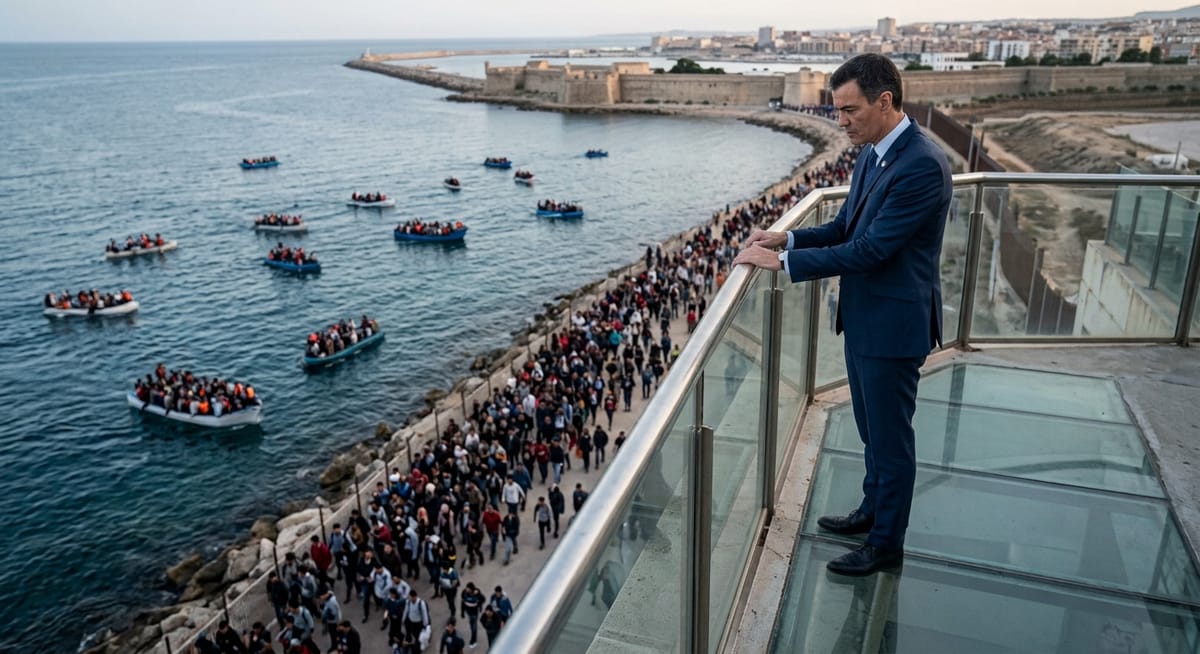
In late July, tens of thousands of migrants breached the territory's borders in what local police described as an overwhelming surge. According to authorities, the migrants took advantage of police forces being deployed to fight widespread wildfires affecting Spain and France at the time, allowing them to enter Ceuta with minimal resistance.
Estimates suggest that between 60,000 and 100,000 undocumented migrants crossed into Spanish Ceuta within a matter of hours. Speaking on a podcast approximately a week ago, Sánchezm, who leads Spain's far-left government, echoed antisemitic conspiracy theories by accusing Israel, alongside Russia and Morocco, of orchestrating the crisis.
Sánchez claimed at the time that an organized social media campaign had convinced Moroccan citizens they would benefit from crossing the border and would receive Spanish status in Ceuta. He alleged that Morocco harbored territorial ambitions over Ceuta, that Russia sought to undermine European Union unity, and that Israel viewed his government as an adversary and enemy.
However, in a speech delivered from the floor of Spain's national parliament, the Spanish prime minister was forced to walk back his accusations, admitting that no organized campaign of the kind he described had taken place. Instead, he acknowledged that the breach was spontaneous and occurred when Ceuta's defenses were inadequate due to his government's policies.
"I can assure you that no evidence has been found that any entity—diplomatic, political, civilian or of any other conceivable type—took part in the events of the incursion into Ceuta, and no finger can be pointed at Morocco, or other countries, as directly responsible for the matter," Sánchez announced in his address to Spain's lower legislative house.
According to Spanish police and an independent investigation by the Civil Guard, while there was coordination on social media platforms, it was spontaneous and not directed by external actors.