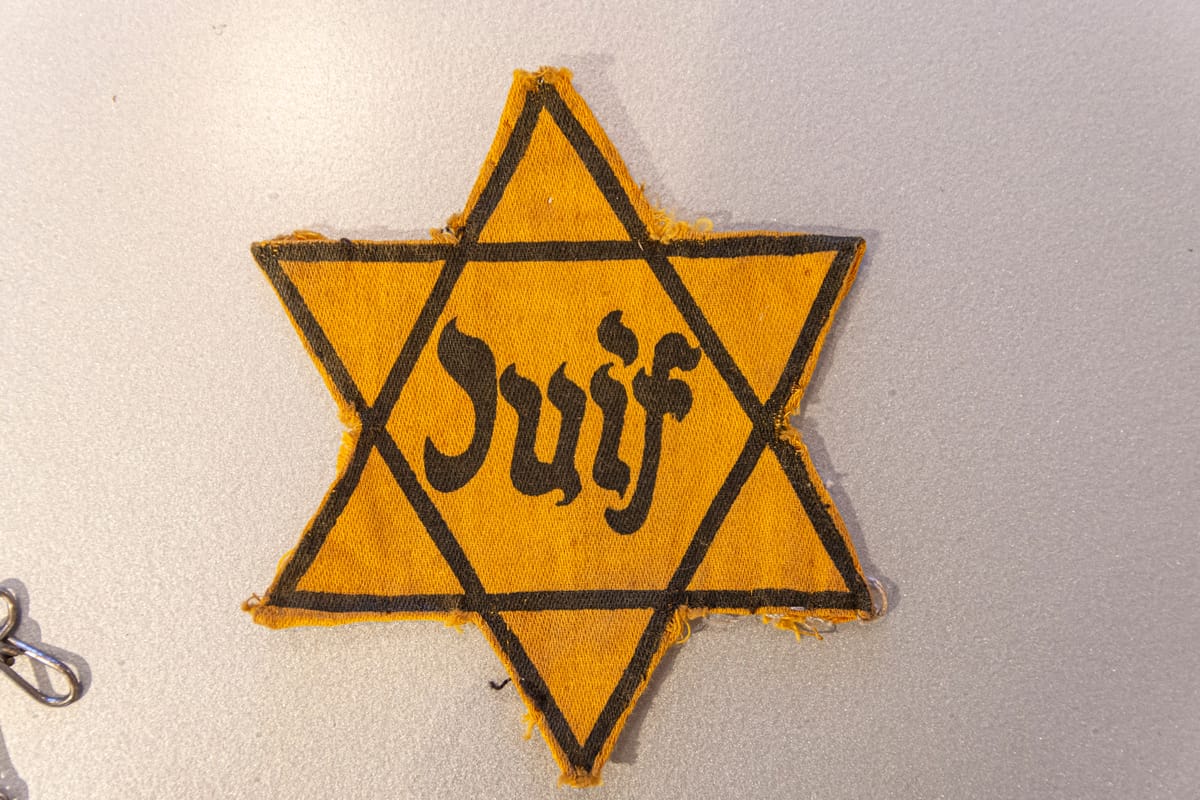
An Israeli court has placed strict limitations on the sale of a yellow badge worn by a Jewish person during the Holocaust, ruling that only representatives of Israeli museums dedicated to Holocaust remembrance may purchase the item.
The case came before the Haifa Magistrate's Court after Yad Ezer L'Haver, a nonprofit organization, petitioned to block Daniel Rafaeli, owner of the "Pa'amonim" auction house, from selling the badge and accompanying identification documents at public auction. In a ruling issued this week, Judge Hava Klampert-Marzki prohibited the sale to private individuals or any entity outside Israel.
Court documents revealed that the badge was worn by a specific individual during persecution in Romania during the Holocaust. The person's name was withheld from the ruling for privacy reasons.
Judge Klampert-Marzki classified the badge as an "object bearing a trace"—meaning its significance derives not from its material composition, rarity, or monetary value, but from its direct connection to a specific person and historical event. "This is the specific badge worn by a specific person at a specific time," she wrote, noting that it cannot be replaced by another yellow badge or substituted with a photograph.
The hearing drew dozens of Holocaust survivors who attended to explain the importance they attach to the yellow badge and its role in preserving Holocaust memory and Jewish collective remembrance.
Rafaeli initially claimed the badge belonged to a third party, but during proceedings admitted it was in his possession and that his earlier statements about ownership were inaccurate. He acknowledged the importance of preserving Holocaust-era artifacts, stating that "tangible items serve as first-rate historical documentation of the highest order."
However, Rafaeli argued that commerce in such items actually helps preserve them, and suggested that a photograph of the badge on the auction house website would suffice. He offered to commit to selling it only to families of Holocaust survivors or public institutions engaged in Holocaust preservation and commemoration.