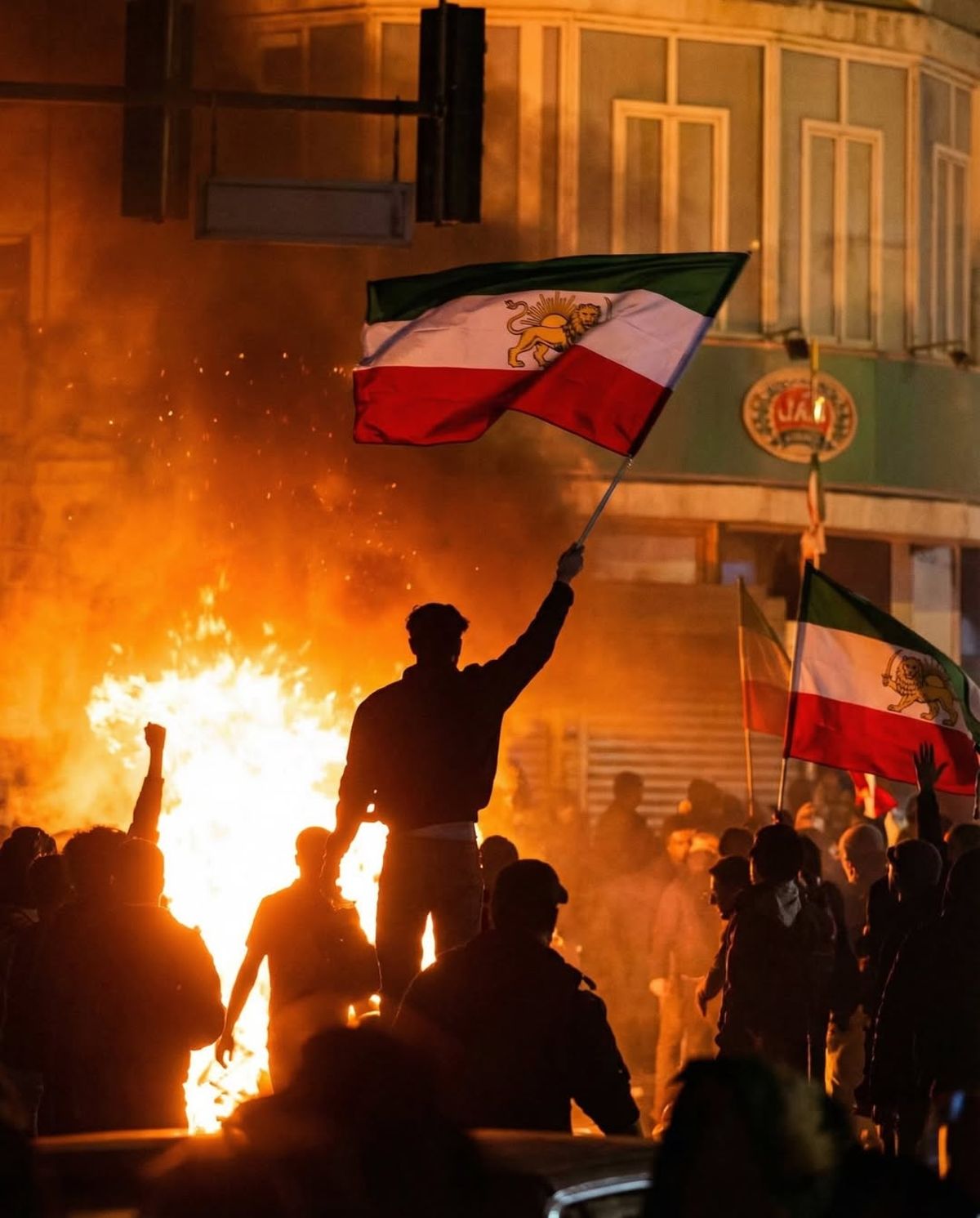
New testimony is emerging from an Iranian refugee who spent eight months on the run before escaping the country, revealing the scale of brutality used by Iranian security forces to crush the wave of protests that swept the Islamic Republic.
Hamid Kohsari, 31, who took part in demonstrations in the city of Gorgan, capital of Golestan Province in northern Iran, has given an account to Iran International of the night his city's streets turned into a killing field, and of the harrowing journey that followed until he was smuggled across the border.
Kohsari, who had already participated in the November 2019 protests and in the women's protests following the death of Mahsa Amini, says nothing in his past prepared him for the level of killing he witnessed during the violent suppression of the demonstrations. According to him, the security forces of the ayatollah regime opened fire with live ammunition and heavy volleys directly into the dense crowd of protesters, without any distinction or mercy. He described how protesters fell around him like sparrows shot from the air, as the forces used Kalashnikov rifles, shotguns and even advanced weapons equipped with laser sights. Using the laser beams, snipers positioned on rooftops marked targets within the crowd, then shot them from close range, even when the marked protesters had melted back into the throng.
One of the most difficult scenes etched into Kohsari's memory from that bloody evening, illustrating the unimaginable cruelty of the suppression apparatus, was an incident in which a young family was caught in the line of fire. A couple carrying their toddler son, only about two years old, in their arms came under direct fire. The father was hit in his lower body and the mother was seriously wounded in her face, neck and abdomen. Kohsari and other citizens rushed to help the wounded parents and evacuated them for assistance, but in the terrible chaos and commotion Kohsari noticed the toddler lying on the edge of the pavement, motionless and silent. When he ran to pick him up, hoping the child had only lost consciousness, he discovered to his horror that the boy had taken a direct and very severe gunshot wound to his face, which had destroyed half his face. Weeping bitterly and screaming in terror, he rushed to transfer the wounded toddler to a woman who was treating the injured at the scene, and since then nothing has been known of what became of the family.
Later that same night, as the riots raged in the streets, a wounded woman approached Kohsari and begged for her life that he not abandon her to the hands of the security forces. Kohsari lifted the woman onto his back and began walking with her toward a safer group of protesters, promising her he would not let her die. However, as he approached the crowd, security forces shot him from behind and hit his right leg. Kohsari managed to take only a few more steps before collapsing to the ground. Protesters who were at the scene quickly pulled him into the crowd, and used scarves and shoelaces to create a makeshift tourniquet and stop the excessive bleeding.
Out of heavy fear that he would be arrested if he sought medical treatment at a hospital—a known practice of the Iranian regime that uses hospitals as traps to arrest wounded protesters—Kohsari avoided going to a medical facility and even from buying medicines at pharmacies. His fear of arrest stemmed in part from a bitter past experience, after he was already arrested and interrogated at length in 2019 at a Revolutionary Guards facility, where heavy pressure was applied against him until he was forced to record a coerced confession. An extraordinary tragedy lies in the fact that Kohsari's father is a disabled veteran of the Iranian army who fought and was wounded in the Iran-Iraq war in the 1980s, and now his son has been shot and seriously wounded by the security forces of his own country.
A doctor who examined Kohsari in secret determined that his leg had suffered serious damage to bone and nerves and he needed urgent surgery, but the surgery never took place. For eight full months Kohsari lived as a hunted man, forced to move from one hiding place to another to evade the long arm of the intelligence apparatus. He moved between car washes, apartments, cattle sheds, abandoned buildings and isolated villas of friends who came to his aid and provided him with food and basic medicines. The constant anxiety that he might be caught grew, especially after he learned that a close friend had been arrested and severely tortured during interrogation. Alongside his flight, his family also paid a heavy price: a relative, Mostafa Kohsari, a father of two, was shot to death on that same deadly night. His body was held by the Revolutionary Guards for four days without notifying the family, and after it was located at the morgue at the end of the process, his funeral and burial were conducted under the close supervision of intelligence agents at dawn, with an absolute prohibition on holding public mourning customs.
In the end, as the noose tightened around him and the danger to his life became tangible and immediate, Kohsari understood that he no longer had the option to remain in his homeland. After tearfully parting from his family members and his faithful dog, he fled from Iran to an anonymous place of refuge, from which he now presents his shocking testimony and exposes the true face of the brutal suppression.