My name is Avishay. I'm 36 years old.
My father is a public askan and baal chessed, a man who lives for the community, knows every corner of the population, and can move the wheels of the system with the press of a button or the lift of a phone.
My father had a longtime partner, a multi-faceted businessman named Betzi (Betzalel). The two of them built a large company together that managed projects and enterprises, and their partnership was legendary. Every time we gathered around the Shabbos table or at family simchos, Betzi would toss into the air his standard joke, one that over time became a kind of prophecy walking a tightrope between laughter and seriousness:
"Avishay, if you become my son-in-law, I'm all set."
The guys around the table would laugh, and me, what do you expect from a young bochur? I felt great. What bochur wouldn't want to feel like he's a "catch," someone they want even before he's entered the shidduch world? But deep down, I understood it was still far off. Until I reached 22, when I entered the world of shidduchim.
The moment that door opened, my father didn't lose a beat. As far as he was concerned, the shidduch was already closed even if there wasn't a vort yet. He had already drawn for me in his imagination, and slowly in reality too, what my life would look like with Maayan, Betzi's daughter. He described how happy I would be, what kind of financial package we would receive, and how our future was guaranteed.
I met with Maayan.
Externally? Everything fit like a glove, but who she really was, that I didn't know for a moment. My father, who was himself a man of considerable means and not inferior to Betzi financially, made sure to explain to me in precise detail what assets, gifts and financial support we would receive as a couple. For me personally? The whole material aspect barely spoke to me. I wanted to know one simple thing: who am I going to share my life with.
But this train was moving at tremendous speed. After five meetings, the environmental pressure, the expectations of both families, and the aura surrounding the family connection between Betzi and my father did their work. For both of us it was clear, or at least that's what we projected to each other from the force of circumstances, that we were the perfect couple.
The engagement period was a fireworks display of euphoria. I felt like a chosson who had won the lottery of perfect life. And that's exactly what I saw in Maayan too, smiles, anticipation, and radiant happiness.
And then came the chuppah.
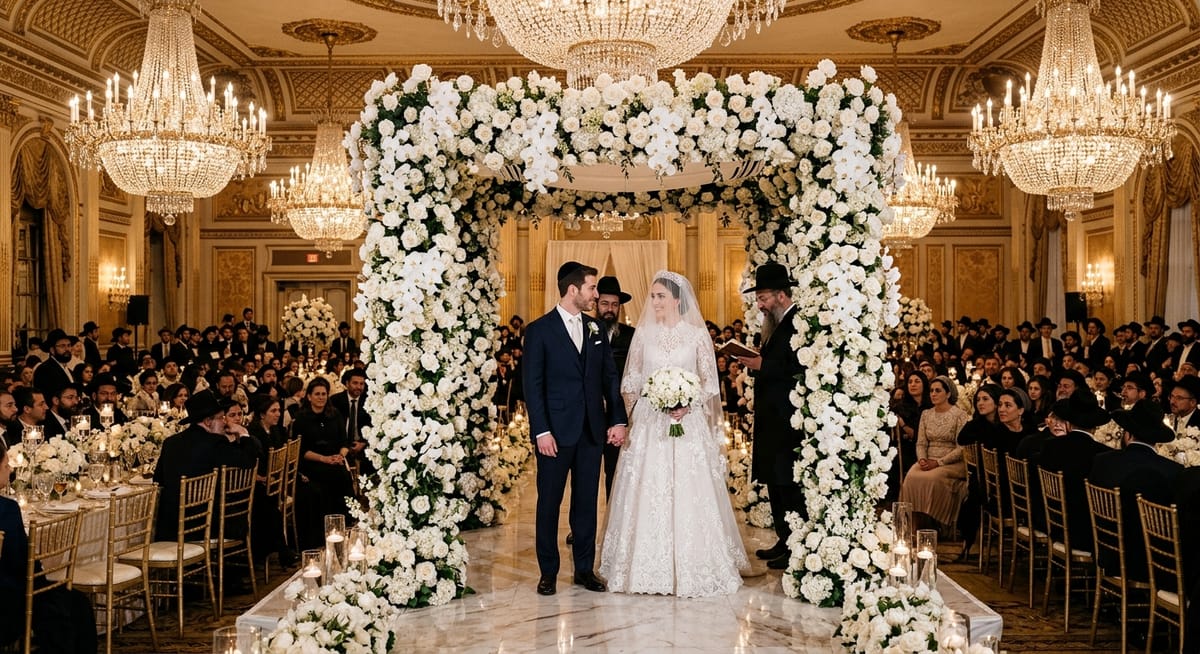
The chuppah was in all its glory, exactly as expected from two economic and social empires. The hall was packed with public figures, rabbanim, businessmen and the finest guests. I stood there and felt on top of the world. I was exactly that chosson that everyone looks at and says to themselves in their heart: "Wow... how good he has it. What a kallah, what families, what a future. His life is going to be honey."
The wedding ended. Exhausted but expectant, we walked as a married couple into the apartment. The door slammed behind us, and in that exact moment, reality slammed shut too.
I received a completely different woman. Bitter, angry, cold as ice. The radiant smiles vanished as if they had never been, and in their place stood a woman entirely foreign to me. This was certainly not the person with whom I had made a vort, and not the one who stood with me under the chuppah, that's how I felt.
Day after day I tried to decode the mystery. What's happening to her? Is the anger at me personally or at me and someone else, or perhaps something is going on inside her? Is she projecting deep emotional distress, and how exactly am I supposed to act? I tried to reconstruct the guidance I had received, maybe this is exactly what the madrich meant? Maybe this is exactly what everyone goes through?
I would come home from kollel and find a woman sleeping in the middle of the day. No hot meal, no kind word, and no one to talk to. Each time I approached with love, tried to break the ice, but I felt like I was standing before a concrete wall. I saw before my eyes a woman who relates to me not as a husband or partner, but as her greatest enemy.
I suggested we go out together to get some fresh air, she refused. I would come home from kollel from time to time with a sweet pastry or chocolate she likes, she didn't even lift her head to acknowledge it. I continued to ask, to speak gently, to express deep empathy out of a genuine desire to ease her transition to shared life. The constant answer I received was one and only: silence.
In repeated conversations with my chosson teacher, I understood that I had fallen into a problem I didn't know how to get out of. He claimed it would be worthwhile to connect her with a trusted woman, maybe she could share what's difficult. I tried to find someone together with her, but there was no cooperation from her side.
I didn't know what to do with myself. My heart was torn. I was terribly afraid to share with my father, maybe it's too early, maybe I need to solve problems like these without involving parents. I was also afraid of his reaction, of the fact that Betzi's "princess," the family's great project, was revealing itself as a collapsing house of cards.
But after a full month of private gehinnom, when I was close to losing my mind, I broke down and told my father the bitter truth.
My father listened, but his response crushed me completely.
"Avishay, are you sure?" he asked in a skeptical tone. "Maybe you're not showing her enough caring? Maybe take her for a drive? Maybe buy her some nice jewelry?! Call your chosson teacher, maybe you forgot something?"
I explained to him in a trembling voice that I had already tried everything, that this isn't a problem of gifts but something deep inside the soul. But my father, to my great sorrow, simply wasn't ready to accept reality. I felt like he was about to blame me for irresponsibility, for immaturity.
Even a man like my father, who was closer to me than anyone else in the world, suddenly became a person asking one question: how to preserve public shalom bayis and how not to damage the business and social relationship with Betzi.
My mother was shattered to pieces. She knew Maayan up close, saw the reality then with her own eyes, and couldn't contain the absurdity. But even her hands were tied, the tremendous fear of hurting the honor of Betzi and his wife overcame the cry of her son.
Silence became official policy.
Three months passed of loneliness inside a home that was supposed to be warm. Finally, out of despair and being pushed to the wall, I decided to do the next thing, perhaps late or perhaps not. I turned to one of the talmidei chachamim with whom I would consult on fateful questions.
I merited to be in contact with a truly great man, who beyond his greatness in Torah is first and foremost a person of broad heart, infinite empathy, and a rare ability to contain another person's pain. For twenty long minutes I sat in his room and poured out everything on my heart. I was silent and cried, and he listened with great attention.
He asked questions down to the smallest details, and I answered him clearly, without embarrassment and without any shame, as if I were at a doctor now.
And then something happened that is engraved in my heart forever: this giant of a man began to cry with me.
The crying of such a great man, who felt my pain as if I were his only son, saved me. It returned air to my lungs. Finally there was someone in the world who heard me, who understood me deeply, and who in no way tried to blame me for the situation. "What spiritual strength you have, to live three months like this in this situation?" he asked me through tears.
From there, the wheel already began to move. The rav himself took the reins into his hands, stood before the parents with unmatched firmness, clarified the situation thoroughly to the end, and did everything to lead to the right solution, divorce.
And even in these moments, as I write these words and my hands are shaking, I still can't believe I'm writing this: even at this final stage, it seemed to me that my parents were more preoccupied with the question of what people would say on the street and how it would look outwardly, more than with the tremendous difficulty and emotional breakdown I went through.
After the divorce, the outside world didn't hesitate to strike. Shocking and baseless rumors came out about me as if I were damaged and problematic. All the gossip and talk circulated around me, as if all the blame lay on me. But with signs and wonders of spiritual fortitude, I chose not to relate at all to human evil and the lies that were spread. I understood that my strength lies in internal relation to myself, to my life, and to the straight path on which I walk before Hashem and man. "I'm so young, I need to build a home," I decided and ignored the rumors.
But from this tremendous darkness, I merited to see the guiding hand of Hashem. Baruch Hashem, after a year, I married again, with a true eishes chayil who filled all the tremendous void that was created in me, and built with me a faithful home of truth, tranquility and great light. Give thanks to Hashem for He is good, for His kindness endures forever.
This story built me, gave me confidence and strength even when it was very difficult. I felt that Hakadosh Baruch Hu did this for my benefit, even if it took me time to feel it.