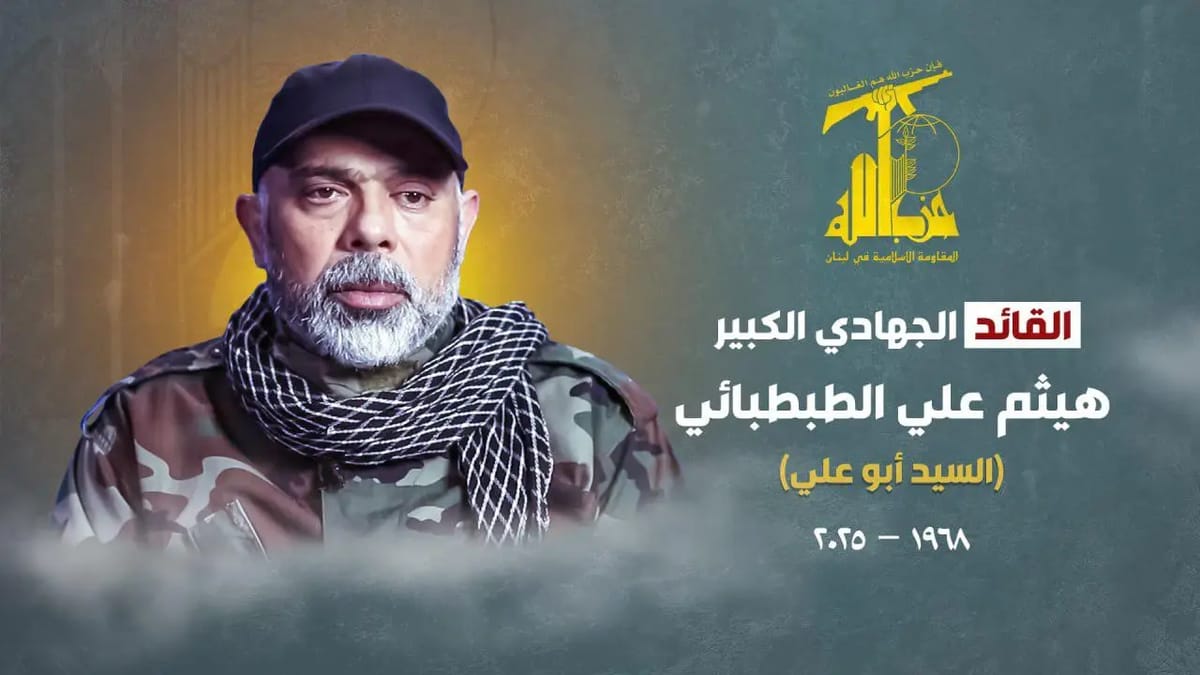
The successful assassination of Ali Tabatabai, Hezbollah's de facto Chief of Staff and the organization's "number two," has placed the terrorist group at a "critical crossroads," forcing it to weigh the risks of war against the cost of lost deterrence. Despite confirming the death of the man they hailed as a "Great Jihad Commander," Hezbollah has maintained a deliberate silence regarding any immediate response.
According to analysis in Lebanese media, this dilemma centers on two catastrophic possibilities:
- Military Response: A retaliatory strike against Israel would risk triggering a large-scale war, a war which the terrorist group is currently ill-prepared to afford.
- Strategic Silence: Refraining from a response would, conversely, nullify the group's entire deterrence and defense strategy against Israel.
The Internal Debate and Iranian Connections
Hezbollah is currently engaged in a difficult internal debate over its next move. A source close to the terrorist group told a French news agency that two distinct views exist within the organization, those who favor a response and those who prefer restraint. The leadership is reportedly "leaning toward adopting" the diplomatic path at this stage, primarily due to the organization’s significant weakening in the recent war and the loss of its key supply line from Syria following the collapse of the Assad regime.
Tabatabai, who was born in Lebanon in 1968 to an Iranian father, was a figure of the organization’s "second generation." He rose quickly, particularly after the elimination of other senior commanders, and fought for the group's allies in Syria and Yemen. He had joined Hezbollah in the 1980s, served in the elite Radwan Force, and was focused on restoring the group’s readiness for war with Israel during the past year’s ceasefire.
A Lebanese security source cited by Reuters confirmed Tabatabaei's rapid promotion and his appointment as Chief of Staff during the last year.
Shifting Equations and Israeli Pressure
A Lebanese analyst familiar with Hezbollah's patterns, Khalil Nasrallah, suggested that a major response is highly unlikely if the organization is still in the process of rebuilding. He admitted that Hezbollah’s previous responses to Israeli assassinations had failed to deter Israel and that any new, impactful response would require complex calculations.
Other Lebanese outlets argue that Israel and the U.S. are intentionally provoking Hezbollah. Al-Modon newspaper stated that Hezbollah is ready to endure the pain of non-response, believing Israel is trying to goad it into action. They contend that the equation has changed: "The question is no longer whether the next comprehensive war will break out, but only when."
Furthermore, the Lebanese newspaper An-Nahar suggested that the strike in Dahiya signals that Israel is unconstrained by red lines or agreements and that the entire policy of targeted assassinations foreshadows the approach of a wider military operation. They noted that the strike occurred just 48 hours after Lebanese President Joseph Aoun declared a new initiative, which was met only with Israeli escalation and U.S. disregard. The prevailing consensus is that Hezbollah believes its best move is to avoid giving Israel the desired pretext for a large-scale escalation.