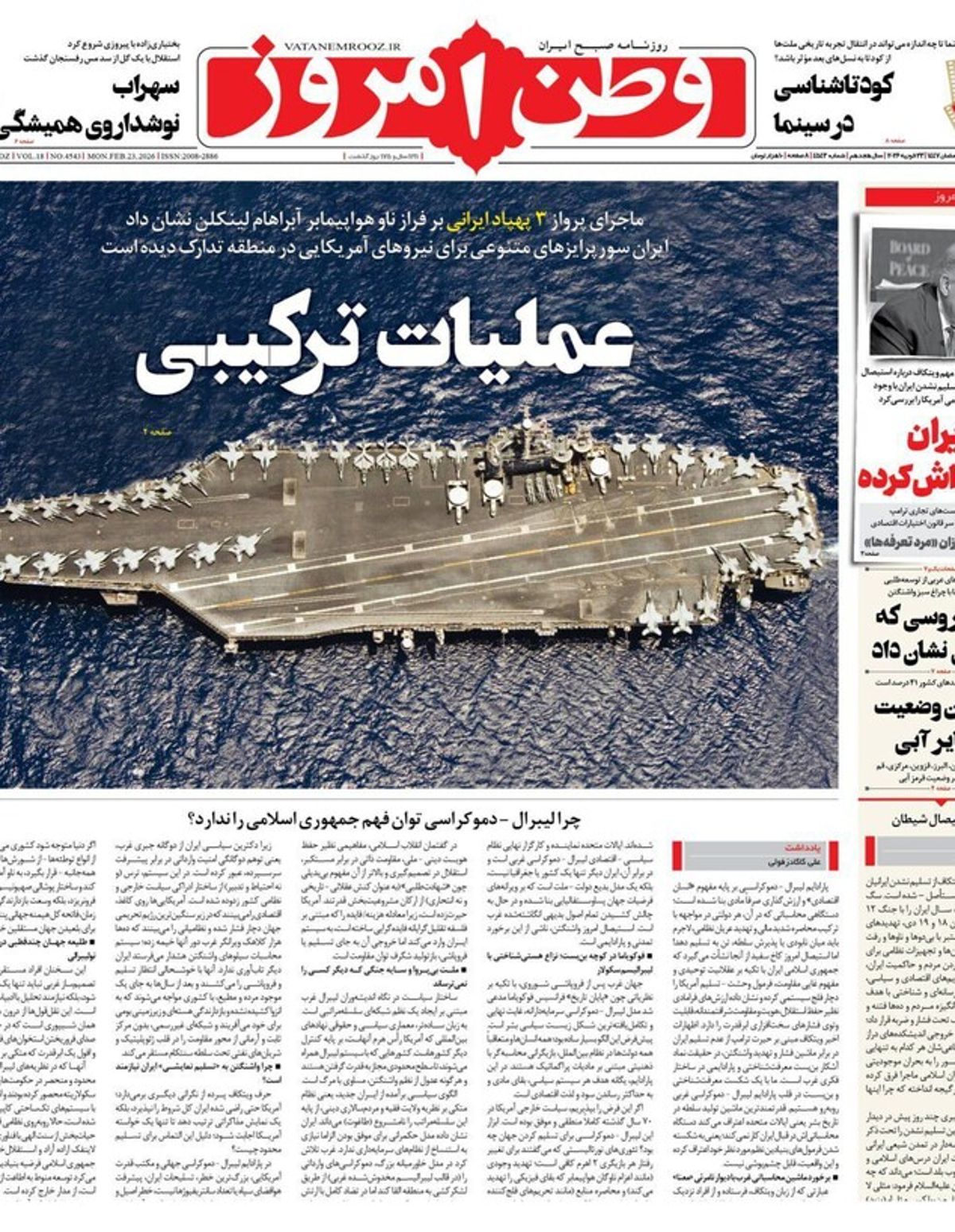
As the United States consolidates a massive naval and aerial presence in the Middle East, the Iranian regime is signaling a radical transformation in its defensive posture. State affiliated media outlets in Tehran, led by the ultra conservative Vatan Emrouz newspaper, are broadcasting a new "simultaneous response" doctrine designed to counter President Trump’s maximum pressure campaign. Following the lessons learned during the recent 12-day war, the Iranian military claims to have deployed advanced radar technologies and long range strike capabilities specifically intended to neutralize American aircraft carriers. Tehran is framing the current U.S. deployment not just as a military threat, but as a form of psychological and diplomatic coercion intended to force concessions at the negotiating table. However, the regime warns that if these "symbolic" threats turn into kinetic action, Iran has already finalized a vast bank of American targets across the region.
The Drone Threat to the USS Abraham Lincoln
The Iranian regime has placed a specific focus on the vulnerability of the USS Abraham Lincoln, claiming that three Iranian drones recently successfully overflew the carrier in a "combined operation" to demonstrate American blind spots. State media boasts that the Shahed-129 drone, capable of carrying eight missiles, is part of a swarm strategy that could overwhelm carrier defenses even from a distance of 4,000 kilometers. "Iran has prepared various surprises for the American forces in the region," the hardline press warned, suggesting that the geographical reach of their drone fleet effectively puts every U.S. naval asset in the Arabian Sea within striking distance.
Furthermore, the regime claims that its new radar systems, deployed following the failures of the 12-day war, now allow for real-time monitoring of U.S. strike preparations. This has led to the adoption of a "parallel response" tactic, meaning Iran will not wait to assess damage before striking back. Instead, the regime intends to launch its own missiles and drones the moment a U.S. attack is confirmed as underway, ensuring a cycle of immediate and total escalation.
Ground Assaults and Regional War
Tehran is also expanding its threats beyond the sea, highlighting its ability to launch "special forces" and ground assaults against U.S. land bases throughout the Middle East. Highlighting Iran's unique geographic position, state media outlets argue that most American military installations in neighboring countries are exposed to direct land based attacks. The regime has warned that any "limited" strike by the Trump administration will inevitably ignite a regional war, a prospect they believe is currently causing deep concern within the Pentagon.
While the Mehr news agency admits that the dual presence of the USS Gerald Ford and the USS Abraham Lincoln represents "maximum diplomatic pressure," they categorize the "beautiful armada" as a tool for political leverage rather than a guarantee of victory. As Trump continues to threaten "very bad things" if the Geneva talks fail, Tehran is attempting to project an image of a nation that has already accepted the reality of war and is prepared to take the entire region down with it. With the 48-hour deadline for a proposal looming, the message from the Iranian street is clear: they will not be pressured into a "fast deal" while staring down the barrels of American guns.