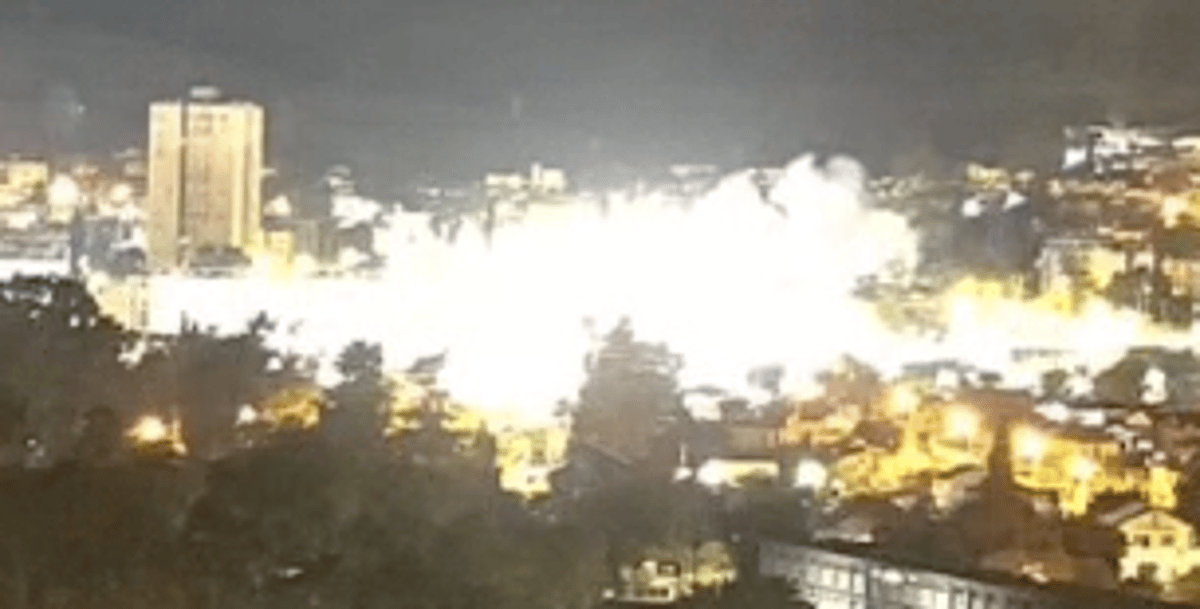
Hezbollah launched repeated rocket barrages targeting northern Israel from Friday night through Saturday, striking communities across the Galilee and forcing residents into shelters throughout the Jewish day of rest. While Iron Dome intercepted the majority of projectiles, one rocket scored a direct hit on a commercial center in Kiryat Shmona, the largest Israeli city on the northern border, causing significant structural damage. The shopping area was closed for Shabbat, and no injuries or casualties were reported.
A Day of Sirens Across the North
The attacks began overnight with an initial salvo of approximately 15 rockets aimed at the Kiryat Shmona area. Throughout Saturday, additional barrages targeted the Safed region, Karmiel, and communities across the Western Galilee. Near Nahariya, rockets fell into the sea as beachgoers scrambled for cover. Some 140 air raid sirens sounded repeatedly across dozens of northern communities, sending families into protected rooms and public shelters for much of the day.
In addition, an explosive drone struck a military site near Shomera, no casualties were reported.
Hezbollah publicly claimed responsibility for the attacks, stating they were carried out "in defense of Lebanon" and in retaliation for what the group described as Israeli ceasefire violations and ongoing IDF operations in southern Lebanon.
A Critical Intelligence Reassessment: Hezbollah Is Not in Dahiyeh
Alongside the day's military developments, Israeli defense officials revealed a significant reassessment of Hezbollah's organizational posture — one with major implications for future targeting decisions.
Israeli intelligence now assesses that the core of Hezbollah's organization and its central command structures have not returned to Dahiyeh, the organization's traditional stronghold in southern Beirut. At the start of the conflict, Hezbollah's leadership dispersed and embedded itself in other parts of Beirut — including Christian (Maronite) neighborhoods and areas outside the city — and did not return when the ceasefire came into effect.
As a result, senior IDF officials are now pushing back against the widely held assumption that strikes on Dahiyeh would operationally cripple Hezbollah's ability to function. If the command and control apparatus is no longer concentrated there, the strategic calculus for striking the district, and the diplomatic cost of doing so, changes significantly. The assessment suggests that Hezbollah has deliberately adapted its dispersal strategy to survive exactly this kind of pressure, making it a harder target than previously assumed.
Netanyahu Convenes Emergency Security Assessment
Prime Minister Benjamin Netanyahu was set to convene an emergency situation assessment Saturday afternoon with Defense Minister Katz and senior security officials. The session was expected to focus on the escalation in the north and the question of whether to tighten home front directives for the civilian population in affected areas.
Notably, the IDF had already identified the possibility of rocket fire in the northern sector during its own morning assessment, but the public warning was only issued at 4:00 PM, a short time before the actual escalation began. The timing gap has drawn criticism.
The Cabinet Has Not Convened. The Strike Wave Has Not Come.
As of Saturday evening, Israel had not yet launched a broader retaliatory wave of strikes into Lebanon, and the security cabinet had not been called into session. The IDF struck individual launch sites in response to specific attacks, but no large-scale campaign was authorized.
That restraint has sparked sharp public criticism, most pointedly from Knesset Member Almog Cohen (Otzma Yehudit), who wrote:
"A direct hit on Kiryat Shmona, sirens in Safed, rockets landing on the beach in Nahariya on Shabbat - routine. The IDF hasn't launched a strike wave on Lebanon. The cabinet isn't convening. What's the rush? One rocket on a beach in the center of the country and Prime Minister Netanyahu would be in the bunker, and Beirut would be burning. That's what it looks like when there's one law for the confrontation line and another law for the center of the country. Sentences I never thought I'd write after October 7."
The remarks reflect a frustration felt by many in the north: that the communities closest to the border — which have endured hundreds of rocket and drone attacks since fighting resumed in March 2026 — are held to a different standard of response and urgency than those in Israel's more populated center.
Broader Context: A War Without a Ceasefire
Saturday's barrages are the latest chapter in a low-to-medium intensity conflict that reignited in March 2026, following the collapse of a fragile ceasefire that had been in place since late 2024. Since then, Hezbollah has carried out hundreds of drone and rocket attacks, while the IDF has responded with targeted airstrikes and limited ground incursions aimed at pushing Hezbollah forces back from the border.
The human cost has been severe. On the Israeli side, dozens of soldiers and a handful of civilians have been killed since March, the majority by drone strikes. Over one million Lebanese have been displaced from border communities.
Saturday's attacks, coming alongside the new Dahiyeh assessment, point to a more complex and durable threat than Israel had previously publicly acknowledged and raise urgent questions about the next phase of Israeli strategy in Lebanon.